
This doctoral project is being undertaken by second year PhD student Katie Manby, and focuses on the British Museum’s collection of copper-alloy statuettes (‘bronzes’) within the Greece and Rome Department, specifically Graeco-Roman deities from first century AD Roman domestic contexts.
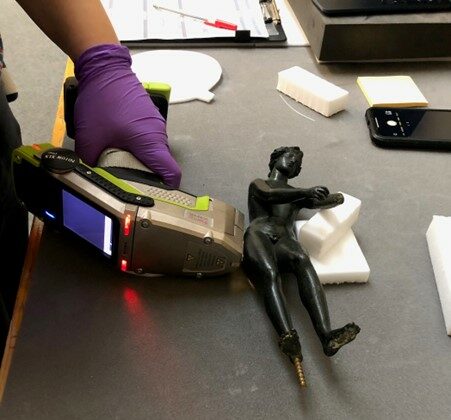
The majority of these items have no confirmed archaeological provenance, but were collected by a series of major collectors (such as envoy, Sir William Hamilton) in the 18th and 19th centuries known to have operated around Naples. Many of the statuettes therefore likely link to the 79AD Vesuvius eruption.
Katie’s research seeks to build individual object biographies for these statuettes, while situating them within a broader empire-wide context of Roman religion and technology. She is developing an integrated methodology, combining more traditional stylistic cataloguing with new chemical and metallurgical analysis (XRF, MP-AES, LA-ICP-MS) alongside collections and archive research. To date, Katie has conducted surface analysis (pXRF) on 400 statuettes within the collection in order to understand their composition, surface decoration and how they might have looked in the Roman period.
© 2024 The Trustees of the British Museum
The next step is taking samples for core composition analysis (MP-AES) to better understand their manufacture and patterns for how different copper-alloys were being used. An additional aspect of the research includes sampling possible volcanic glass (or tephra) corroded onto the surface of the statuettes (using LA-ICP-MS), in order to definitively link them to the 79AD Vesuvius eruption.
This project is an AHRC funded Collaborative Doctoral Partnership Project with the British Museum (Department of Greece & Rome/Scientific research).