
ClimateAdapt-TR project
The ClimateAdapt-TR project aims to provide insights for climate adaptation roadmap for the Turkish construction industry. A participatory workshop was held to raise awareness, facilitate dialogue among key industry stakeholders, and co-produce a preliminary roadmap. The “Climate Adaptation Workshop” that was conducted on 19th November 2024 in Ankara brought together 27 participants representing stakeholders from private companies, governmental and non-governmental institutions. The workshop was moderated by Professor Green and Professor Dikmen from the University of Reading, and Dr. Atasoy and Dr. Akcay from the Middle East Technical University.
Key findings from the workshop point out 10 adaptation strategies as a part of national climate adaptation pathways.
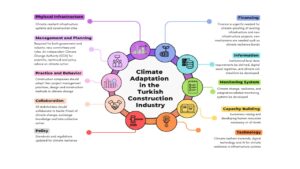 Key short-term actions for stakeholders include ;
- Integrating climate adaptation into design standards, technical regulations, and project management processes.
- Developing climate-resilient infrastructure, particularly for water and transport networks, through enhanced asset management, digitalization, and technology deployment.
- Establishing a centralized Climate Change Authority to coordinate policy, facilitate data sharing, and ensure the alignment of sectoral adaptation actions.
- Creating innovative financial mechanisms, such as climate resilience bonds, to fund adaptation investments and de-risk private sector participation.
- Enhancing awareness and capacity across all levels of the sector, from project teams to senior leadership, through targeted training, improved risk assessment tools, and clear climate adaptation guidelines.
- Collaborations to develop construction methods, technology, contractual arrangements and project delivery models for climate resilient built environment systems
The workshop outputs emphasize the need for a holistic and cross-sectoral approach that aligns climate adaptation actions with broader national strategies while addressing the specific vulnerabilities and capabilities of the construction industry. The vulnerabilities within the built environment are found to stem from lack of governance systems, including knowledge, data and regulations for climate risk-informed decision-making. By embedding climate resilience into sectoral planning to minimize vulnerabilities, exposure and impact, Turkish construction industry can play a proactive role in safeguarding the built environment, reducing future costs and losses due to climate change, and enabling sustainable and climate resilient development.
The ClimateAdapt-TR project is funded by the International Science Partnership Fund (ISPF) ODA Institutional Support Grant 2024-25 from the University of Reading in UK and in-kind support from the Middle East Technical University (METU) and METU Technopark. [/vc_column_text][/vc_column][/vc_row]