The Community-Led Research Pilot (CLRP) was a programme of six projects which were co-created between community groups across Reading and Slough, the University of Reading (UoR), the British Science Association (BSA), and funded UK Research and Innovation (UKRI). The CLRP was designed to position diverse communities at the heart of the research process, shaping and developing their own research questions, hoping to address community need, priorities, and development goals.
Here, we share a case study for the CLRP project co-designed and delivered by the Integrated Research and Development Centre (IRDC).
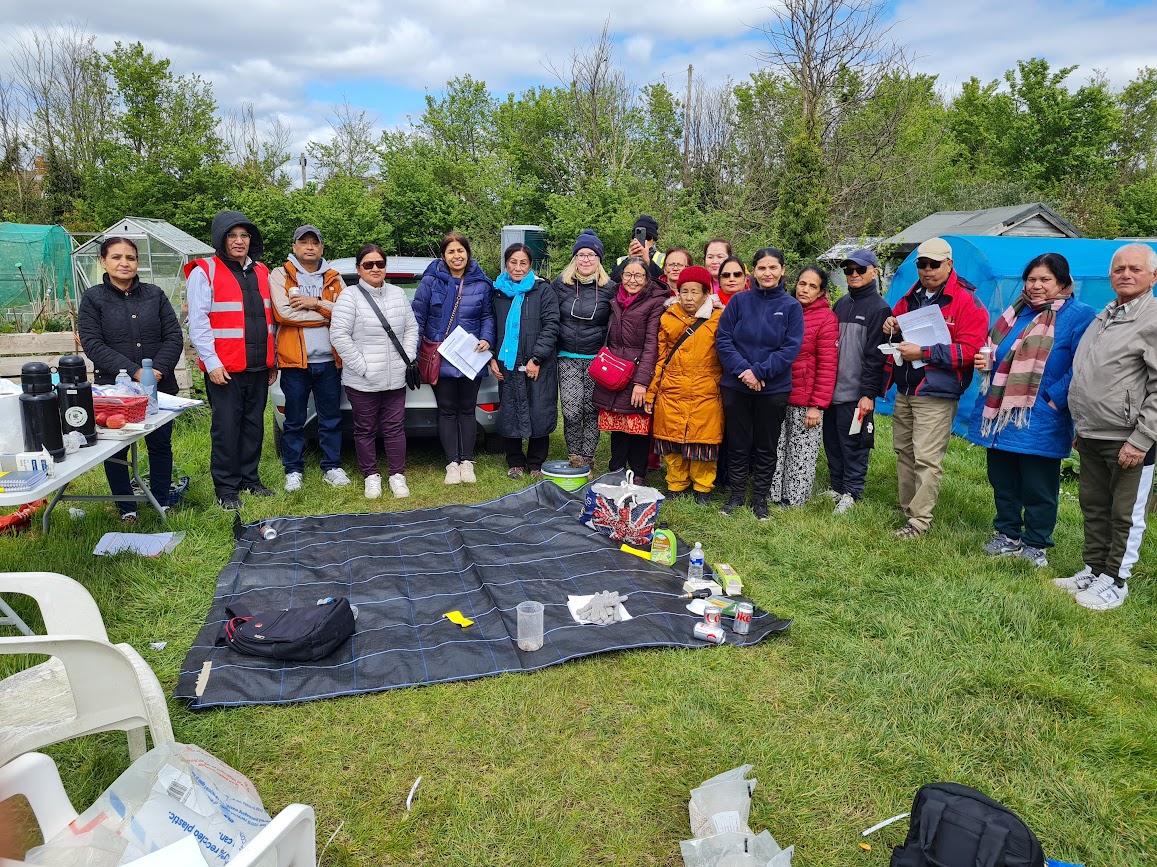
The Integrated Research Development Centre (IRDC) is a Community Interest Company (CIC) based in Reading, which was established in 2013. The IRDC exists to address health and environmental challenges across underrepresented communities in Reading, with a particular focus on the Nepalese community.
“I think the [community] groups have done a wonderful job. They are in power; they have come up with their own issues and they can freely share their experiences, even in a formal setting. They have built up confidence.” Krishna Neupane, Community Researcher
Aims
Core research theme: Responding to healthy living challenges through improved gardening and waste management among underrepresented communities (particularly Nepalese communities) in Reading.
In line with its focus as an organisation on the environment, health, and wellbeing, the IRDC co-designed a community horticultural project to investigate multiple areas of interest to:
- Promote horticulture projects and practices for community integration, healthier living, and adapting to the environment
- Educate participating communities about the importance of food growing and gardening to fulfil nutritional requirements for healthy living
- Develop and promote sustainable recycling (garden and food waste) to improve the surrounding environment, people’s health, and develop home-composting practices
- Analyse homemade compost in comparison to supermarket products to assess the quality and nutritional value of growing crops
The group was supported throughout the project by Dr Sally Lloyd-Evans and Dr Alice Mpofu-Coles from the University of Reading’s Participatory Action Research (PAR) team. The aims were established in the activity testing phase, which was further supported by UoR PhD researchers Robyn Woronka and Jen Stokes, and included a series of group meetings, group visits to organic vegetable gardens and allotments, and visits to commercial organic farms. Additionally, the group gathered responses to questionnaires which were developed to gather tangible and intangible evidence related to gardening to generate interest from community members in the project.
Methods, Principles & Practices
Building on their core research aims establishing in the activity testing phase, the group developed their project with UoR researchers who offered technical and material support in the research process and opened access to University equipment and facilities. They were Community Researcher, Krishna Neupane (a member of the IRDC who also works as a Community Research in UoR’s PAR team), Dr Deepti Angra, Post-Doctoral Research Associate specialising in Crop Sciences, Professor Hong Yang from the Department of Geography & Environmental Sciences, with additional support provided by James Hadley, Senior Technician in the School of Agriculture, Policy and Design.
With these supporting structures and the core research themes and aims in place, the IRDC began engagement activities. From the growing and gardening perspective, the group was able to learn and develop knowledge around effective and sustainable horticultural practices which were implemented at various allotment locations around Reading. They included:
- Understanding of soil dynamics and composition through analysis using soil testing tools from UoR
- Introduction and management of non-native plant or crop species to aid biodiversity in a changing UK climate
- The process and benefits of home composting and waste management
The group delivered an experimentation and testing phase, which compared the nutrient composition of homemade composts – one made from materials such as wood chip and garden waste, and another from kitchen waste – with those that are available to buy. The results of this are summarised in the following ‘Outcomes’ section.
Outcomes
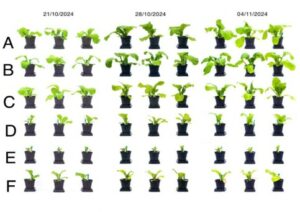
The analysis compared the quality of the home-produced compost and provided a very clear set of results within a short timeframe that showed the quality of the IRDC’s compost was at least comparable, if not better, than those available to buy in supermarkets and garden centres. The image below illustrates the rate of growth of broad leaf mustard plants using the homemade compost (A & B) versus four supermarket-bought peat-free equivalents. Compost-A was prepared in allotments and was composed of garden waste (plant/vegetable residues), wooden chips, used tea and coffee grounds. Compost-B was prepared from kitchen waste (especially used coffee grounds etc.), fruit and vegetable skins, green and brown leaves, cardboard, and paper. Images C to F were the shop-bought equivalents in this experiment.
Using soil testing kits supplied by the University, which group members were subsequently trained to use, the IRDC was also able to continuously improve the soil condition compounds across its allotment sites and community member’s gardens which in turn showed a positive impact on plant growth and produce.
In addition, the social and wellbeing outcomes observed within the community group as a result of the Pilot included more group members taking part in research over time, being able to express themselves more freely and confidently, increased physical exercise through the gardening activities, and some participants said it supported their mental health through interaction with others and growing nutritious food for the community. More households expressed an interest in connecting with the gardening group, requesting guidance around horticultural practices and support. Visits to the University facilities to observe experiments and testing led to excitement and enthusiasm around the research theme, illustrating the benefit of access to resources. The Nepalese community in Reading is well-established, but long underserved, with this partnership also reflecting ambitions of the University to develop better and more productive interactions with University staff and students to build trusted relationships, feeds into the University’s strategy and values.
IRDC Leader, Baburam Banstola, commented on several phases of the project, saying: “Visiting home gardens and directly addressing field problems, particularly concerning soil and varieties, was incredibly impactful. This hands-on approach allowed us to provide immediate, practical solutions. The positive results we observed from the homemade compost were significant and empowered community members with sustainable practices.”
This research has led to an ongoing partnership between IRDC and the University’s Agriculture department, which continues to support the group to develop its practices and draw benefit from the University’s resources and equipment to analyse produce from its allotments. Dr Angra has also been in consultation with the Department of Agriculture related principles and practices from community-led research being embedded within undergraduate and postgraduate programmes, illustrating the potential for institutional impact in terms of curriculum development.
Both Dr Angra and James Hadley have also reflected on their practices as researchers, and the impact of the CLRP, with Dr Angra saying: “In the future, I would like to try and conduct research which brings more of a social impact and solutions into the real world. I have really liked that in this project sustainable goals can be achieved through experimentation, testing, and community engagement.”
James added: “Home growing is a very prevalent thing at this time. So if you can work with communities to illustrate the value of this it can be incredibly beneficial and worthwhile. It has been a really nice thing to work with the community and to see how they engaged with the project, and for me, to try and find the best way to communicate the collecting and documentation of data to people that maybe don’t come from a scientific background, has also been a good thing.”
Future Prospects
Alongside continuing to work with the University on new projects, the IRDC has developed a range of next steps, as well as recommendations for similar community-led research projects in the future. This would be done with the aim of continuing community gardening and growing and creating new networks within communities in Reading for health, wellbeing and biodiversity.
The group would like to continue its work to introduce non-native plant species in the Berkshire area to improve biodiversity and assess nutritional value and the wider health benefits to communities in the region. These species include Colocasia antiquorum (Elephant Ear), Cucumis Sativus (South-Asian cucumbers), Lagenaria Siceraria (Bottle Gourd), and Sechium edule (Chayote).
Following the Pilot, group members have requested to make visits to appropriate experiment sites to observe and learn how food and garden waste recycling can improve the local environment and have positive impacts on health. There is also an aspiration to receive further funding to support the involvement of retired age and disabled gardening group members to improve inclusion and accessibility.