
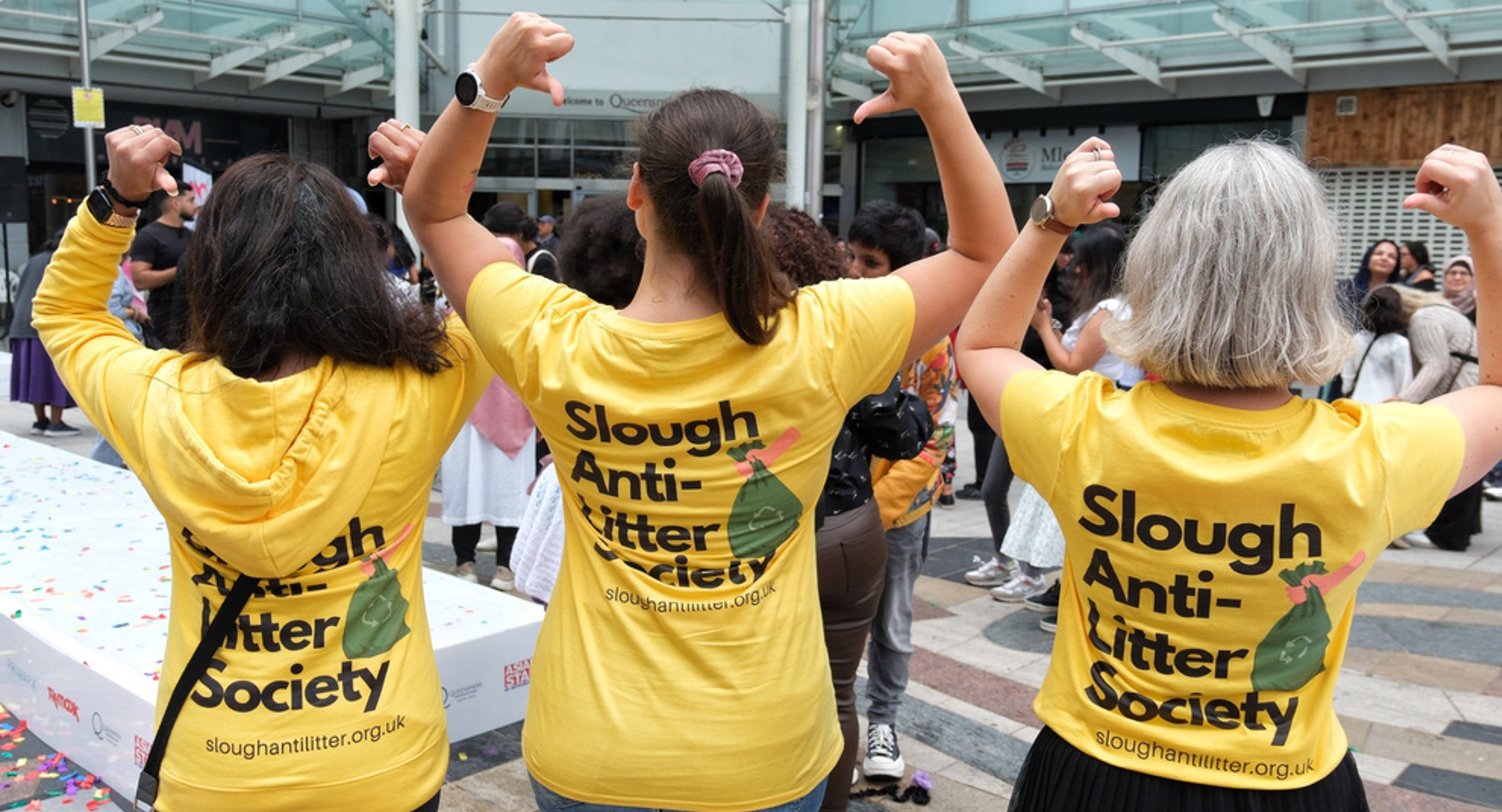
Slough Anti-Litter Society (SALS) was founded in 2021, during the COVID-19 pandemic, growing out of grassroots community action to combat widespread littering, so that people who live, work, or learn in Slough can collectively create a cleaner, greener town.
Prior to its involvement in the CLRP, SALS engaged the public in activities such as repair cafés, litter-picking, and upcycling activities. Although participation was strong, gathering an evidence base for behaviour change in the community proved a challenge, which led to the development of the SALS project within the CLRP.
“It has changed my opinion about community research. It is showing how important it is to have research that you can directly implement and use within your community group. Not research that is just done and lying on a shelf somewhere and nothing gets done afterwards. This is research that we literally put into practice straight away, which shows you how important that sort of research is.” Tirza Meinema, Co-Founder & Chair, Slough Anti-Litter Society
Aims
Core research theme: Investigate behaviour change to understand why people litter, what influences these behaviours, and how these behaviours can be changed
The research project aims for SALS were aligned with its desire to have a positive impact on the social responsibility of Slough’s residents, engender behaviour change resulting in collective action, and develop an evidence base that could be used to put pressure on the local council to improve its waste management. The aims included:
- Enable the Slough community to record their own waste/littering, learn about ways to reduce littering, record litter they observe in the town, and participate in community projects related to the local environment and sustainability
- Establish effective ways to combat littering in the community and empower residents to take ownership of creating a cleaner town
- Use community-gathered data to develop an Anti-Litter App tracking behaviour change and social action
- Influence local policymakers and businesses by using community-generated evidence
Methods, Principles & Practices
Having established the research theme, core question, and aims, SALS was paired with UoR’s Dr Rosa Walling-Wefelmeyer, who is a lecturer in criminology specialising in creative and participatory research methodologies in the Law Department at University of Reading, and Professor Keiichi Nakata, specialising in cognitive systems engineering and participatory systems at Henley Business School.
In the early stages, Dr Walling-Wefelmeyer assisted the group in conducting a SWOT analysis (Strengths, Weaknesses, Opportunities, Threats) to provide SALS with a grounding for their activities, capacity, and broadly taking stock of their participation approaches to date, such as what is currently done well and what could be developed. This linked to ongoing activities including litter-picking, repair cafés, and upcycling events, as well as surveying of participants throughout, to tailor their research approach and establish community interest and engagement on key issues.
UoR researchers developed a workshop to introduce a 3D-RAB models to SALS which represents the three-dimensional relationships between attitude towards behaviour, attitude towards change, or maintaining a change, and current behaviours. This then fed into an ideation session in which volunteers could share their vision, ideas and opportunities for activities which SALS could focus on to help deliver on its aims and impact behaviour change within the community.
Outcomes
Following on from these activities, SALS developed a clear focus on creating a community education programme, to be taken into schools initially, with a view to expanding this to various different communities and stakeholders in the town including places of worship for different faiths, businesses, and policymakers.
The programme they developed is designed to be accessible and adaptable to all ages and focuses on four distinct areas relating to environmental concerns, which are: litter decomposition, e-waste, fashion waste, and food waste.
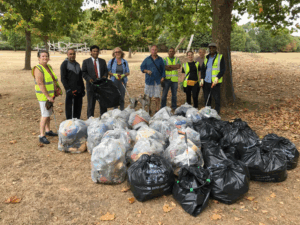
SALS was also able to create a range of short, medium and long-term goals as a result of the engagement and the data and feedback gathered throughout, which are:
- Short term:
- Increased community stakeholder participation in SALS activities
- Enhanced knowledge and skills
- Positive experiences and satisfaction from participating in events
- Medium term:
- Stronger sense of community belonging
- Improved attitudes towards sustainability and anti-littering behaviours
- More frequent engagement in environmentally friendly practices
- Long term:
- Sustained behaviour change towards littering and increased civic responsibility
- Cleaner and more pleasant town environment
Through evaluation and data collection on these goals, the group was able to draw-up a clear set of outcome indicators, information collection methods, and means of reporting and usage for each different goal. This approach also helped SALS look at sustainability and associated activities in a more holistic way – by developing a range of different events and activities whilst also addressing social responsibility and behaviour change.
Dr Walling-Wefelmeyer also commented on the learnings and approaches from the project: “There’s definitely a lot to learn from this particular project, and I think first and foremost it’s renewed my sense of how important relationships are, and that relationships are at the core of this kind of research. Those relationships need to dictate the time, the scale, the language, the frameworks, so starting inside out rather than outside in. I have found this project incredibly rewarding, and it has shown the necessity for slowness, and for gentle, supportive frameworks, people you can talk to, and sense-check your experiences against.”
Future Prospects
As indicated in the ‘Outcomes’ section, SALS is progressing to an outreach phase with its community education programme and is planning and delivering activities related to the goals set as a result of its involvement in the CLRP.
The group is keen to develop more formalised ways of gathering data to measure impact and acquire further funding to enable its work at a greater scale, whilst also contributing to an annual impact report. This report aims to canvas public opinion and experiences in the town on littering and environmental issues, with supporting data providing a year-on-year comparison and the opportunity to devise and deliver further solutions.