
Project Title:
Investigating the effects of GOS on inflammation by targeting gut microbiota and barrier function
Project Partners:
- Professor Nathaie Juge, Quadrum Institute Bioscience (PI)
- Clasado Ltd (Industrial Collaborator)
Research issue, problem, risk or opportunity being addressed:
Bimuno® GOS (B-GOS) produced by Clasado Biosciences, is a patent-protected prebiotic ingredient featuring a unique blend of non-digestible galactooligosaccharides (GOS) commercialised as a high fibre food supplement. It reaches the colon intact and selectively feeds beneficial bacteria like bifidobacteria and lactobacilli. B-GOS delivers selectivity, excellent tolerability, and clinically proven efficacy at low doses, making it a candidate for applications in a range of conditions, although with variable response among participants.
The aim of this work was to identify GOS structures that restore gut health by:
- Screening isolated GOS structures in high throughput fermentation models
- Determining their effects on intestinal barrier function and inflammation
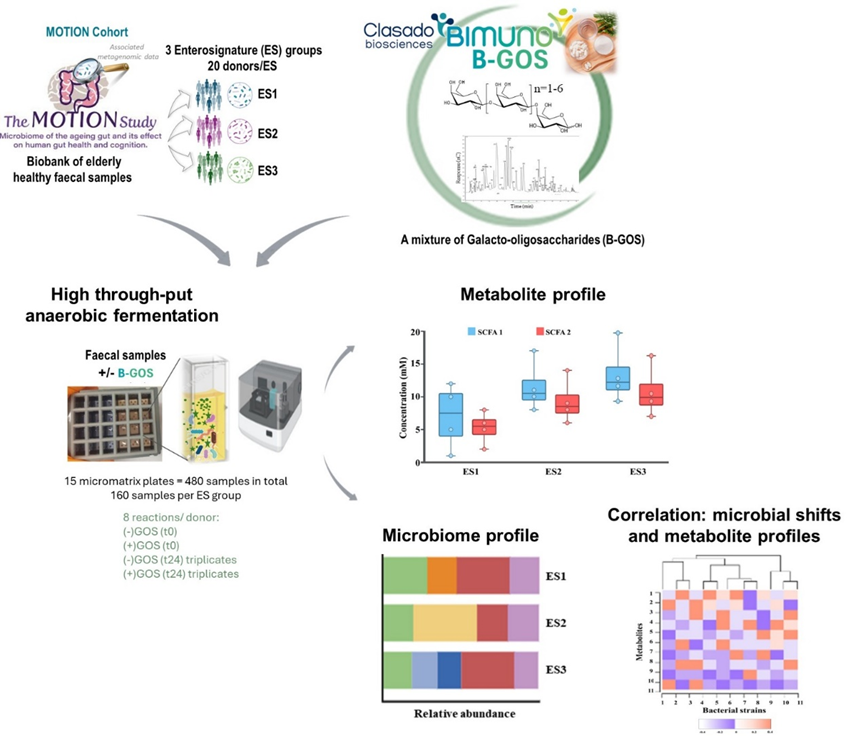
Figure 1: Study design. Faecal samples from the QIB MOTION cohort were grouped into microbiome enterosignatures and used into micro-Matrix fermentation models to assess the response of Bimuno® GOS (B-GOS™) manufactured by Clasado Bioscience on microbiome composition and metabolic profile.
Project Objectives:
We first showed that B-GOS supplementation produced clear and statistically robust prebiotic effects, enhancing beneficial bacteria relative abundance while maintaining global diversity and overall community structure. B-GOS supplementation consistently increased Bifidobacterium, Streptococcus and Turicibacter, and decreased Escherichia–Shigella and Paeniclostridium, with effect estimates and FDR-corrected q-values supporting statistically robust, albeit quantitatively modest changes within the conditions tested (24 h fermentation). On the functional side, we showed that the short-chain fatty acid (SCFA) profile paralleled changes in microbiome, including increased propionate and butyrate and modest valerate increases. Due to limitations with the amount of individual GOS required for fermentation assays, only B-GOS could be tested in these experiments, and the second objective was therefore revised to test the role of donor microbiota on GOS response and the hypothesis that enterosignatures (ES) could be used as a tool to stratify and identify best responders.
This revised objective provided a key conceptual advance. This work benefited from access to samples and sequencing data from the MOTION cohort (healthy participants > 60 years old) from the Quadram Institute Bioscience (QIB). The study’s clinical trial is registered at https://clinicaltrials.gov/ (registration number is NCT04199195). Three groups (n=20 per group) were selected based on their Enterosignatures (ES) determined by the Hildebrand Group (QIB). Individual faecal samples were incubated with and without B-GOS supplementation using the MicroMatrix model, a small-scale bioreactor that offers high-throughput capacity and reproducibility with pH, temperature and dissolved oxygen control. Fermentations were performed in triplicates, and microbiota composition and metabolic function analysed at T0 and T24. Microbiota-metabolite correlations linked B-GOS-induced microbial shifts with metabolite production.
The specific taxa responding to B-GOS were strongly enterosignature-dependent. For example, ES_Firmicutes showed a clear SCFA-associated profile with increases in Bifidobacterium, Streptococcus and Turicibacter, whereas ES_ Bacteroides showed little metabolic change, in agreement with the metagenomic data showing no significant taxa modification upon B-GOS treatment. The third group, ES_Prevotella exhibited a reduction in Escherichia–Shigella, Paeniclostridium in addition to butyrate-producing bacteria from Lacticaseibacillus & Ruminococcus gauvreauii groups. These compositional shifts coincided with changes in metabolite production, including a decrease of propionate and butyrate and a modest valerate increases.
Together, these findings showed that while B-GOS exerts reproducible, taxa- and function-specific effects whose pattern is shaped by the initial enterosignature of the microbiome. This provides evidence for the development of a more stratified, enterosignature-informed prebiotic intervention.
Project Achievements/Outputs:
The project strengthened the collaboration between the industry and academic applicant and expanded the collaboration with the Quadram Institute Bioscience (QIB) to include members of the Hildebrand group (Microbiome and Bioinformatics- for enterosignatures of MOTION samples) and QIB Human Study Team (access to microbiome samples and metadata from the MOTION study) at the Quadram Institute Bioscience (QIB) to optimise the delivery and impact of the project.
The outcomes of the project and methodology informed the scientific direction of a BBSRC CASE PhD studentship between the academic and industrial partner.
A joint manuscript on enterosignature-stratified responses to GOS supplementation is in preparation.
An on-site visit of Clasado to the Quadram Institute (QI) took place, including a tour of QI endoscopy unit, Clinical Research Facility (CRF), and Research Labs and 1:1 meetings with QIB Group Leaders and managers of core facility (sequencing, colon fermentation models, bioinformatics, analytical facility, biostatistician) and QIBExra, to widen and explore potential collaborations.
Challenges Faced:
Optimisation of fermentation model to reduce variability and avoid artefactual community shifts and loss of oxygen-sensitive taxa. This was carried out through:
- Stepwise validation with test fermentations to confirm that the system maintained physiologically relevant anaerobiosis and pH profiles before running the full experimental series.
Pilot runs to compare growth medium formulations (by adjusting carbohydrate and nitrogen sources, buffering capacity and selective components) and identify conditions that preserved overall diversity of the starting material
Statistical and modelling challenges.
- Alpha-diversity and genus-level models frequently violated classical assumptions (heteroscedasticity, non-normal residuals, influential observations), and enterosignature stratification reduced effective sample size per group.
- These issues were handled using robust linear mixed models, explicit variance checks (e.g. Levene’s tests), down-weighting of influential points, and FDR correction in MaAsLin2, ensuring that reported GOS effects are conservative and statistically defensible.
Advancing Science:
Prebiotics such as GOS have been shown to confer health benefits to the host but recent evidence showed disparity in responses, which may be linked to the original individual gut microbiota. Enterosignatures (ES) define common bacterial guilds in the human gut microbiome and provide an interpretable and generic model that enables an intuitive characterisation of gut microbiome composition in health and disease. Here, we tested the hypothesis that ES would help predict which individuals are responsive or not to the prebiotic supplementation.
This project advanced our understanding of prebiotic mechanism of action by linking inter-individual baseline microbiome community structure to compositional and functional responses to B-GOS supplementation.
Combining enterosignature profiling (ES_Firmicutes, ES_Prevotella and ES_ Bacteroides) with in vitro fermentation of B-GOS, metagenomic and metabolomic analyses moves the field beyond “one-size-fits-all” prebiotic effects toward a mechanistic-based, precision nutrition and microbiome approach.
Project Potential:
The collaboration with Clasado will continue through a 4-year BBSRC- sponsored NRP Bioscience DTP CASE studentship.
It is expected that the data generated by this project, following publication, and the associated experimental approach (based on ES-stratification) will be used in support of future grant applications in Precision Nutrition and Microbiome.
Clasado Ltd Comment:
This project expanded our collaboration with the Quadram Institute Bioscience, providing access to a curated repository of fully sequenced human microbiomes, high throughput microbiome in vitro assays, advanced bioinformatics expertise, multi-omics and statistical analyses, which allowed us to test the influence of donor microbiota in response to B-GOS supplementation. The findings from this research provided a strong foundation for microbiota-based stratification of the population, potentially leading to more cost- effective and tailored clinical trials.
MAY 2025