
Project Title:
Exploring the effects of prebiotics for mental strain and physiological markers of stress in healthy, mildly stressed adults
Project Partners:
- Dr Daniel Lamport, University of Reading (PI)
- Professor Claire Williams, University of Reading
- Clasado Ltd (Industry Partner)
Research issue, problem, risk or opportunity being addressed:
This 9-month project addressed several specific challenges, including: (i) identifying specific mental health outcomes that could be influenced through prebiotic supplementation via the gut–brain axis; (ii) determining the experimental conditions under which these outcomes could be affected by prebiotics; (iii) evaluating the magnitude and clinical relevance of changes in these outcome measures; and (iv) generating pilot data to inform a larger future clinical trial.
These challenges were addressed through the completion of the proposed feasibility study. Specifically, the study employed a parallel-group, randomised, controlled design over a 6-week treatment period, during which participants received either a prebiotic intervention or a matched control product. The primary outcome measure was psychological stress, while secondary outcome measures included depression, anxiety, sleep, mood, cognitive function, and cortisol awakening response.
The participants were 50 healthy adults, aged 25–40 years, with mild levels of psychological stress. A postdoctoral research assistant was recruited to undertake the research at UoR and was supervised by the UoR PI and Co-I, alongside the industry partner Co-I. The prebiotic product was provided by the industry partner.
This pilot study allowed the collection of data relating to the efficacy of a daily prebiotic supplement for various health outcomes known to be associated with the gut–brain axis. Specifically, it provided information regarding the sensitivity of a mildly stressed population, indications of effect sizes, appropriate dosage and treatment duration, tolerability of both the intervention and control products, and the likely attrition rate for a larger trial.
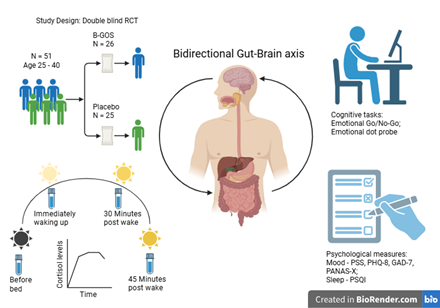
Figure 1: Schematic representation of the key components of the feasibility trial, including prebiotic supplementation, assessment of perceived psychological stress, mood and sleep, cognitive testing and measurement of salivary cortisol as an index of hypothalamic‑pituitary‑adrenal (HPA) axis activity. The study integrated behavioural and physiological measures to investigate the effects of prebiotics on stress‑related outcomes in mildly stressed adults.
Project Objectives:
The primary objective of this feasibility project was to establish whether a 6‑week prebiotic (B‑GOS) intervention could influence psychological stress and related behavioural and physiological markers in mildly stressed, healthy adults, and to generate high‑quality pilot data to inform a definitive trial. These objectives were largely met.
A double‑blind, randomised, placebo‑controlled trial was successfully delivered, recruiting 55 participants (51 completers), exceeding the minimum target and demonstrating strong feasibility in this population. Compliance was excellent (>97% across both groups), attrition was low, and no adverse events were reported, supporting acceptability and tolerability of the intervention and study procedures. Robust protocols were implemented for assessing psychological stress (primary outcome), mood, sleep, affective cognition, and cortisol awakening response.
The primary outcome (perceived stress) improved significantly over time (ηp² = 0.44) in both the treatment group and the control group, with comparable improvements also observed in depression, anxiety, and sleep quality, indicating sensitivity of the chosen outcomes and population to change. While no additional benefit of B‑GOS over placebo was detected on self‑report outcomes, the study identified small but potentially meaningful treatment‑specific effects on affective cognitive control (e.g. reduced commission errors in emotional go/no‑go tasks) and trends toward potentially healthier diurnal cortisol profiles following B‑GOS supplementation.
Importantly, the project delivered key feasibility metrics (recruitment rates, compliance, attrition, outcome variability, and effect size estimates) with a manuscript close to submission for peer-review. Collectively, these outcomes provide strong empirical and methodological foundations for refinement and powering of further clinical trials.
Project Achievements/Outputs:
This project delivered several important scientific, collaborative and translational outputs that together represent a substantial return on the Feasibility Award investment.
Delivery of a high-quality randomised controlled trial
The principal achievement was the successful completion of a double-blind, randomised, placebo-controlled feasibility trial examining the effects of a prebiotic (B‑GOS) on psychological stress, affective cognition and physiological stress markers in mildly stressed adults. The study recruited 55 participants (51 completers), exceeding feasibility targets, with excellent compliance (>97%), low attrition and no adverse events. This demonstrates the practicality, acceptability and robustness of the study design, population selection and outcome measures, providing a strong platform for a future definitive trial.
Generation of a near‑submission‑ready research manuscript
The project has resulted in a full manuscript (“Exploring the effects of 6‑weeks B‑GOS supplementation for psychological and physiological markers of stress in healthy, stressed adults”), currently in final preparation for journal submission. This represents a substantive academic output and provides transparent reporting of null, positive and nuanced findings, which is particularly valuable in an area where publication bias is a known concern.
New scientific insights and refined hypotheses
While no additional benefit of B‑GOS over placebo was observed for self‑reported stress or mood, the study identified subtle treatment‑specific effects on affective cognitive control (e.g. reduced commission errors in emotionally valenced go/no‑go tasks) and trends towards healthier diurnal cortisol regulation. These findings refine understanding of how prebiotics may influence stress-related processes and helped clarify which outcome domains and populations are most promising for future intervention studies.
Key feasibility metrics to inform future funding
The project generated critical metrics required for powering and optimising a larger trial, including recruitment rates, attrition, adherence, tolerability, outcome variability, effect size estimates and practical insight into cortisol collection protocols. These data directly address funder expectations for feasibility studies and substantially strengthen the case for further external funding.
Strengthened academic–industry collaboration
The award supported a productive collaboration between the University of Reading and Clasado Biosciences, including co-design of the intervention study, access to a commercially available prebiotic product, and shared interpretation of findings that have commercial relevance. Since the initiation of this project, the partnership of Clasado and the University of Reading has continued, with the parties committing to deliver further translational and applied research through a match-funded PhD studentship.
Research capacity building and skills development
The project supported the employment and training of an early‑career postdoctoral researcher, contributing to skills development in clinical trial delivery, psychophysiological measurement, advanced statistical modelling and the opportunity to experience research collaboration with an industrial partner.
Foundations for impact and next-stage activity
Outputs from this study are already being used to refine trial design, outcome selection and population targeting for future larger‑scale studies, ensuring that the feasibility award has provided durable value beyond the life of the project.
Challenges Faced:
Recruitment of mildly stressed but otherwise healthy adults proved more challenging than anticipated, largely due to the narrow inclusion criteria, including the specified age range, stress thresholds, and health status requirements, as well as the time commitment associated with a 6-week intervention involving multiple laboratory visits and home saliva sampling. These challenges were addressed by broadening recruitment channels, including the use of social media and community advertising, extending the recruitment period, and maintaining close engagement with existing participant databases. Collectively, these strategies were successful, enabling the study to meet and slightly exceed its recruitment target while maintaining low attrition and excellent participant compliance.
A second challenge related to the interpretation of cortisol awakening response data. Cortisol measures demonstrated substantial natural inter-individual variability, and some data loss occurred because of missed or delayed samples despite detailed participant training. This highlighted the recognised complexity of cortisol as a biomarker for psychological stress and health outcomes, particularly in free-living adult populations. These challenges were mitigated through the application of stringent quality-control criteria, adherence to expert consensus guidelines for cortisol awakening response analysis, and cautious interpretation of cortisol findings alongside behavioural outcomes. Importantly, this experience provided valuable methodological insight that will inform the refinement of biomarker selection, sampling protocols, and statistical powering decisions in future trials.
Advancing Science:
This project has advanced the science of diet–gut–brain interactions by providing a rigorous and well‑characterised test of prebiotic supplementation on psychological, cognitive and physiological markers of stress in a mildly stressed adult population. While much of the existing literature reports mixed or selective findings, this study contributes high‑quality evidence that clarifies where prebiotics may, and may not, exert measurable benefits.
Importantly, the project demonstrates that improvements in perceived stress, mood and sleep can occur in stressed populations independently of prebiotic treatment, highlighting the need for careful trial design, appropriate control conditions and realistic expectations regarding effect sizes in behavioural nutrition research. This advances the field by helping distinguish true treatment effects from contextual and placebo‑related influences, an issue that remains under‑addressed in nutritional intervention studies targeting mental health.
The inclusion of affective cognitive tasks alongside traditional self‑report measures provides novel insight into potential mechanisms through which prebiotics may influence stress‑related processes, revealing subtle effects on emotional inhibitory control that would not be captured by questionnaires alone. In addition, the detailed cortisol data underscore the complexity and limitations of cortisol awakening response as a biomarker of psychological stress in free‑living adults, informing future methodological choices in psychobiological research.
Collectively, the findings refine theoretical models of how prebiotics may influence stress‑related outcomes, identify the boundaries of their effects, and provide a more mature evidence base to guide future hypothesis‑driven trials in nutritional neuroscience and mental health.
Project Potential:
This feasibility project has established a strong foundation for a broader programme of research examining the role of prebiotics in psychological health and wellbeing. The findings have already directly informed the development of a funded three-year PhD programme investigating the effects of prebiotic supplementation on psychological outcomes, with sleep identified as the primary outcome measure.
Insights gained from the feasibility trial, particularly in relation to outcome sensitivity, placebo effects, recruitment strategies, participant compliance, and biomarker variability, have provided critical methodological guidance for future studies. These lessons are enabling the refinement of study design within the PhD programme, including the implementation of longer intervention periods, more targeted population selection, and an increased focus on mechanistic pathways underlying the gut–brain axis.
Future work will extend beyond behavioural outcomes to investigate potential biological mechanisms through which prebiotics may influence mental health and sleep. Planned mechanistic assessments include measures of gut permeability, gut and systemic inflammation, and related physiological pathways implicated in psychological functioning and sleep regulation. This integrated approach has the potential to generate a more comprehensive understanding of how nutritional interventions can support mental health.
The project has also strengthened an ongoing collaboration with the industry partner, Clasado Biosciences, creating opportunities for continued translational research and access to well-characterised prebiotic formulations. This partnership is expected to support future innovation, enhance the real-world applicability of findings, and facilitate the development of evidence-based nutritional products targeting psychological wellbeing.
Importantly, the feasibility study has positioned the research team to pursue larger external funding opportunities and fully powered clinical trials. Anticipated outputs include multiple peer-reviewed publications, expanded interdisciplinary collaborations, and the development of a sustained research programme with potential impact across academia, healthcare, and industry. Overall, the award has enabled progression from an initial pilot randomised controlled trial to a strategically aligned, longer-term programme of mechanistic and applied research with significant potential to advance evidence-based nutritional approaches for mental health.
Clasado Ltd Comments:
Clasado is an SME founded on science, and as such, having an evidence-based product is extremely important to the business. This research collaboration with the University of Reading provided a cost-effective way to conduct scientifically credible and robust clinical research by working alongside leading academics in the gut-brain axis space, to further our understanding of the potential efficacy of our proprietary prebiotic ingredient, Bimuno GOS, in relation to mental health outcomes. Not only does the study fill a knowledge-gap, but it also extends our portfolio of clinical research, which is commercially advantageous. Furthermore, the findings provide a foundation and direction for future research.
MAY 2025