
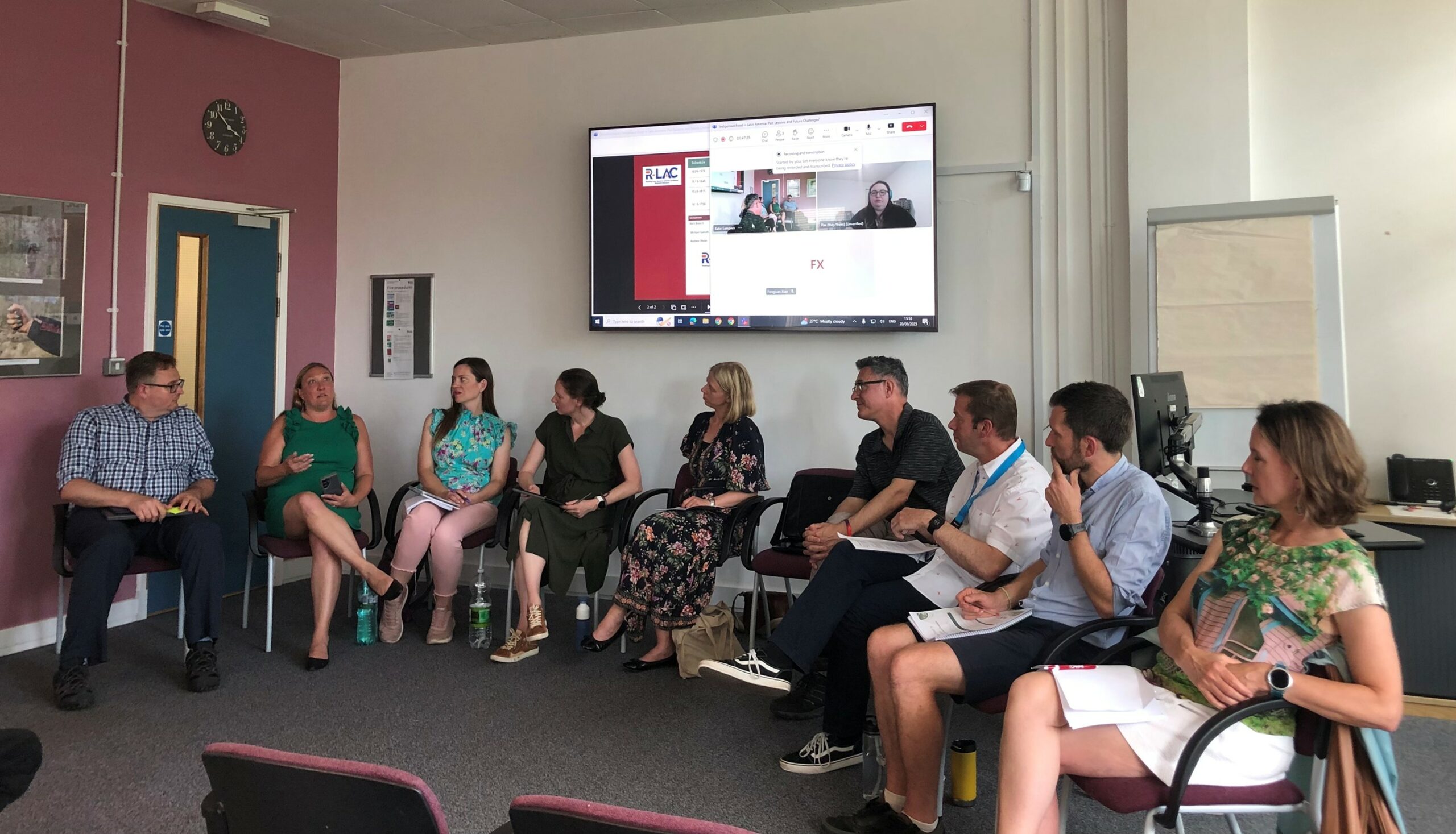

On 20 June 2025 R-LAC sponsored a roundtable discussion that brought together seven visiting scholars and four UoR scholars from diverse disciplines who all research food systems in Latin America. The seven visiting scholars pre-circulated their papers that dealt with historical evidence of Indigenous food procurement, distribution, and consumption. Katie Sampeck (UoR Department of Archaeology) organised the event as part of her British Academy Global Professorship activities.
The papers all focused on the Early Modern period and ranged from as far north as sixteenth-century La Florida (today’s US Southeast) to the Strait of Magellan. Sampeck contributed a paper about how cuisine delineated political boundaries, and hospitality was a means of diplomacy in the sixteenth-century US Southeast. Another UK scholar, Mario Graña Taborelli (UCL), also wrote about food as a medium of political agency, but among the Spanish and Chiriguanaes in Southeastern Charcas, Bolivia. A third UK scholar, Joshua Fitzgerald (Cambridge University), focused on Central Mexico and the fascinating example of the meaning and role of Nahua edible arts sculpted with amaranth. Estelle Praet (British Museum) brought a scientific focus of organic residue analysis to understanding food consumption in Mesoamerica.
The other visiting scholars came from US institutions and several papers focused on Spanish La Florida and the Caribbean. Elizabeth Gansen (Grand Valley State University) analysed the way Gonzalo Fernández de Oviedo wrote about Indigenous environmental knowledge and food practices. Pax Johnson (University of West Florida) presented archaeological evidence of diet in contexts related to the 1559-1561 settlement of Tristán de Luna in La Florida. Erin Stone (University of West Florida), focused on a case of Spanish cannibalism of a French captive in sixteenth century La Florida. Katy Kole de Peralta (Arizona State University) brought perspectives from the other end of Spanish America—a place called Port Famine, which lies along Magellan’s Strait.
These papers inspired a wide-ranging debate about the deep past of Indigenous practices and knowledge of food production, distribution, and consumption. The three discussants connected the examples to the food-related legacies of Spanish colonialism, especially how this multifaceted past continues to have global impacts. Nick Branch (Professor, Geography & Environmental Sciences), Michael Garratt (Professor, Sustainable Land Management), and Andrew Wade (Professor of Hydrology, Geography & Environmental Sciences) led the discussion that focused on two key ‘lessons’ from the past: (1) Indigenous empowerment in food systems and (2) Indigenous ecosystems of food production, harvesting, and land management.
Discussants asked the panelists to explain whether ‘empowerment’ was ‘in’ indigenous food systems or ‘from’ indigenous food systems and to compare food-related, social, and political power. Drawing on ongoing projects in Bolivia and Peru, discussants drew parallels with colonial examples and the mixed success of international sustainable agriculture, water management, and biodiversity initiatives. Nick Branch emphasised the highly successful transformation of the landscape by Indigenous people into sophisticated agricultural systems that sustained high population levels in what might be regarded today as an extreme, fragile environments. The rehabilitation of these pre-Hispanic infrastructures coupled with indigenous knowledge of varietal crop selection could help create more resilient systems that maintain agrobiodiversity and enhance quality of life. Michael Garrett and Andrew Wade stressed that Indigenous crops are likely highly climate resilient. Andrew Wade encouraged the panelists to foreground even more writings or stories by Indigenous people, an effort that is important in more deeply understanding the past and in the discussants’ current projects on sustainability in food systems in Latin America.
The event ended with further friendly conversation during the R-LAC sponsored reception. Since June, the paper contributors have revised their work and the collection is planned for submission to an academic press in early 2026. The R-LAC event was very important for enhancing exciting research on Latin America and the Caribbean.