

The University of Reading’s Reading Latin America and the Caribbean (R-LAC) Research Network celebrated its 5th anniversary on Monday 9 March with a vibrant afternoon symposium showcasing the breadth and depth of Latin America-focused research across the University, followed by a keynote public lecture from preeminent international barrister Mónica Feria Tinta.
Showcasing the Breadth of R-LAC Scholarship:
Held in Edith Morley 226, the anniversary symposium brought together colleagues from across disciplines to reflect on five years of collaboration, community building, and research impact. Opening the event, Dr Cherilyn Elston, Co-Chair of R-LAC, highlighted the network’s achievements since its founding in 2021 and emphasised how R-LAC has strengthened interdisciplinary connections, enabled funding applications, and fostered new lines of inquiry on the cultural, social, environmental, and political transformations shaping Latin America and the Caribbean.
The symposium featured three research presentations that exemplified the network’s intellectual diversity and global reach:
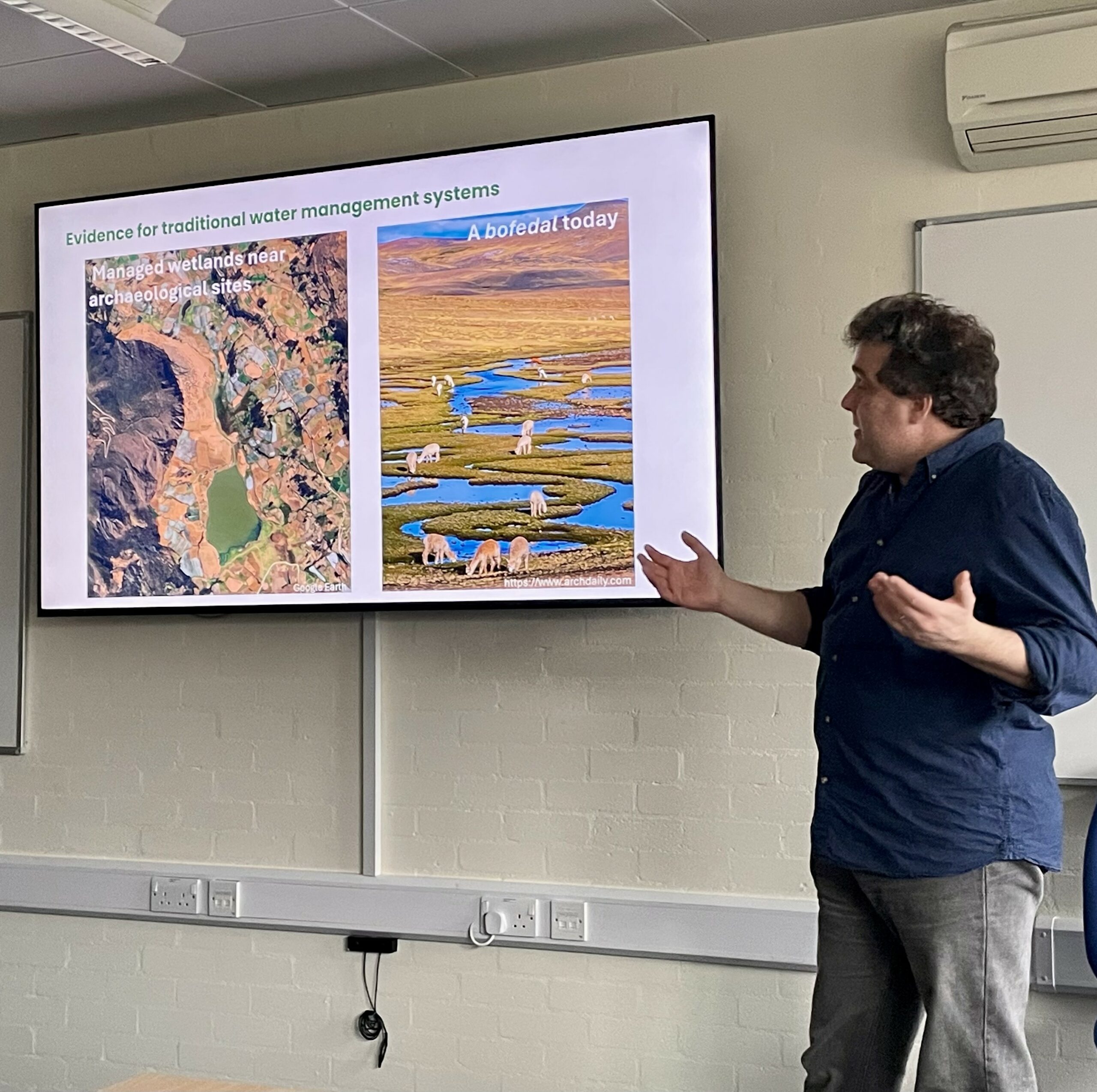
- Professor Nick Branch and Professor Kevin Lane (Geography & Environmental Science) examined the revitalisation of ancestral water management technologies in the Peruvian Andes, exploring how cultural heritage can contribute to contemporary water security and agropastoral resilience. Their research includes work in the Cordillera Negra, one of the driest ranges in the Andes, where communities rely solely on seasonal rainfall and runoff due to the absence of glacial ice. In this region, Lane and his collaborators have demonstrated that restored pre-hispanic dams, built using locally sourced stone and clay, are proving more resilient and cost effective than modern concrete structures. These indigenous dams, some of which have been successfully rehabilitated for contemporary use, withstand seismic activity better than rigid cement dams, require far less financial investment, and draw on longstanding local ecological knowledge.
- Dr Claudia Murray (Real Estate & Planning) presented a critical reflection on how neoliberal housing regimes have shaped access, land, and rights across Latin America for decades. Drawing on comparative research from Argentina, Chile and Colombia, she showed that ownership oriented policies, promoted across governments of different political leanings, have created a persistent path dependency that limits experimentation with more inclusive models. She highlighted how market logics increasingly permeate not only formal housing but also informal settlements and Indigenous or communal land systems, narrowing the range of viable alternatives. Murray called for a pluriversal housing agenda that recentres community-led and Indigenous land practices and opens space for more diverse, context-responsive housing futures.
- Professor Lúcia Nagib (Film, Theatre & Television) explored innovative cinematic approaches that resist anthropocentrism, outlining what she terms “zoomorphic cinema” as a way of reimagining human–nonhuman relations in the Anthropocene. She illustrated this concept with a striking excerpt from Albatross (Chris Jordan, 2017), a film that documents the devastating effects of ocean plastic on albatross colonies. The sequence shown revealed parent birds inadvertently feeding plastic debris to their chicks, offering a powerful visual reminder of the entanglement between human-made waste and non-human life and exemplifying the urgent ecological questions her work seeks to foreground. Nagib also drew on Birds of Passage (Cristina Gallego & Ciro Guerra, 2018), an ethnographically rich film that blends myth and realism to portray the Wayúu (Colombia) people’s struggle to maintain their traditions amid social and economic upheaval. In the film, birds act as powerful omens of death, echoing the community’s spiritual worldview and highlighting how cultural identities can become endangered when ancestral systems of meaning begin to disappear.
A lively Q&A session followed, with colleagues discussing thematic crossovers, shared methodological challenges in rights-based research, and opportunities for future collaboration.
Keynote Public Lecture:
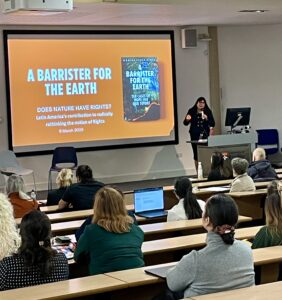
After the symposium, attendees moved to the Henley Business School for the keynote public lecture, “Does Nature Have Rights? Latin America’s Contribution to Radically Rethinking the Notion of Rights”, delivered by international human rights barrister Mónica Feria Tinta. Drawing on landmark cases and constitutional innovations across Latin America, Feria Tinta examined how rights of nature frameworks are reshaping legal and environmental debates globally. The Q&A session following Feria Tinta’s keynote was chaired by Professor David Bilchitz, an internationally recognised scholar of fundamental rights, constitutional law, business and human rights, and environmental law based at the School of Law, University of Reading.
The lecture and Q&A were followed by a drinks reception, offering space for further discussion and networking. During the drinks reception, Mónica Feria Tinta also signed copies of her acclaimed book A Barrister for the Earth, published by Faber & Faber in April 2025. The book, shortlisted for the 2025 Westminster Book Awards, guides readers through landmark legal cases that redefine how rights of nature frameworks can transform environmental justice.
The book sale was kindly facilitated by Four Bears, the Reading-based independent bookshop, enabling attendees to purchase signed copies and continue the evening’s reflections on law, nature, and planetary protection.
Reimagining Our Place in the World: Forging the Next Chapter for R-LAC
Taken together, the day’s presentations revealed a clear paradigm shift emerging across disciplines at Reading: a move away from anthropocentric frameworks toward approaches that recognise the agency of nature, foreground indigenous knowledge systems, and reassess forms of heritage long undervalued. This trajectory reached its culmination in Mónica Feria Tinta’s keynote lecture, which powerfully re-centred discussions around humans as an integral part of nature rather than its managers or owners. By drawing on Latin America’s legal innovations and indigenous worldviews, her contribution reinforced a shared intellectual movement visible across the afternoon, one that embraces more plural, environmentally attuned, and justice-oriented ways of understanding the world.
Looking ahead, R-LAC’s next five years will build on this momentum, consolidating Reading’s strengths in Latin America-related research and sustaining the network’s role as a catalyst for interdisciplinary collaboration, public dialogue, and real-world impact.