
Maasai herdsmen value quality over quantity
 by Felix Muchiri
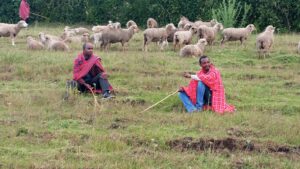
They sit quietly on the green slope, red ‘shúkas’ draped across their shoulders, staffs resting in their hands. Behind them, a flock of sheep grazes steadily, heads down, unhurried. It is a scene that feels both timeless and new.
For generations, the Maasai community of Kenya has been synonymous with cattle. Cattle were not merely livestock; they were wealth, identity, dowry, nutrition, and social capital. Herd size symbolised prestige. A man with many cattle commanded respect. Quantity mattered.
But the landscape is changing.
Across Kajiado, Narok and parts of Laikipia, grazing land is shrinking. Subdivision of communal land into private parcels has fragmented traditional rangelands. Agricultural expansion presses steadily into former grazing corridors. Fences now stand where herds once moved freely. Wildlife conservancies, settlements, infrastructure development and speculative land sales further constrain mobility.
Mobility, once the Maasai’s greatest adaptive strength, is increasingly limited.
In this context, the logic of livestock production is shifting. The new conversation is no longer about how many animals one owns, but about what those animals are worth.
The flock in this image tells that story.
Sheep and goats are gaining prominence alongside, and sometimes in place of large cattle herds. Small ruminants require less water, adapt more quickly to variable forage conditions, and reproduce faster. They offer quicker turnover in local markets. In times of drought, selling a few sheep cushions a household without dismantling its entire asset base.
More importantly, the emphasis is moving from quantity to quality.
Improved breeds, better veterinary care, controlled breeding, and strategic feeding are replacing the old metric of herd accumulation. A smaller herd of high-quality animals can generate more consistent income than a large herd weakened by overgrazing and recurrent drought. Weight gain, carcass quality, milk yield, and market access now matter more than sheer numbers.
This shift is not merely technical; it is cultural and economic.
Young Maasai entrepreneurs are engaging with livestock as agribusiness. They track and anticipate market prices, participate in organised livestock auctions, and explore value addition, from meat processing to wool and hide utilisation. Digital platforms increasingly connect producers to buyers beyond local markets. Livestock insurance products are slowly gaining traction. Cooperative models strengthen bargaining power.
Simultaneously, diversification is unfolding.
Some Maasai households are integrating crop agriculture; maize, beans, vegetables, particularly in higher rainfall zones. Others invest in poultry, dairy enterprises, or fodder production. Climate variability has forced risk management strategies that blend pastoralism with agriculture. This mixed production model reduces vulnerability to rainfall shocks and volatile livestock markets.
Yet this transformation is not without tension.
Land fragmentation can undermine traditional grazing systems. Commercialisation risks excluding poorer households who lack capital to invest in improved breeds or inputs. Cultural identity remains deeply tied to cattle. The transition from herd size prestige to productivity metrics requires negotiation within families and communities.
Still, adaptation is visible.
The men seated before their sheep represent a quiet recalibration. They are not abandoning pastoralism; they are refining it. They are responding to ecological pressure with economic strategy. They are recognising that in an era of climate uncertainty and land scarcity, resilience lies not in accumulation, but in optimisation.
Quality over quantity.
In this evolving Maasai landscape, agribusiness does not replace tradition, it reshapes it. And as grazing land becomes contested and rainfall more erratic, the future of Maasai livestock production may well depend on this deliberate, strategic shift: fewer animals, stronger returns, sustainable livelihoods.