
Members of the COEXIST Team attended and presented at the 11th International Council for Archaeozoology (ICAZ) Archaeozoology, Genetics, Proteomics, and Morphometrics (AGPM) Working Group Meeting (2025), hosted by the University of Copenhagen, Denmark. The meeting highlighted the growing importance of interdisciplinary approaches in archaeozoology, particularly the integration of genetics, proteomics, and morphometrics.
Day 1: The conference opened with two inspiring keynote lectures: Jean-Denis Vigne traced the evolutionary history of dog domestication, while Eline Lorenzen explored how biomolecular data can be used to understand ecoevolutionary change in wild species. The day concluded with a stimulating round-table discussion on the development and future directions of interdisciplinary methods in archaeozoology.
Day 2: The second day featured four sessions covering a wide range of innovative research topics, from keratin-based proteomics on Camelidae and the earliest Palaeolithic dog genomes across Western Eurasia, to the use of 2D geometric morphometrics to distinguish between Bos and Bison.
Day 3: Day three continued with more fascinating presentations, including work on rapid palaeoproteomic amelogenin-based sex estimation of cattle remains to investigate sex biases in Iron Age Britain, and an entire session dedicated to bird remains and the various biomolecular techniques used to study them.
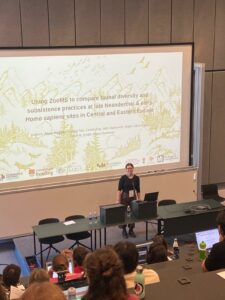
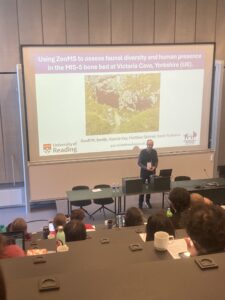
In Session 6, Anna Wagner (PhD student COEXIST) presented her research comparing faunal diversity and subsistence practices at late Neanderthal and early Homo sapiens cave sites and rock shelters across Central and Eastern Europe. Geoff M. Smith (Senior Researcher COEXIST) also presented his ongoing work on Palaeolithic Britain, using ZooMS to investigate faunal diversity and human presence in the MIS 5 layer at Victoria Cave.
Day 4: The final day concluded with two more engaging sessions showcasing presentations, such as using shotgun proteomics to distinguish suid species from Southeast Asia, and research exploring the representation and phylogenetic relationships of the extinct British lynx. The concluding keynote, delivered by Mary Prendergast, addressed the status of archaeological science in Africa and the potential for zooarchaeological training to facilitate increased research undertaken by local researchers.