

Events · 21 October 2026, Europa Experience Building, Luxembourg
EINSTEIN contributed to the EMN Luxembourg national conference on document fraud, with a presentation on face morphing attack detection and a place on the afternoon policy panel.
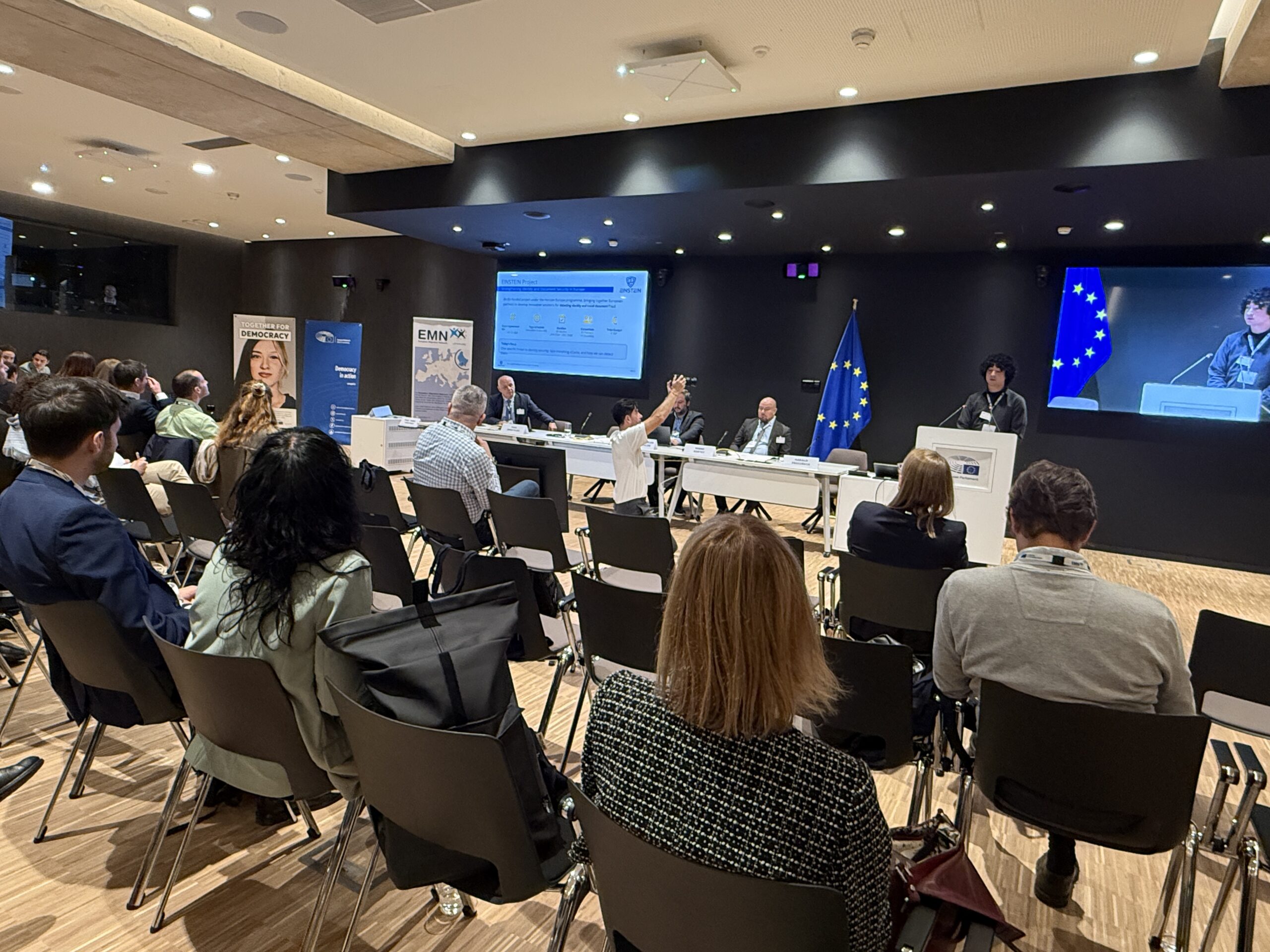
On 21 October 2026, EINSTEIN participated in Document Fraud in the Age of Artificial Intelligence: Challenges and Responses in Migration Management, a national conference organised by EMN Luxembourg and the General Department of Immigration of the Ministry of Home Affairs of Luxembourg, held at the Europa Experience Building in Kirchberg, Luxembourg.
The invitation-only conference brought together national and international experts — practitioners and policymakers from EU agencies, border management authorities, and migration services — to examine how generative AI is transforming the document fraud landscape and what technological and institutional responses are emerging at national and European level.
EINSTEIN contributed to Session 1, The Threat Landscape, with a presentation by Raúl Ismayilov (University of Twente) on face morphing attack detection. The presentation set out why morphing attacks represent a growing and serious threat to identity verification systems: a morphed image combines the facial features of two individuals, allowing multiple people to share a single travel document. Advances in generative AI have made such morphs easier to synthesise and significantly harder to detect, with AI-generated methods such as Arc2Morph showing attack success rates above 98% against multiple face recognition systems simultaneously.
The presentation introduced EINSTEIN’s approach to differential morphing attack detection (D-MAD), including the face demorphing technique — which reconstructs the hidden identity in a morphed image to expose the manipulation — and the Biometric Authentication System’s parallel multi-module architecture, which provides redundancy when individual detectors fail. Independent evaluation by NIST on approximately 1.9 million bona fide images confirmed strong generalisation across diverse morphing techniques and unseen attack methods. EINSTEIN’s work in this area also builds on a lineage of EU-funded research including D4FLY and EU BMVI, with EINSTEIN’s APP3 (advanced visual document authenticator) developing these capabilities further.
Professor James Ferryman (University of Reading) joined the afternoon discussion panel, Policy Responses and International Cooperation, moderated by Adolfo Sommarribas (LISER). The panel addressed three questions on how EU member states and institutions should respond to the evolving document fraud threat.
On cooperation and good practice exchange, Prof Ferryman argued that the fraud-technology arms race cannot be won by any single institution acting alone — EINSTEIN demonstrates that EU-funded research consortia are a practical model for pooling expertise across border authorities, document security labs, and civil society, but that outputs need faster pathways into operational practice than traditional project cycles allow. He noted that good practice exchange remains too fragmented: Frontex, eu-LISA, INTERPOL, and national forensic labs each hold relevant intelligence but without a common operational picture, and called for a structured early-warning mechanism for new fraud typologies — similar to CERT structures in cybersecurity. He also highlighted an underweighted dimension: AI-powered verification can produce false positives with serious consequences for legitimate travellers, particularly those from groups with lower biometric capture quality, and that any cooperation framework must include accountability mechanisms for these errors.
On learning from third-country verification systems while safeguarding privacy, Prof Ferryman noted that countries such as India, the UAE, and several Gulf states have moved faster on digital verification infrastructure partly because they operate under fewer privacy constraints — Europe should learn from the functional architecture without importing the governance model. He drew attention to a data-sovereignty risk: verification apps developed outside the EU often involve data processed or stored in third-country jurisdictions, making data access a national security question as well as a GDPR one. He also raised the “verification gap”: where EU systems cannot authenticate documents issued by certain third countries, border officers fall back on slower, less consistent manual checks, and called for targeted bilateral technical cooperation with a data-minimisation framework.
On a common EU approach to AI in document verification, Prof Ferryman commented that while the AI Act classifies biometric identification systems at borders as high-risk — triggering conformity assessment, transparency, and human oversight requirements — implementation guidance for document verification specifically remains thin, and called for ENISA or eu-LISA to develop sector-specific guidance. He identified accountability as the weak link: when an AI system incorrectly flags a document as fraudulent, the chain of responsibility between system developer, procuring authority, and acting officer is often unclear, and this needs to be resolved in procurement frameworks rather than left to post-hoc litigation. He concluded that a common EU approach does not require a single centralised system, but common standards for auditability, logging, and redress that national systems must meet — achievable through the existing EU framework without requiring member states to surrender operational control.
EINSTEIN is a Horizon Europe Innovation Action (grant agreement 101121280) developing and trialling identity verification technologies for border management and law enforcement across six application areas. For more information, visit einstein-horizon.eu.
Event details
Document Fraud in the Age of Artificial Intelligence
21 October 2026 · Europa Experience Building Konrad Adenauer, Kirchberg, Luxembourg
Organised by EMN Luxembourg and the General Department of Immigration, Ministry of Home Affairs of Luxembourg