



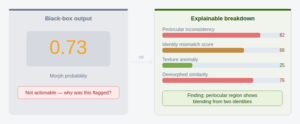
Imagine a border officer is presented with a screen showing that the face recognition system has flagged a passport photograph as a possible morphing attack. The system’s confidence score reads 0.73. The threshold is 0.5. The algorithm says: reject. But what does the officer do with that? What does 0.73 mean? Which feature of the image triggered the detection?
Why scores alone are not enough
Most modern biometric algorithms are built on deep neural networks. These networks are extraordinarily effective at learning discriminative features from training data. They are considerably less good at explaining what those features are. In security-critical applications, decisions that affect people’s ability to travel, access services, or prove their identity must be explainable, auditable, and contestable.
Explainability in quality assessment
Face image quality is one area where explainability has been successfully implemented. The ISO/IEC 29794-5 standard’s 28 component quality measures are inherently explainable. When an image is rejected for quality reasons, the system can specify exactly which measure failed. The OFIQ tool provides this component-level feedback as standard, making it actionable for both operators and data subjects.
Explainability in morphing attack detection
Morphing attack detection is harder to make explainable because the signal of a morph is often subtle and distributed across the image. Research is exploring attention-based neural network architectures that highlight which regions of an image drove a detection decision, and feature importance methods that identify which aspects of the differential between a document image and a live capture contributed most to the morphing score.
The regulatory requirement
The EU AI Act explicitly requires that high-risk AI systems — a category that includes biometric systems used in border management — provide sufficient transparency to allow human oversight. The GDPR’s Article 22 provides a right not to be subject to solely automated decision-making with significant effects. Explainability is no longer optional. It is a design requirement.
© 2026 EINSTEIN Consortium. EINSTEIN is funded by the European Union’s Horizon Europe programme (GA No. 101121280) and by UKRI (IFS 10093453). Views expressed are those of the authors only. www.einstein-horizon.eu