



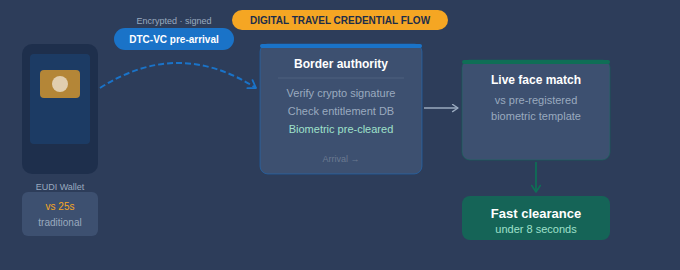
Land border crossings present border management challenges quite different from airports. There is less advance information about who is coming, when, and why. Traffic flows are harder to predict and manage. And the consequences of a slow crossing are borne immediately — in queues stretching back along highways, in idling vehicles, in commuters late for work. Pre-registration offers a different model: moving some of the border processing upstream, before the traveller arrives.
How pre-registration works
A traveller submits their biometric data and a Digital Travel Credential in advance of their journey — through a smartphone app or web interface. The border authority verifies the credential and checks the traveller’s entitlement to cross against relevant databases. When the pre-registered traveller subsequently arrives at the crossing point, a facial recognition match against their pre-submitted biometric confirms their identity, and their already-verified travel entitlement enables rapid clearance.
Research has demonstrated that pre-registration can reduce average border processing time from approximately 25 seconds per traveller to under 8 seconds — a threefold improvement that, at a busy crossing, can eliminate queues entirely during peak periods.
The technical challenges
Pre-registration at a land border introduces specific technical challenges. The matching at the crossing point must work reliably in outdoor conditions — variable lighting, weather, and the capture geometry of a pedestrian lane. Facial ageing between enrolment and crossing must be accommodated. Real-time checks against revocation databases are essential.
Voluntary participation
Pre-registration is, and must remain, entirely voluntary. The EINSTEIN project’s Land Border Pre-Registration application, led by CERTH, is developing and field-testing this capability at the Promachonas-Kulata crossing point on the Greece-Bulgaria border, in partnership with the Hellenic Police and Bulgarian Border Police.
© 2026 EINSTEIN Consortium. EINSTEIN is funded by the European Union’s Horizon Europe programme (GA No. 101121280) and by UKRI (IFS 10093453). Views expressed are those of the authors only. www.einstein-horizon.eu