


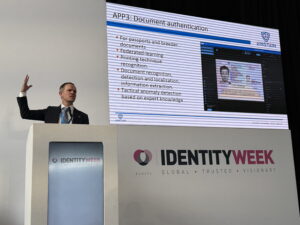
This week, the EINSTEIN project took to the stage at Identity Week Europe 2026 in Amsterdam, with a presentation and panel discussion bringing together technologists, researchers, and border authority practitioners to share results and reflect on what the project has delivered for real-world identity management and document fraud detection.
Iterative Development: The Engine Behind the Results
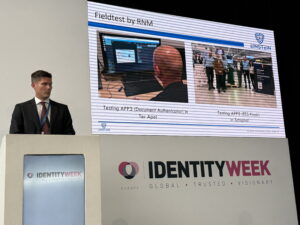
A central message of the presentation was that EINSTEIN’s progress was not the product of a single development push, but of three structured integration cycles running across 2024, 2025, and 2026. Each cycle moved through the same sequence — technology development, application integration, and field testing — before feeding practitioner feedback back into the next round. This iterative model, with end users actively involved at every stage rather than consulted only at the end, proved critical to producing tools that work in real operational settings.
The concrete impact of this approach was evident in the field test results presented on the day.
End-User Assessment: What Border Forces Found
Rob Schotman of the Royal Netherlands Marechaussee (RNM) and its Expertise Centre for Identity and Document Fraud (ECID) described how the iterative cycles allowed practitioners to steer development priorities in a direct and measurable way. RNM led field testing of APP3 (Document Authenticator) at Ter Apel and APP5 (EES Kiosk) at Amsterdam Schiphol Airport across the three cycles, with each round sharpening the tools based on what officers actually encountered in use:
- APP3 was praised for its broad and flexible authentication capabilities. RNM’s feedback from early cycles pushed the consortium to prioritise printing-technique recognition specifically — and the result, by the third cycle, was a large, measurable improvement in that capability.
- APP5 impressed as a seamless traveller identity verification solution with automated supervision. Feedback on the operational, performance, and legal constraints of kiosk deployment at border crossing points drove the addition of behavioural anomaly detection and improved supervision workflows in subsequent cycles.
Panel Discussion: Practitioners and Technologists in Conversation
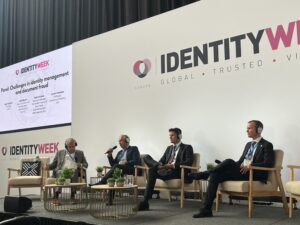
The panel brought together voices from across the consortium to discuss EINSTEIN’s broader impact and the road ahead. Key themes included:
Day-to-day realities at the border: The panel opened with an honest look at the frontline challenges border officers face — balancing speed and throughput with rigorous fraud detection, as document forgery techniques continue to evolve. EINSTEIN’s tools were assessed not just technically but against these operational realities.
How end users steered the project: Rob Schotman described how RNM was able to influence development priorities through structured feedback at each integration cycle — a model that proved effective at closing the gap between what researchers build and what practitioners actually need.
Ethics, law, and privacy: The panel addressed how legal and ethical considerations were embedded throughout the project rather than treated as an afterthought. Measures discussed included GDPR compliance frameworks (DPIA, Joint Controllership Agreements, informed consent), alignment with the AI Act’s requirements for transparency and human oversight, and technical choices such as federated learning to limit data centralisation.
Impact on secondary checks: The discussion explored whether and how EINSTEIN’s innovations could meaningfully improve the handling of secondary screening — an area where better automated tools and human-oversight workflows could have significant operational impact.
Beyond EINSTEIN — sustaining the innovation: The panel was frank about the “valley of death” challenge that many EU research projects face after funding ends. Panellists shared their exploitation plans and discussed the conditions needed for operational deployment, including the evolving regulatory environment around automated information exchange between security and border authorities, and the opportunities presented by the EES roll-out.
Lessons learned: Closing the discussion, panellists reflected on what they would do differently if starting the project again — a candid exchange that offered useful pointers for future collaborative projects between researchers and security practitioners.
The EINSTEIN project is funded by the European Union under Grant Agreement No. 101121280 and by UKRI Funding Service under IFS reference 10093453. Views and opinions expressed are those of the author(s) only and do not necessarily reflect those of the EU, its Executive Agency, or UKRI.