
Two University of Reading staff members have recently received British Academy (BA) small research grants to support projects that aim to explore the future of technology and society.
Smartphones and Urban Livelihoods in Tanzania

Dr Nathan Salvidge , Lecturer in Development Geography in the Department of Geography and Environmental Science, received a small grant towards his project titled: ‘An investigation into the role of smartphone technologies and digital platforms in (re)shaping young informal vendors’ complex and diverse livelihoods in urban Tanzania’. The project will investigate how urban youth adopt smartphones and digital platforms, using their capabilities for sharing photos, documents, and videos in near real time to develop and sustain informal livelihoods. The study will include life-mapping interviews with 24 youth participants (12 in each city) and a novel “screenshot elicitation” method. In addition, eight semi-structured interviews will be conducted with key stakeholders (four in each city).
Reflecting on this award, Dr Salvidge said, “I am thrilled to have this opportunity to build on previous research of a similar nature undertaken in Dar es Salaam earlier this year. This will allow me to further develop insight into how digital technologies are shaping and reshaping young people’s lives and livelihoods in urban Tanzania. Informal work is central to many young people’s lives, so understanding how they navigate and negotiate this contemporary form of work is crucial for both the present and the future. This knowledge can help inform strategies for youth support, economic development, and policies that respond to evolving urban challenges”.
Drones and Urban Futures
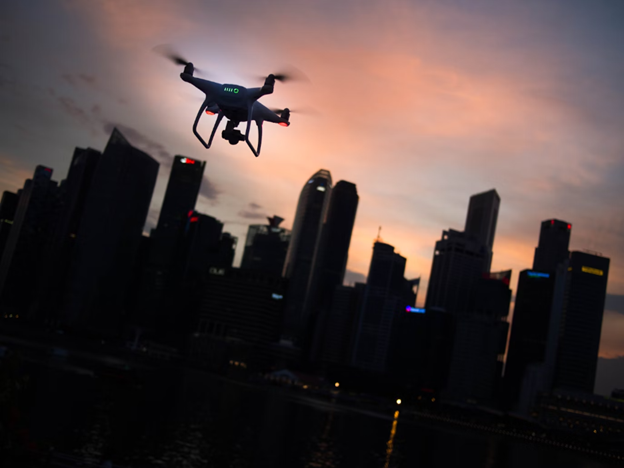
The second recipient is Dr Anna Jackman, Associate Professor in Human Geography, also in the Department of Geography and Environmental Science. She received £9988.38 for her project application titled ‘Future drone skies: Planning in volume’, alongside her Co-Investigator Dr Paul Cureton at Lancaster University.
This Future drone skies: Planning in volume project examines the growing role of drones in the UK skies. From infrastructure inspection to emergency services, aerial drones increasingly feature in UK skies. The UK Government, alongside airspace regulators and industry alike, argue that drones at once support wide-ranging applications and offer economic, social, and sustainability benefits. However, as Jackman explains, “while a recent UK Government ambition statement outlines aims for commercial drones to be “commonplace by 2030,” the impact of drones upon built environments is nonetheless yet to be fully considered and addressed. From landing pads and charging stations to flight routing, drones raise critical yet under-examined questions about changing geographies of UK planning” .
This interdisciplinary project involving academics in geography and design engages with both UK planners and publics through workshops, serious games and citizen crowdsources mapping, to address a major research gap surrounding the implications of drones in three-dimensional (volumetric) airspace for UK built environments and the lived experiences of residents in their midst.
About the British Academy Small Research Grants
The British Academy Small Research Grants support primary research in the humanities and social sciences. The awards support up to £10,000 in value and provides