
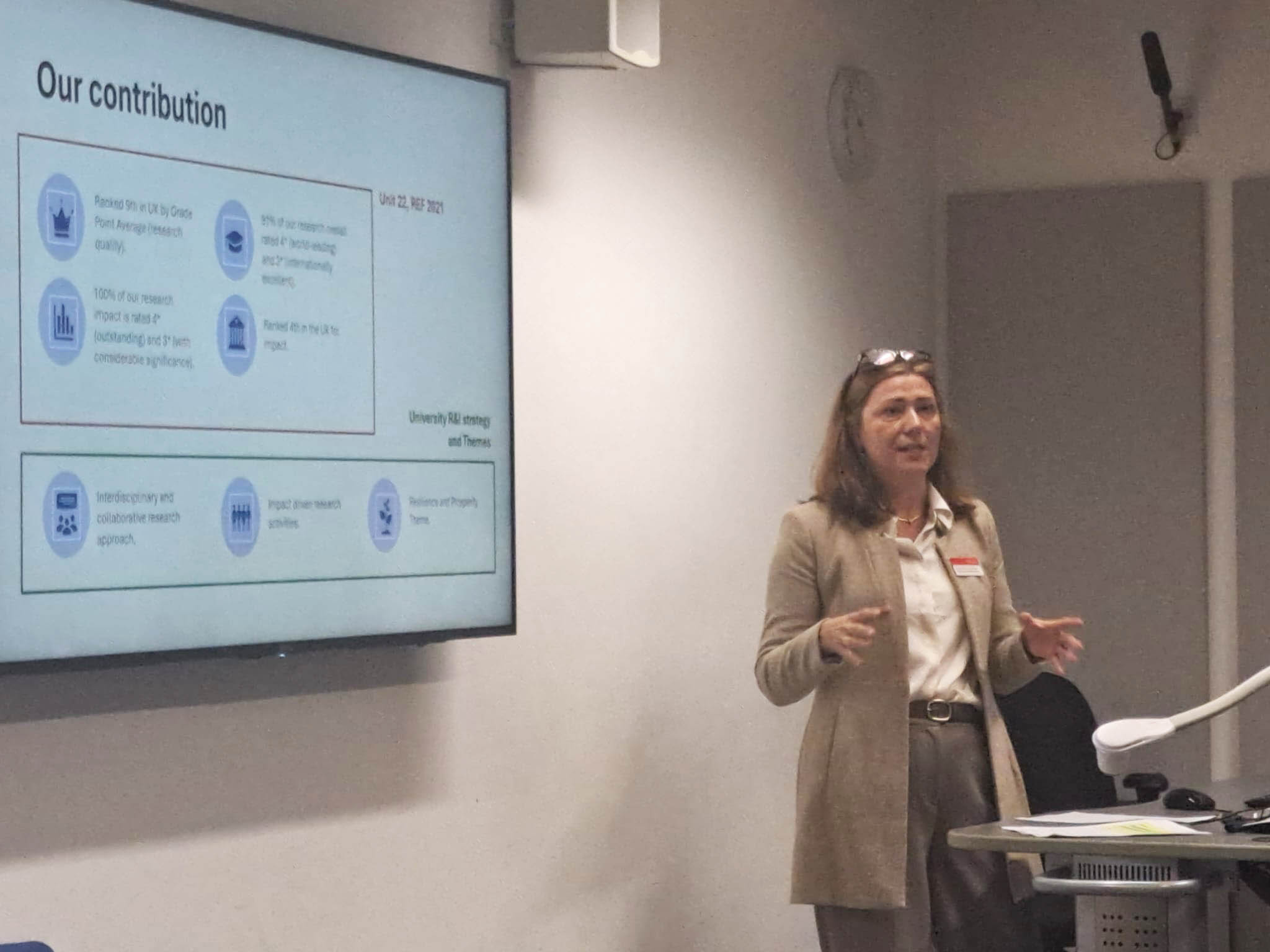
On 21 January 2026, the Global Development Research Division convened a showcase event bringing together researchers working across participatory methodologies, environmental sustainability, and interdisciplinary global development. The event highlighted not only the breadth of ongoing research but also the Division’s commitment to grounded engagement, with research conducted alongside communities, practitioners and policy actors to generate meaningful change.
The first session, Using participatory action research to deliver policy and practice impact, chaired by Yaw Adjei-Amoako, centred on research approaches that move beyond consultation towards collaboration. Esther Oenga and Matt Burrows explored Community Participatory Action Research in the UK, demonstrating how community-led processes shape both knowledge production and implementation. Alex Arnall discussed coastal research and community engagement in the UK, illustrating how co-produced insights inform adaptive responses in fragile coastal environments. Erica Bower presented the Knowledge and Innovation for Advisory Services in Regenerative Agriculture project across the EU, emphasising the importance of effective partnerships in strengthening advisory systems and accelerating regenerative transitions.
The second session, chaired by Mike Goodman, focused on Advancing interdisciplinary research to support environmental sustainability. Contributions reflected the Division’s global reach and methodological diversity. Peter Dorward outlined the international ePICSA programme, examining how climate services can support locally relevant decision-making. Henny Osbahr provided updates on community-based natural farming in India, highlighting locally rooted innovation and resilience. Nathan Salvidge addressed livelihoods across East Africa, while Andrew Ainslie introduced the Livestock Observatory in Southern Africa as a platform for evidence-informed livestock systems transformation. Stefania Levo concluded by presenting research from the Development Economics cluster, underscoring the economic dimensions of sustainability transitions.
Dr Nathan Salvidge presenting on youth livelihoods and emerging economic pathways in East Africa.
Across both sessions, discussion returned to a shared theme: environmental sustainability cannot be separated from questions of inequality, justice, prosperity and resilience. Participants reflected on the dynamics of interdisciplinary collaboration, the challenges of translating research into policy contexts, and the necessity of sustained engagement with stakeholders at multiple scales.
The event reaffirmed the Division’s approach to global development research as grounded, collaborative and conceptually rigorous, ensuring that environmental sustainability outcomes are pursued in ways that address structural inequalities and support long-term social and ecological resilience.