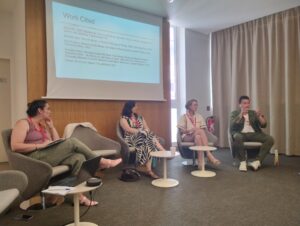
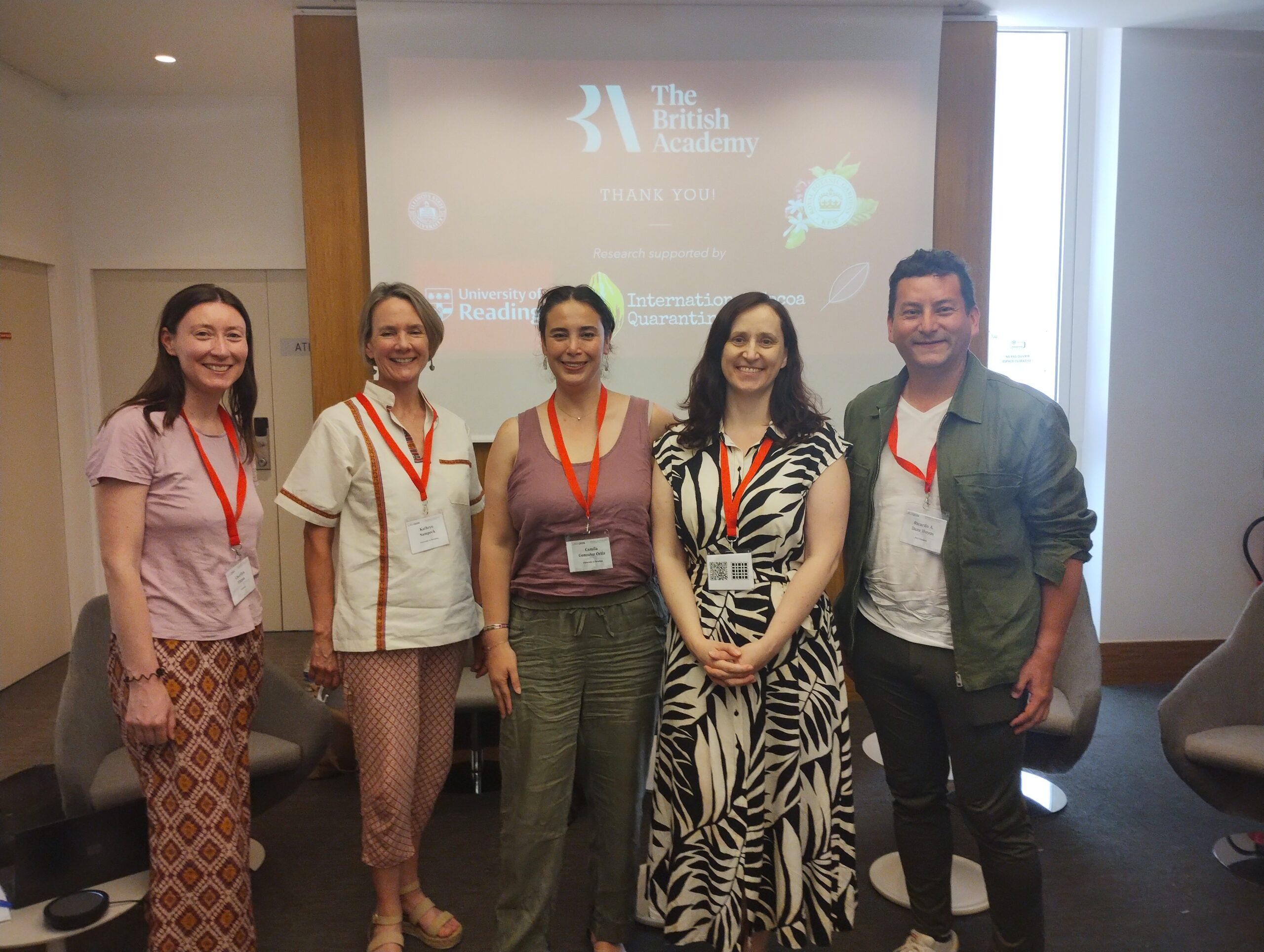

In May 2026 members of R-LAC organised a panel at the Latin American Studies Association (LASA) annual conference in Paris. LASA is the largest professional association in the world for individuals and institutions engaged in the study of Latin America.
Entitled ‘Reading Latin American and the Caribbean Network: Decolonial and Interdisciplinary Approaches to Land, Climate and the More-than-Human in Latin America’, R-LAC’s panel brought together scholars from across the network, representing different career stages, whose research adopts diverse disciplinary approaches – ranging from cultural studies to meteorology, real estate to archaeology – to issues of land ownership, food biodiversity, climate change and green neo-colonialism in Latin America.
Professor Katie Sampeck, who holds a BA Global Professorship in the Department of Archaeology at Reading, spoke about biodiversity and resiliency in cacao cultivation and consumption in El Salvador. Dr Catriona McAllister, Associate Professor in the Department of Languages and Cultures, demonstrated how videographic research was facilitating interdisciplinary dialogues between the humanities and meteorology to explore the effects of climate change in Bolivia. Ricardo Daza Hoyos, PhD student in the Department of Real Estate and Planning, showcased his research on decolonising land ownership in Latin America through the model of Community Land Trusts. Dr Camila González Ortiz, Lecturer in the Department of Languages and Cultures, explored how Chilean theatre enables us to think critically about practices of greenwashing and neocolonialism in the region.
In facilitating a conversation across disciplinary boundaries, the panel highlighted the diversity of Latin American research at Reading and explored the ways in which truly interdisciplinary conversations and methods can open up new approaches, incorporating decolonial and more-than-human worlds, to urgent questions affecting Latin America.