
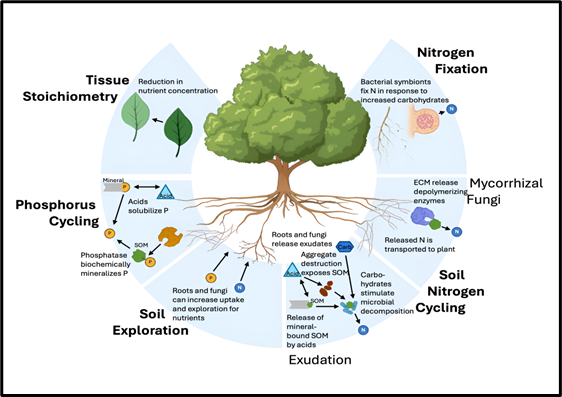

A new study published in Nature Climate Change—Plant nutrient acquisition under elevated CO₂ and implications for the land carbon sink—offers fresh insight into a long-standing climate science puzzle: how nutrient limitations interact with rising atmospheric CO₂ to shape the land carbon sink. The research, led by Trevor Cambron (MIT) and co-authored by Benjamin Stocker, Trevor Keenan, and Colin Prentice from the LEMONTREE project, with support from several international collaborators, presents a compelling case for better representing plant nutrient acquisition strategies in climate models.
As global CO₂ levels climb, Earth’s vegetation has helped buffer warming by absorbing a large share of our emissions. But how much longer can plants keep pace? That depends not only on photosynthesis, but also on whether plants can access the nitrogen and phosphorus they need to turn CO₂ into long-lived carbon storage.
What the Experiments Say
Meta-analyses of long-term elevated CO₂ (eCO₂) experiments show that while aboveground biomass (AGB) is often constrained by nutrient availability, total ecosystem carbon (including belowground biomass and soil organic carbon) still tends to increase. This study found an average 11.8% increase in ecosystem-level carbon across eCO₂ experiments longer than 3 years, highlighting the importance of belowground carbon allocation and nutrient acquisition in sustaining the land sink.
At sites like DukeFACE and ORNL, belowground responses—such as enhanced coarse and fine root growth—drove meaningful carbon gains. In contrast, Aspen FACE illustrated how nutrient mining can trade off soil carbon to support biomass increases. Soil sampling depth also influenced estimates of carbon storage, underscoring the need for more standardized methodologies.
The Modelling Gap
Most Earth System Models (ESMs) fail to represent these belowground dynamics. C-only models, which ignore nutrient constraints, overestimate the land carbon sink, while CN models (which include carbon and nitrogen cycles but not adaptive plant strategies) tend to underestimate it.
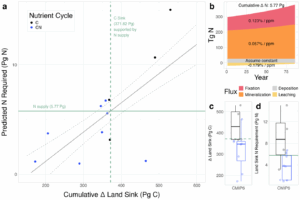
In a proof-of-concept exercise, the team used CMIP6 simulation data and experimental results to estimate plausible increases in biological nitrogen fixation (BNF), mineralization, and reductions in leaching under eCO₂. Their estimate suggests a cumulative increase in nitrogen availability of 5.77 Pg N over 86 years—enough to support a 372 Pg C land sink. That’s 16.7% higher than what CN-enabled CMIP6 models currently predict.
In order understand the future role that ecosystems can play in climate change mitigation, we need to understand how limited by nutrients plants will be. This study shows that plants have a range of strategies to acquire nutrients under global change and makes the case that better representations of these strategies in models may help us to better understand the future of the land carbon sink.
Trevor Cambron (MIT) Lead Author
Big Questions and Data Gaps
The study underscores the urgent need for more diverse and long-term eCO₂ experiments. Existing experiments skew heavily toward temperate forests and short timescales. New initiatives like BiFOR FACE, EucFACE, and the newly launched AmazonFACE are vital, but they’re only a start. The tropics remain vastly underrepresented despite being critical to the global carbon budget. Key unknowns include whether elevated CO₂ causes forests to raise their maximum biomass or just reach it faster, and how nutrient limitations evolve over decades. The paper emphasizes that combining CO₂ treatments with other global change drivers (e.g. warming or drought) will also be essential for capturing real-world complexity.
A Call for Next-Generation Models
Moving forward, it’s important for ESMs to incorporate more mechanistic representations of plant nutrient acquisition, including:
- Root exudation and priming
- Mycorrhizal associations
- Flexible rooting depth and nutrient foraging
- Dynamic mineralization and resorption rates
- Spatial variability in nutrient limitation
These strategies are already observed in the field, but most models still treat plants as passive recipients of nutrients. Incorporating their adaptive capacity could dramatically improve predictions of the future land sink.
Conclusion: Nutrient Strategies Matter
Ultimately, the study finds that nutrient limitation is real, but not absolute. Through evolved strategies, many ecosystems may continue absorbing CO₂, though perhaps not indefinitely or uniformly. We need model development to reflect these processes and more data to inform them. If we want to know how long nature’s carbon sink can hold, we must look not just to the sky, but underground.
Citation
Cambron, T.W., Fisher, J.B., Hungate, B., Stocker, B.D., Keenan, T., Prentice, I.C. & Terrer, C., 2025. Plant nutrient acquisition under elevated CO₂ and implications for the land carbon sink. Nature Climate Change. https://doi.org/10.1038/s41558-025-02386-y