

Anthropogenic climate change brings many challenges for society, and for science. But without knowledge of past climate changes and their impacts, we are flying blind. Climate changes, with diverse causes, magnitudes, patterns and rates, have occurred throughout Earth history. Rapid climate change today, caused by human modification of the atmosphere on an unprecedented scale, has no previous analogue; but this fact does not absolve us from the need to understand how climate has changed – and living organisms and communities have responded – in the past.
Palaeoclimate science and palaeoecology are substantial fields of study, largely ignored by ecologists and policy makers alike. They are absent from most academic curricula in biology or meteorology. In the UK at least, it is mainly geography departments that teach these subjects. Few ecologists are knowledgeable about them. I have encountered incredulity when, for example, pointing out (as has been known for over a century!) that much of northern Europe was around two degrees warmer in the mid-Holocene (about 6000 years ago) than it has been in recent years; or to the well-documented Dansgaard-Oeschger (D-O) warming events during the last ice age, when Greenland warmed by as much as 10-15˚C (and Europe by 5-8˚C) over the course of a few decades.
The treatment of past climates in IPCC reports has been patchy. For example, the IPCC Fifth Assessment report (AR5) actually documented D-O events (in a specific chapter on past climates in the WG1 Report), but they were not mentioned in the Technical Summary and were ignored altogether in WG2. The IPCC Sixth Assessment Report (AR6) “mainstreamed” palaeoclimate, which is thus mentioned in several chapters – but attention was confined to reconstructed changes in mean annual temperature, a one-dimensional view of climate.
I have heard many (bogus) excuses for not studying past climates.
“Past climate changes were much slower”. One paper in Science in 2013 even claimed that they were “orders of magnitude” slower, based on a diagram (deeply buried in the paper’s supplementary material) that shows unrealistically small magnitudes and rates of change – for example, at the end of the last ice age, when the global (unglaciated) land surface warmed by 5˚C or more during about 20 years.
“Not enough information is available.” This might have been true half a century ago; it is not true now. Moreover, major efforts are underway to synthesize information from multiple data sources on all continents.
“The time resolution of the records is insufficient”. Not all palaeoclimate archives are highly resolved. However some – especially those from ice cores, laminated lake sediments, and speleothems – can resolve individual decades, and these records provide the detailed chronology that is essential for reconstructing rates of change.
“Dating control is inadequate”. Various dating methods are used, and none is perfect. However, many techniques are used to synchronize records within a region, including tephras (markers of volcanic eruptions) and dynamic time warping (matching the shapes of time series).
“The data are questionable”. Many indirect methods, including isotopic analyses, are used to infer past climates and environments from sedimentary, speleothem and ice-core records. Continual progress is being made in refining these methods. In addition, some data sources are closely linked to the system they record: pollen assemblages to surrounding vegetation, and charcoal abundances to fires in the catchment.
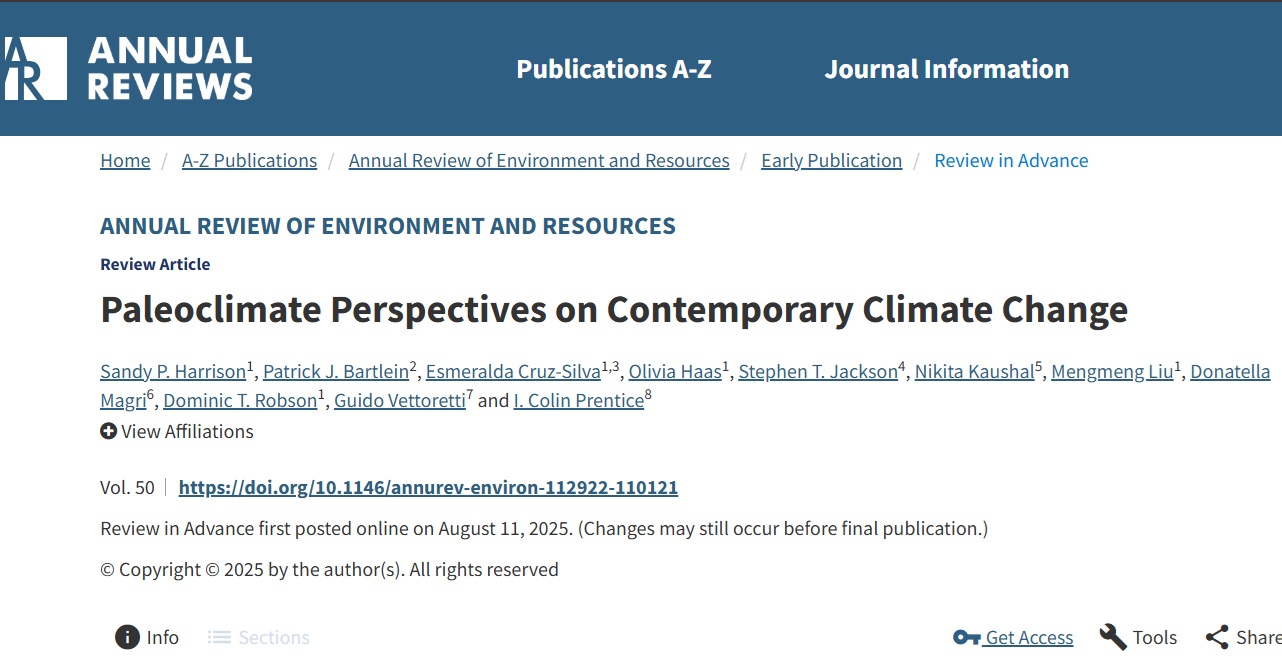
I was invited to write a review for Annual Review of Environment and Resources on the relevance of studying past climates for present and future climates. The journal agreed that Sandy Harrison (Reading University) should take the lead author position, reflecting her role as a leading researcher on the reconstruction and modelling of Quaternary climate change and ecosystems on land. The final author list includes both highly experienced scientists straddling palaeoclimate science, modelling and ecology, and early-career scientists from our groups and elsewhere. Some of the key points we make in the review are as follows.
- Natural climate changes have sometimes been remarkably fast, corresponding to “tipping points” being crossed. The response of the biota can also be fast. Phylogenetic niche conservatism dictates that species populations do not primarily adjust to climate change by adaptive evolution but can shift habitats, and even migrate long distances – by mechanisms that are still not fully understood.
- Many tree species have proved able to withstand large and fast climate changes, including by long-distance migration as well as elevational and habitat shifts. Among plant species, only one is known to have gone extinct during the rapid warming at the end of the last ice age. Large mammals, in contrast, have suffered multiple extinctions linked to rapid warming events – including the end of the last ice age (although hunting by people may have assisted their demise). This assessment of the relative vulnerability of trees and large mammals to rapid warming is opposite to that made in IPCC AR5, on the basis of (limited) contemporary evidence.
- From the relatively new technique of sedimentary ancient DNA analysis, which has taken species-level identification to the next level, it has emerged that the recovery rate of ecosystem function can be much faster than the re-emergence of complete communities.
- Biosphere-climate feedbacks are large. D-O events, as registered in ice cores, show positive feedbacks linked to CH4 and N2O that are among the largest of previous estimates; and several times larger than those presented in IPCC AR6. Positive feedbacks linked to changes in land-surface albedo may be larger still, perhaps even helping to destabilize global climate during ice ages.
- Wildfires have been nearly ubiquitous even in the absence of human settlement. Increases in wildfire have been associated with climate changes and biome shifts.
- CO2 concentration has varied between about 180 and 1600 ppm during the past 50 million years. These variations have profoundly influenced the nature of ecosystems and plant geography. The warm, high-CO2 world of the Eocene was characterized by forest almost everywhere on land. The cold, low-CO2 world at the last glacial maximum was characterized by widespread C4-dominated grasslands and shrublands, and a severe restriction of forests.
- “Novel ecosystems” are nothing new. “Novel” combinations of species have come into being innumerable times.
We noted that palaeoclimate science has made a few notable contributions to mainstream climate science, including providing one data source (the contrast in climate between the last glacial maximum and the present (Holocene) interglacial) that has helped to constrain the value of the equilibrium climate sensitivity. Palaeodata have also been used in a few recent publications to provide additional constraints on climate model parameters. However, there is scope for far more work along these lines.
The review also contains some warnings.
- Age models must be good enough for the purpose for which they are used. In other words, dating uncertainty has to be taken seriously before inferring leads and lags between different processes in the global climate system.
- Reducing climate change to mean annual temperature, although a convenient shorthand for contemporary climate changes forced by CO2, is simplistic. Changes in seasonality are important for the biota and are a natural consequence of changes in the Earth’s orbit, which are ultimately responsible for the alternation of ice ages and warm periods.
- The interpretation of palaeodata is continually improving, so the most useful ways in which information on past environments can contribute to contemporary climate science will involve collaboration, rather than simply a handover of data.
A supplement to the review provides readers with information on important compilations of data on past environments, presented with hopes of facilitating such collaboration.
There are many outstanding questions in this field. Climate models fail to represent some aspects of past environments well (including, famously, the full extent of the “green Sahara” during the mid-Holocene); we do not know why. However, if palaeodata are only used as a test of climate models – they have often been presented in this way – then it is not clear what to do when the test fails (an all-too-common response is to question the data!). Instead, we advocate the use of palaeodata as a test of specific causal hypotheses – which will also require running bespoke model “experiments”. The literature to date provides relatively few examples; much more could be done.
I would like to end (lest my words be taken out of context – a common hazard) by re-iterating that nothing in the palaeorecord gives the slightest grounds for climate “scepticism”. Analogies from the past can only be taken so far. Conservation in today’s landscapes cannot simply rely on species’ ability to adjust to changing conditions in a less fragmented past. Climate-induced changes in fire regimes now impact settled human populations in many ways, and could lead to extinction of species that have been confined to reserves or marginal habitats. However, we do need realism – in order to act on what is actually known to science. Palaeodata tell us, for example, that ecosystems have continually changed. Nowhere is there a prelapsarian state to which “rewilding” would return us. Rising CO2 does bring increased primary production and greening of ecosystems, alleviating some effects of climate change. And the organisms at the greatest risk of extinction due to a changing climate are probably large mammals – not trees.
You can read the full paper here:
Harrison, S.P., Bartlein, P.J., Cruz-Silva, E., Haas, O., Jackson, S.T., Kaushal, N., Liu, M., Magri, D., Robson, D.T., Vettoretti, G. & Prentice, I.C. (2025). Paleoclimate perspectives on contemporary climate change. Annual Review of Environment and Resources, 50,