
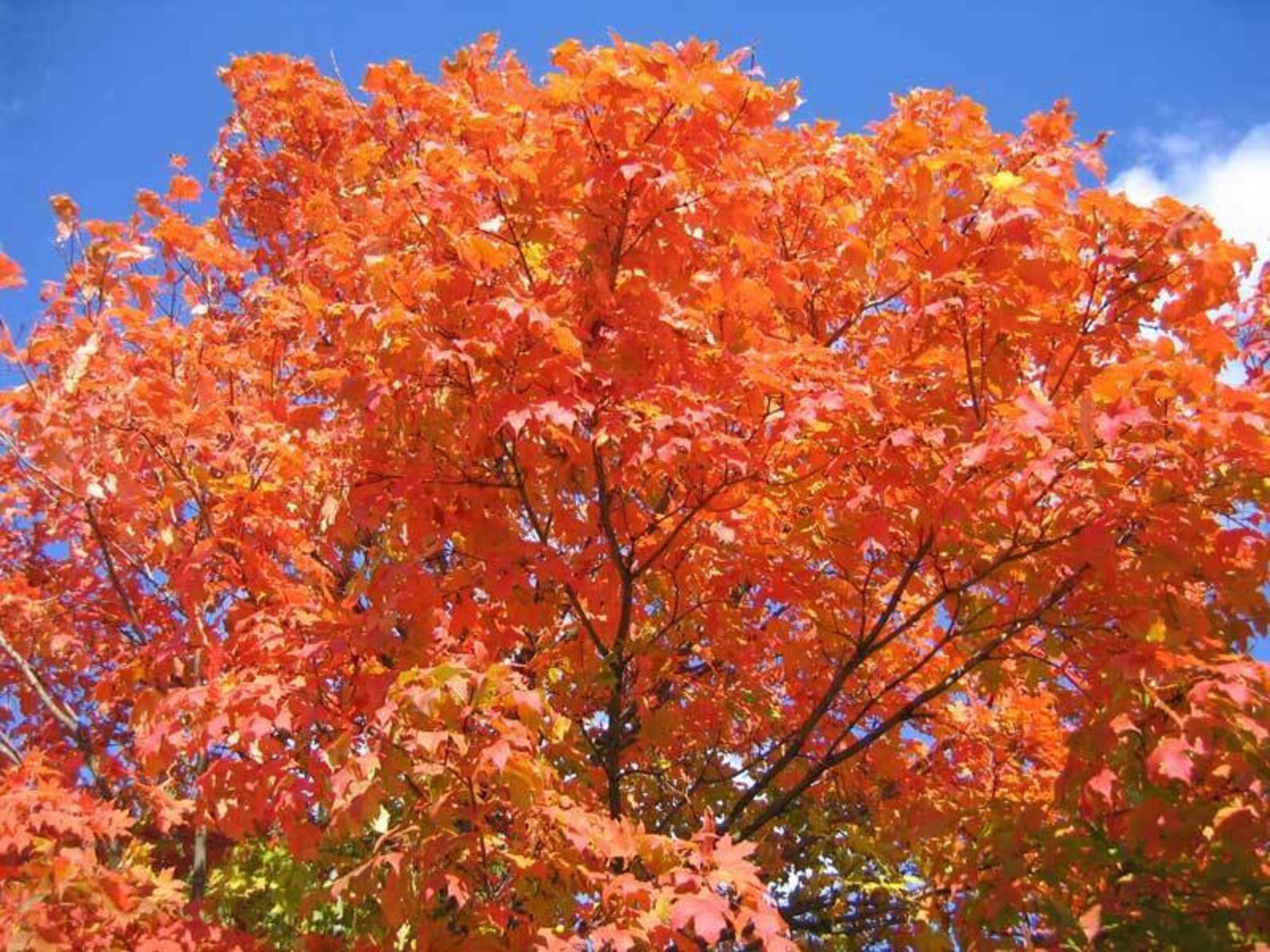

How do trees decide how to use the resources available to them? Just like any economy, plants face trade-offs. They must balance investments of nutrients and water to maintain photosynthesis.
A new study led by LEMONTREE’s Evan Perkowski (Texas Tech University) study has provided rare experimental evidence for this balancing act. Working with sugar maple (Acer saccharum), a dominant tree species of northeastern U.S. forests, they showed that trees maintained steady rates of photosynthesis across a nitrogen fertilisation gradient by using nitrogen less efficiently in exchange for conserving water. In other words, when nitrogen was plentiful, trees “spent” it more freely, while saving water.
These findings provide strong support for predictions from photosynthetic least-cost theory, the Eco Evolutionary Optimality framework that explains how plants optimise resource use to achieve photosynthesis at the lowest combined cost. And they have important implications for understanding how forests will respond to global changes in nitrogen deposition, soil acidification, and climate.
Study site
The study took place in summer 2019 at three mature forest stands near Ithaca, New York. These late-successional mixed deciduous forests are dominated by sugar maple, which accounts for nearly half (43%) of total aboveground biomass. Other important species include American beech, white ash, red maple, and red oak.
The soils are channery silt loam Inceptisols (young soils with little layering), and the climate is cool-temperate: the region receives nearly 1,000 mm of precipitation annually, with an average temperature of just under 8°C. Long-term monitoring shows large declines in nitrogen and sulfur deposition since the early 2000s, thanks to U.S. Clean Air Act regulations. Nitrogen inputs, however, remain high enough to influence forest nutrient dynamics—making these sites an ideal living laboratory for studying how trees balance nutrient and water use.
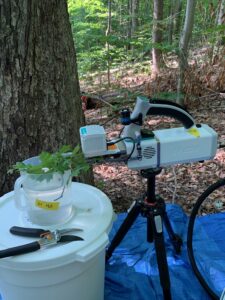
To test least-cost predictions, the team used a nine-year nitrogen-by-pH field manipulation experiment. By carefully adjusting nitrogen availability and soil acidity across plots, they could observe how sugar maple leaves responded in terms of photosynthetic traits, nitrogen allocation, and water use efficiency.
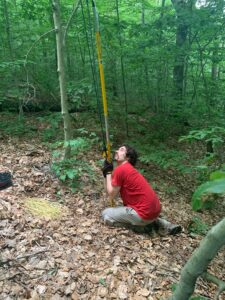
Fieldwork in these tall forests came with some challenges. Collecting sunlit leaves from the upper canopy required an ingenious technique: using a slingshot with a string and weighted ball to snag high branches. As Evan notes, it was both an effective and rather amusing way to gather samples (see photo of collaborator David Frey putting the method to work).
What the trees revealed
The results aligned well with least-cost theory. Across the nitrogen treatments, sugar maples:
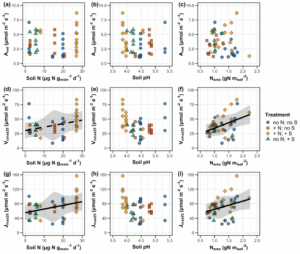
- Maintained net photosynthesis rates (no change in carbon gain, despite more nitrogen).
- Increased leaf nitrogen content (Narea) and photosynthetic capacity (Vcmax, Jmax).
- Reduced the ratio of internal to external CO₂ (χ), a proxy for stomatal conductance.
Importantly, the team also found a strong negative correlation between Narea and χ, regardless of nitrogen fertilisation. This is one of the clearest demonstrations yet of the nitrogen–water use trade-off predicted by least-cost theory, strengthening earlier work (Wright et al. 2003; Prentice et al. 2014) with robust experimental evidence.
Together, these shifts meant that trees traded lower nitrogen-use efficiency for higher water-use efficiency. In other words, with nitrogen readily available, they allocated more of it to photosynthetic machinery (e.g., Rubisco), while tightening stomatal control to conserve water.
Soil pH, surprisingly, had no direct effect on these trade-offs when considered across all plots. This suggests that earlier studies reporting pH effects may actually have been picking up indirect nutrient effects, for example, how soil acidity alters nitrogen availability.
Why it matters
This study provides some of the first field experimental evidence for nitrogen–water trade-offs predicted by photosynthetic least-cost theory. It shows that plants don’t always use additional nitrogen to boost photosynthesis, as many models assume. Instead, they may maintain steady photosynthesis while shifting their internal economy of resources.
The implications are far-reaching. If Earth system models overestimate the boost in photosynthesis from nitrogen deposition, they may also overestimate carbon uptake by forests, while underestimating reductions in water loss. Similarly, as nitrogen deposition continues to decline in regions like the northeastern U.S., plants may partially offset growing nitrogen limitation by relaxing their water conservation.
This adaptive flexibility helps explain why forests are remarkably resilient in maintaining photosynthesis under shifting nutrient conditions. It also underscores the need for models to include nitrogen–water trade-offs explicitly, rather than treating nutrient and water-use efficiency as fixed.
“We are so glad to see this work finally out after a seemingly endless review process. This paper improved greatly from these reviews and I’m grateful for reviewers that provide thorough and constructive feedback.”
Dr Evan Perkowski, lead author, Texas Tech University
Building on LEMONTREE’s nitrogen research
This work deepens a central theme in LEMONTREE: how nitrogen shapes plant strategies and, in turn, the land carbon sink. Previous blogs have explored:
- How nitrogen shapes plant responses to elevated CO₂
- The crucial role of climate and nitrogen in leaf nitrogen dynamics
- Why plant nutrient strategies hold the key to predicting the land carbon sink
- Leaf Nitrogen Declines: What European Forests Reveal About CO₂ Acclimation and Ecosystem Resilience – Lemontree
- Our Latest Tansley Review on Carbon and Nitrogen Cycles is Here! – Lemontree
Together with the new sugar maple study, these pieces of research highlight how nitrogen is not just a resource, but central to shaping plant responses to global change.
You can read the full paper here:
Perkowski, E.A., Frey, D.W., Goodale, C.L. & Smith, N.G. (2025). Increasing nitrogen availability increases water use efficiency and decreases nitrogen use efficiency in Acer Saccharum. Tree Physiology, tpaf119, https://doi.org/10.1093/treephys/tpaf119