
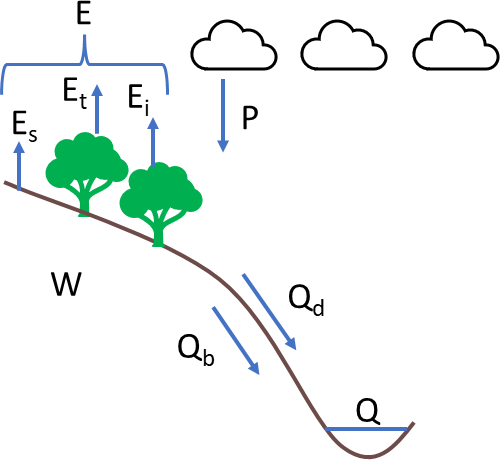

Evapotranspiration (E) sits at the centre of the water–energy–carbon relationship. Yet a fundamental question remains unresolved: what fraction of ET is due to plant transpiration? Published estimates of the transpiration fraction (Et/E) range wildly from 0.24 to 0.90, reflecting major methodological and scaling uncertainties.
This matters because transpiration is actively regulated by plants and tightly coupled to photosynthesis, vegetation dynamics, and ecosystem responses to climate change. In contrast, soil evaporation and interception are governed largely by physical processes. Distinguishing between these components is therefore essential for understanding land–atmosphere feedbacks and for improving hydrological, land-surface, and climate models.
In our recent paper published in Hydrology and Earth System Sciences, we present a new, observation-based approach to estimating long-term mean evapotranspiration partitioning at the watershed scale, using widely available hydrological data and a simple but powerful theoretical framework. This work was led by Amin Hassan with Xu Liang, both from the University of Pittsburgh and Colin Prentice of Imperial College London.
A hydrological approach to ET partitioning
Most existing evapotranspiration-partitioning methods rely on flux towers, isotopes, sap flow measurements, or remote sensing. While valuable, these approaches are often limited in spatial coverage and can yield inconsistent results.
Our method instead builds on the Generalized Proportionality Hypothesis (GPH), a framework long used in hydrology to describe how water fluxes scale and partition. Using long-term observations of precipitation and streamflow, we estimate watershed-scale evaporation from the water balance and infer how evapotranspiration is divided between transpiration and non-transpirational losses.
The key advantages of this approach are that it:
- relies on long-term hydrological observations,
- naturally integrates heterogeneous vegetation and land cover, and
- is readily applicable across many catchments.
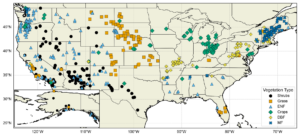
We applied the method to 648 watersheds across the United States, classified into six major vegetation types, spanning grasslands and shrublands to croplands and forests.
Reducing uncertainty from potential evapotranspiration
A major challenge in ET studies is uncertainty in potential evapotranspiration (Ep). Different Ep products often differ substantially in magnitude due to variations in forcing data and parameter choices.
We show, however, that while absolute Ep values vary widely, the E/Ep ratios within most products are relatively consistent. We exploit this by rescaling Ep using watershed water-balance evaporation, while preserving each product’s internal E/Ep physics. This substantially reduces the influence of Ep uncertainty and allows a robust assessment of evapotranspiration partitioning across multiple datasets.
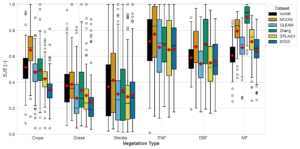
The result is consistency in Et/E estimates across six widely used Ep products.
Clear and interpretable patterns across vegetation types
Across all datasets, we find coherent and physically interpretable patterns in ET partitioning:
- Grasslands and shrublands exhibit the lowest Et/E ratios (~0.25–0.4), reflecting sparse vegetation, shallow rooting for grasslands, high bare-soil evaporation, and water stress for shrubs with reduced root water uptake.
- Croplands show intermediate Et/E values, consistent with dense canopy cover and enhanced water availability, often supported by irrigation.
- Forests have the highest Et/E ratios, particularly mixed forests, due to deep rooting systems, canopy shading, and reduced soil evaporation.
Because our estimates are made at the watershed scale, they implicitly account for vegetation sparseness, secondary land cover, and bare areas — features that are often missed by plot-scale methods.
What controls ET partitioning?
We further explored how Et/E responds to hydrological and environmental drivers. Et/E increases with water availability, as reflected by both runoff ratio (Q/P) and baseflow ratio (Qb/Q), indicating the importance of soil moisture storage. Et/E also increases non-linearly with leaf area index (LAI), though with substantial scatter, highlighting the combined influence of vegetation structure and climate.
Among environmental variables, aridity index and soil moisture emerge as dominant controls. Increasing aridity leads to lower Et/E as plants adopt water-conserving strategies, while higher soil moisture enhances transpiration.
A watershed-scale transpiration bell curve
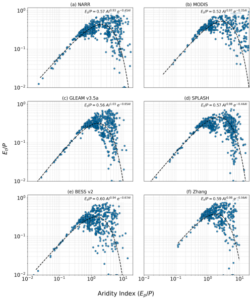
Using our Et/E estimates, we calculated transpiration-to-precipitation ratios (Et/P) and examined their relationship with aridity. We recover a clear bell-shaped Et/P–aridity relationship, with maximum Et/P (~0.5–0.6) at intermediate aridity — consistent with earlier findings at field and remote-sensing scales.
This demonstrates that a key ecohydrological relationship also holds at the watershed scal
Why this matters
When applied to the same flux-tower data, existing ET-partitioning methods produce widely divergent Et/E estimates. In contrast, our hydrology-based approach yields robust, physically interpretable patterns that are consistent across datasets and vegetation types.
By grounding evapotranspiration partitioning in long-term water balance behaviour, this work provides a new perspective on a long-standing problem and a practical tool for constraining hydrological, land-surface, and climate models.
You can read the full paper here:
Hassan, A., Prentice, I.C. & Liang, X. (2026). Insights into evapotranspiration partitioning based on hydrological observations using the generalized proportionality hypothesis. Hydrology and Earth System Science, 30, 317-341, https://doi.org/10.5194/hess-30-317-2026