

As climate change continues to reshape agriculture, one of the biggest challenges we face is how to sustain crop production under increasingly unpredictable conditions. Wheat, which provides around a fifth of the world’s calories and protein, sits at the centre of this challenge. Rising temperatures, shifting rainfall patterns, and more frequent extremes are already affecting yields, and these pressures are only expected to intensify.
A new study (link here) led by Shengchao Qiao at Hainan University, in collaboration with LEMONTREE PI’s Professor’s Han Wang, Colin Prentice and Sandy Harrison, takes a fresh approach to this problem. Instead of focusing on technological fixes like new crop varieties or increased inputs, the study asks a deceptively simple question: “what if farmers adapt by changing when they sow wheat?”
Rather than prescribing how crops should behave, the study uses eco-evolutionary optimality (EEO) theory that biological systems tend to adjust their behaviour to maximise performance under given environmental conditions. In this case, that means identifying the sowing date that would maximise wheat yield under a changing climate.
From Fixed Calendars to Adaptive Decisions
Most global crop models still rely on fixed sowing dates or simple rules tied to historical climate conditions. But farmers are not static decision-makers. They respond to weather, experience, and changing conditions. The timing of sowing is not fixed, it is adaptive.
The EEO-based modelling approach used in this study captures that adaptability. By simulating wheat growth across all possible planting dates within a feasible season, the model identifies the timing that would produce the highest yield each year and in each location. In other words, sowing dates are not imposed, they emerge from the interaction between crop physiology and the environment.
This shift in perspective is important as it allows the model to reflect how management decisions evolve alongside climate, rather than assuming they remain frozen in time.
A World of Shifting Seasons
When this optimality framework is applied globally, a clear pattern emerges. As the climate warms, the “best” time to plant wheat shifts in different directions depending on location.
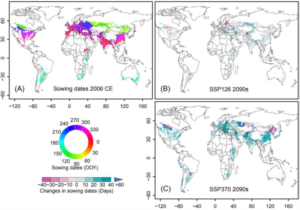
These shifts are not uniform across the globe (Figure 1). In cooler regions, where low temperatures have historically constrained planting, warming opens up new opportunities. The model shows that sowing dates move earlier in the year, in some cases by several weeks. In parts of northern China and high-latitude regions of North America and Eurasia, these shifts are substantial, reflecting the reduced risk of frost and a longer potential growing season.
In contrast, in warmer regions where heat is already a limiting factor, the optimal sowing date moves later. Delaying planting helps crops avoid the most intense heat during critical stages of development. Under stronger warming scenarios, these delays can extend to over a month.
In some areas, warming even enables a more fundamental shift from spring wheat systems to winter wheat. Highlighting how climate change can reshape agricultural practices at a structural level.
What Happens Without Adaptation?
If sowing dates remain fixed while the climate changes, the outlook is global wheat yields decline. The model projects reductions in potential yield under both moderate and high warming scenarios, driven by faster crop development, shorter growing periods, and increased physiological stress at higher temperatures.
Warmer conditions accelerate plant development, leaving less time for biomass accumulation and grain filling. At the same time, photosynthesis becomes less efficient beyond optimal temperatures, and water stress becomes more likely.
Adaptation Through Optimal Timing
What happens when the model allows sowing dates to adjust optimally?
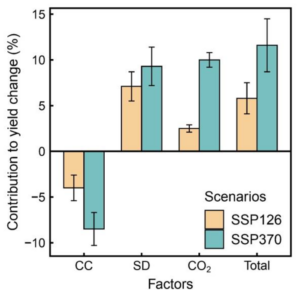
By simply shifting planting dates, a substantial portion of the climate-driven yield loss can be recovered. Crops are better aligned with favourable environmental windows, avoiding periods of extreme heat or unfavourable conditions.
This is where the EEO framework really shows its potential. The improvement is not the result of adding new processes or tuning parameters it emerges naturally from the principle that plants (and, by extension, farming decisions) respond in ways that maximise performance.
When rising atmospheric CO₂ is also taken into account, the picture improves further. Elevated CO₂ enhances photosynthesis and water-use efficiency, amplifying the benefits of adaptive sowing. Together, these effects can offset much of the negative impact of climate change on global wheat yields, and in some cases even lead to gains relative to a no-adaptation scenario.
Uneven Geography of Risk and Opportunity
Despite these encouraging results, the benefits are not evenly distributed. The model highlights a strong geographical divide.
In temperate regions such as Europe, China, and the United States, cooler baseline temperatures mean that warming, combined with adaptive sowing and CO₂ fertilisation, can create conditions that are more favourable for wheat production. Here, the optimality-driven adjustments in sowing date help extend the effective growing season and improve yields.
In contrast, in tropical and subtropical regions, where temperatures are already close to or above the optimum for wheat growth, further warming pushes crops into increasingly stressful conditions. Even with optimal sowing dates, these regions experience significant declines in potential yield. In places like sub-Saharan Africa and parts of Latin America, the combination of heat stress, altered rainfall, and limited adaptive capacity leads to some of the largest projected losses.
This contrast underscores an important point: while optimality-based adaptation can reduce risk, it cannot fully compensate for unfavourable climatic conditions everywhere.
Why Optimality Matters
By applying eco-evolutionary optimality principles, the model avoids relying on fixed assumptions about crop behaviour or management. Instead, it allows both physiological processes and human decisions, i.e. when farmers should sow, to adjust dynamically in response to environmental change.
This offers a more realistic representation of how agricultural systems function in the real world. It also provides a powerful tool for exploring adaptation strategies, particularly those that are simple, low-cost, and widely accessible.
Changing sowing dates does not require new technology, major investment, or infrastructure. It is a decision that farmers can make using existing knowledge and resources, making it particularly vital and practical for less developed regions. The fact that such a simple adjustment can have a measurable global impact highlights the importance of management decisions in shaping future food security.
You can read the full paper here:
Qiao, S., Harrison, S.P., Prentice, I.C., Huang, X., Wang, H. & Yu, C. 2026. Adaptive sowing helps mitigate future wheat losses globally. Earth’s Future. https://doi.org/10.1029/2025EF006554