
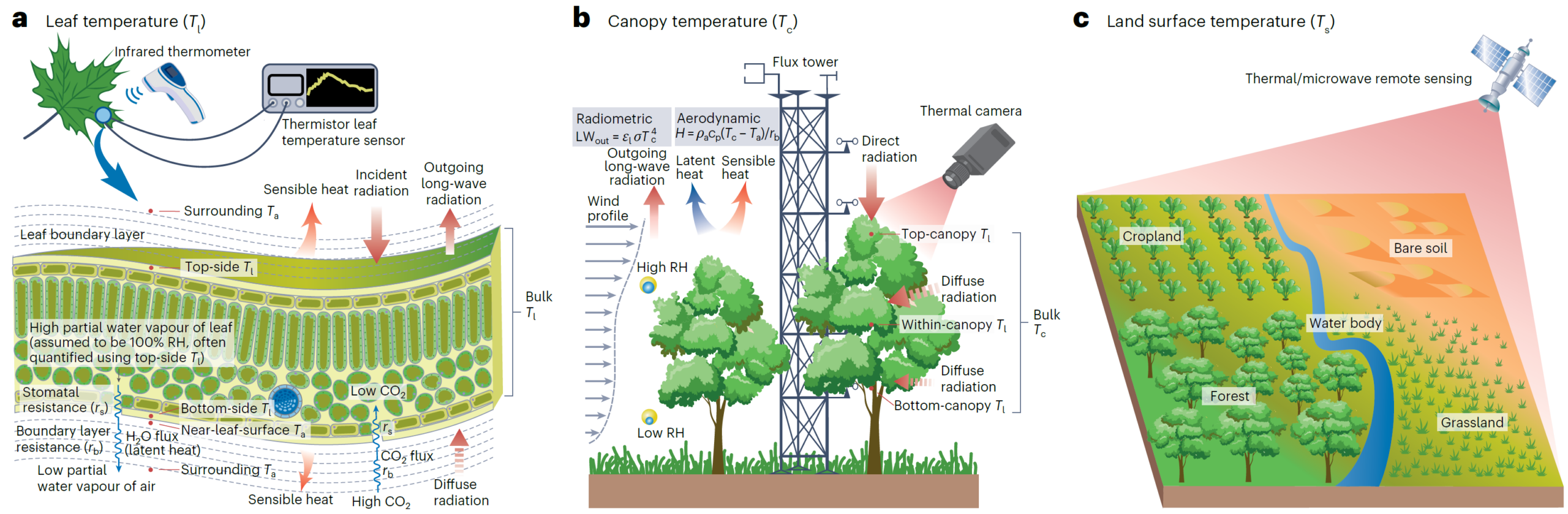

As the climate warms, understanding how plants respond to warming and particularly extreme temperature is important for predicting the future of ecosystems and the global carbon cycle. Most land surface models oversimplify leaf temperature or even use air temperature to simulate how plants function under warming conditions. But there’s a problem: plants do not respond directly to air temperature. They respond to the temperature of their leaves.
A new review published in Nature Plants by former LEMONTREE post-doc Xu Lian (now an Associate Professor at Peking University) and colleagues (many from PI Prof Pierre Gentine’s lab at Columbia University) argues that leaf temperature (Tl), not air temperature (Ta), should be central to how we understand plant physiology, thermoregulation, and future carbon-climate feedbacks.
Their review, Leaf temperature and its departure from ambient air temperature, synthesizes global observations across climates, ecosystems, and measurement scales to reveal how plants regulate heat, and why current models may be missing one of the most important pieces of the puzzle: leaf temperature
Leaves Are Often Much Hotter Than the Air Around Them
Leaf temperature is the temperature at the leaf surface, where plants exchange both carbon and water with the atmosphere. This is where photosynthesis happens, where transpiration cools the plant, and where heat stress can damage tissues.
Although leaf temperature is closely linked to air temperature, the two can differ substantially .
In some dry, sunny environments, leaf temperatures can exceed air temperature especially in exposed canopy-top leaves. In tropical forests, leaves can reach dangerous temperatures of nearly 50°C, approaching thresholds where irreversible damage occurs.
This difference between leaf and air temperature, known as ΔT (delta T), depends on how much heat a leaf absorbs and how effectively it can cool itself.
Plants cool leaves through:
- Transpiration (evaporative cooling through stomata)
- Convective heat loss to surrounding air
- Longwave radiation emission
Plants warm leaves through:
- Solar radiation
- Longwave radiation from the atmosphere
- Reduced cooling under dry, still conditions
This balance determines whether a leaf stays safe or if it overheats.
Do Plants “Thermoregulate”?
It’s long been debated if plants actively regulate the temperature of their leaves. This thermoregulation capacity is often assessed by measuring how leaf temperature changes relative to air temperature. We know that there are three main patterns discussed in literature:
- Limited homeothermy: leaves warm more slowly than air
- Poikilothermy: leaves track air temperature closely
- Megathermy: leaves warm faster than air
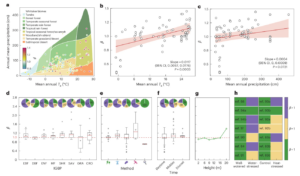
Using a global synthesis of 180 observations across different biomes, Xu Lian et al., found that all three patterns occur—but where and when they occur depends strongly on the background climate.
Warm ecosystems tend toward megathermy
In warm tropical forests and dry environments, especially in sun-exposed canopy-top leaves, plants often show megathermy—leaf temperatures rise faster than air temperature because excess solar radiation cannot be dissipated efficiently.
Cold ecosystems show more homeothermy
In colder ecosystems or shaded sub-canopy leaves, plants more often show limited homeothermy, where leaves remain buffered against rapid air temperature changes.
Leaf temperature responses differ across climate zones, canopy position, measurement method, time of day and water availability. This means that the long-standing debate over whether plants thermoregulate may actually depend on where and how we measure temperature. In short: there is no single global thermoregulation strategy.
Stomata Are Doing More Than Saving Water
If you’ve been following our blog for a while, you will know a lot of our research focuses on stomatal regulation of carbon uptake (for photosynthesis) and water loss (through transpiration). But one of the most important insights from the review is that stomata may be actively regulating temperature as well.
Most current stomatal theories assume plants optimize a trade-off between carbon gain vs. water loss. But under heat stress, particularly when water is not a major concern, that may not be enough to explain the stomatal behaviour.
The review shows that when temperatures become dangerously high, some plants, especially warm-adapted species, keep stomata open even when photosynthesis has largely stopped.
Why?
Because transpiration helps cool the leaf. Plants may choose to lose water to avoid overheating.
This creates a third optimization target:
Carbon gain + Water conservation + Thermal safety
This “triple-target optimization” challenges the foundations of many current stomatal models.
For example, during extreme heatwaves, well-watered trees have been observed maintaining high stomatal conductance simply to keep leaves cooler, even at the cost of increased hydraulic risk. Traditional stomatal models based only on carbon-water trade-offs cannot explain this behaviour.
Why This Matters for Climate Models
This has major implications for how we model photosynthesis and predict future carbon uptake.
Most land surface models still simplify leaf temperature by using air temperature as a proxy, assuming stomata respond only to carbon and water economics and neglecting vertical temperature differences within canopies.
These simplifications can create large errors in predicted photosynthesis, transpiration, and carbon sequestration.
For example: Elevated CO₂ often reduces stomatal opening, which improves water-use efficiency. But smaller stomatal opening also means: Less evaporative cooling → hotter leaves → greater heat stress
This is especially concerning for tropical forests, where many species already operate close to their thermal limits. Without explicitly representing leaf temperature, models may underestimate heat stress and overestimate future carbon uptake.
From Leaf to Canopy: Measuring Temperature Better
This review also highlights the need for better observations. Different methods capture different thermal signals:
- thermocouples measure individual leaf temperature directly
- thermal cameras observe canopy-top leaves
- satellites measure land surface temperature, often mixing vegetation and soil signals
This might explain why studies sometimes report conflicting thermoregulation patterns. What we need, maybe slightly ambitiously, is a globally coordinated observation system using a combination of the three along with co-located measurements of stomata, sap flow and plant traits. This is one reason why we have a big emphasis on experimental measurements as a core part of the LEMONTREE project.
Can Plants Keep Up With Warming?
Studies show that as temperatures rise, plants can shift their thermal tolerance thresholds upward. But this acclimation is often insufficient and there is a limit. Typically, critical temperature limits increase by less than 0.4°C for every 1°C of warming.
This means that as warming accelerates, plants may run out of thermal safety margin and tropical species may be especially vulnerable, as many already live near their upper thermal limits and show limited capacity for further acclimation.
Once critical thresholds are crossed, it can trigger severe physiological damage to the leaves and reduced carbon uptake.
Final Thoughts
This review paper makes a powerful case that leaf temperature, not air temperature, should be central to plant ecology and climate prediction.
It shows that plants are not simply passive to warming. They actively regulate temperature through coordinated changes in physiology, especially stomatal behaviour.
However, under future climate extremes, that regulation may fail.
To predict ecosystem responses accurately, models must move beyond simple carbon-water trade-offs and include the full reality of plant thermoregulation:
Carbon, Water, and Heat.
For more details, see the full paper in Nature Plants.
Lian, X., Jiji, J., Fang, J., Han, J., Ryu, Y., Harrison, S.P., Jeong, S., Zhang, H., Novick, K., Benson, M.C., Dong, N., Green, J.K., Sandoval, D., Jiu, J., Keenan, T.F. & Gentine, P. (2026). Leaf temperature and its departure from ambient air temperature. Nature Plants. https://doi.org/10.1038/s41477-026-02304-w