

In our latest LEMONTREE science-themed meeting, we explored carbon allocation across scales—from belowground processes controlling fine root investment and nutrient acquisition, through whole-plant allocation strategies and forest demographic processes, to experimental manipulations designed to test and constrain theory. Together, these talks highlighted how LEMONTREE is combining theory, observations, and experiments to move towards a more comprehensive and mechanistic understanding of vegetation carbon allocation.
Towards a Cost–Benefit Framework for Predicting Fine Root Biomass: Yuzhi Zhu (Tsinghua University)
Yushi Zhu presented work towards developing a mechanistic framework for predicting fine root biomass through a cost–benefit optimisation approach. The work is motivated by observations that different components of belowground carbon dynamics appear to operate on distinct timescales. Fine root mass-specific respiration responds rapidly to changing environmental conditions, acclimating over timescales of weeks and tracking aboveground metabolic activity, whereas fine root biomass itself appears to be regulated over longer periods and remains relatively stable at sub-seasonal to seasonal scales.
Building on these observations, the proposed framework separates fine root respiration (Rr) into two components: Fine root biomass which represents allocation (Mr) (regulated at a timescale of years to decades) and mass-specific respiration rate (rr) (around a bi-weekly acclimation timescale). The central hypothesis is that fine root biomass is optimised under local environmental constraints through balancing nutrient uptake capacity against maintenance carbon costs.
The framework conceptualises fine root biomass as emerging from a trade-off between two opposing pressures. Insufficient root biomass leads to high nutrient uptake costs and inability to meet canopy demands, while excessive root biomass increases carbon expenditure through maintenance respiration. The optimal biomass therefore represents a minimum-cost solution that satisfies canopy nutrient requirements.
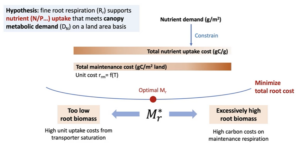
To implement this framework, canopy nutrient demand is estimated from optimality-based approaches and coupled to belowground uptake requirements. Root costs are represented through maintenance respiration (a constant under a given environment and Tg dependent) and nutrient uptake costs (related to fine root biomass and soil nutrient availability), with multiple formulations currently being explored.
Ongoing work focuses on testing alternative cost functions, compiling global datasets on root traits and biomass, and addressing key uncertainties surrounding nutrient uptake costs and fine root lifespan. Ultimately, this framework aims to provide a more mechanistic representation of belowground carbon allocation within ecosystem models.
You can read Yuzhi’s recent paper on this topic that was published in Ecology Letters here.
Drivers of Vegetation Belowground Allocation: Wenjia (Shirley) Cai, (Imperial College London)
Wenjia (Shirley) Cai explored how plants allocate carbon belowground through multiple nutrient acquisition strategies and how these strategies can be represented mechanistically within carbon allocation models. The talk focused on understanding belowground allocation as a balance between alternative approaches to nutrient acquisition and the environmental constraints that shape them.

Plants can acquire nutrients through several pathways, including morphological strategies such as increasing root length for soil exploration, biochemical strategies such as root exudation that mobilise nutrients from organic matter, and symbiotic strategies involving mycorrhizal associations. These strategies involve trade-offs between “do-it-yourself” approaches, where plants invest directly in roots and exudates, and collaborative approaches where nutrient acquisition is outsourced to fungal partners. With core EEO assumption being that plants minimise nutrient uptake cost per carbon gain.
The talk highlighted how these strategies can be represented within a two-dimensional root economics framework. Along one axis, plants occupy a fast–slow resource economics spectrum analogous to leaf economics, while a second axis captures the continuum between self-reliance and collaboration. The relative importance of different strategies depends strongly on soil nutrient availability, nutrient forms, root traits, and soil physical properties, while associations with arbuscular mycorrhizal (AM) and ectomycorrhizal (EcM) fungi influence the extent to which plants rely on root foraging, exudation, or symbiotic nutrient acquisition.
A central component of the framework is Z cost, which represents the carbon costs per leaf area associated with nutrient acquisition and water supply. Rather than directly prescribing fine root biomass, the approach introduces ζ – the ratio of fine root biomass to leaf area – to unify the belowground investment to aboveground leaf level, in consistent with the centre parameter of P model β—the ratio between a (stem respiration to transpiration capacity) and b (mitochondrial respiration to carboxylation capacity)—which links environmental controls on nutrient and water availability to belowground allocation to support photosynthesis. Through β and ζ, Z cost becomes integrated within canopy optimisation and net carbon profit, allowing belowground investment strategies to influence whole-plant carbon economics.
By coupling these processes with environmental drivers including temperature, vapour pressure deficit, soil properties, nutrient availability, and water constraints, the framework aims to integrate both bottom-up environmental controls and top-down optimisation within models of vegetation carbon allocation.
Towards General Principles Linking Tree Dimensions, Primary Production and Forest Demography: Ruijie Ding (Imperial College London)
Ruijie Ding presented work aimed at developing a unified framework linking carbon allocation, tree growth, forest structure, and demographic processes through a set of general principles connecting primary production with tree dimensions.
The motivation for the work comes from observations that carbon allocation patterns vary substantially across plant compartments. While allocation to canopy production appears relatively constrained, allocation to wood and fine roots shows much larger variation. Existing evidence suggests that trade-offs primarily occur between belowground investment and wood production rather than being fully explained by simple root-to-shoot relationships. This raises the question of how plants allocate carbon in ways that maximise competitive success.
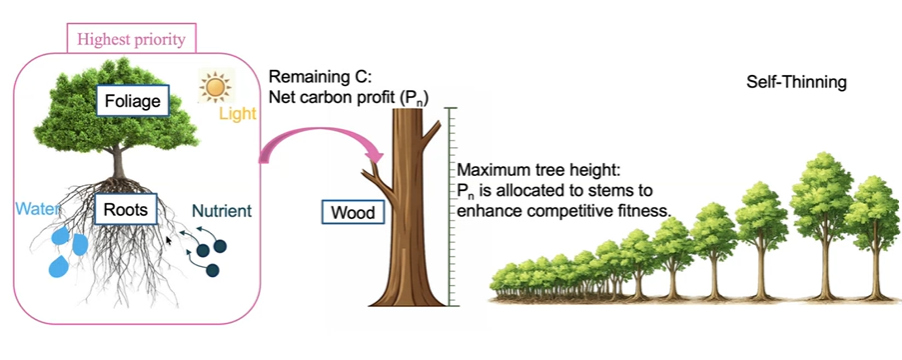
The framework assumes a hierarchical allocation strategy in which carbon is first invested in leaves to maximise light capture, followed by belowground investment to acquire water and nutrients required to sustain canopy function. Remaining carbon is treated as “net carbon profit” and allocated to wood production, enabling trees to grow taller and compete more effectively for light.
Starting from predictions of gross primary production from the P model, the framework combines carbon profit calculations with allometric relationships linking tree dimensions—including height, diameter, crown area, and biomass—to predict diameter growth, stand biomass, turnover rates, and maximum tree height. The approach incorporates geometric constraints on tree form, allowing maximum height to emerge from the interaction between growth potential and carbon availability.
Model predictions suggest that net carbon profit strongly controls tree growth and structure, with high productivity predicted not only in tropical regions but also in temperate evergreen and mixed forests. The framework also reproduces classic self-thinning relationships, predicting a biomass–density scaling exponent close to observations (−1.6 versus observed values near −1.62). Overall, the work demonstrates how carbon allocation principles may provide a mechanistic bridge between individual tree physiology and large-scale forest demographic patterns.
Allocation Results from Manipulative Experiments: Nick Smith (Texas Tech University)
Nick Smith presented results from a series of manipulative experiments designed to understand how plants alter allocation patterns in response to changing environmental conditions. The talk focused on how experimental evidence can inform broader theories of carbon allocation by examining responses across multiple resource gradients and environmental drivers.
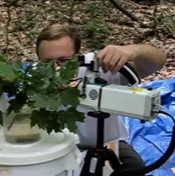
The experiments investigate allocation at both within-leaf (e.g., carbon, nitrogen, and phosphorus allocation) and whole-plant scales, although the presentation focused primarily on whole-plant allocation metrics, particularly root-to-shoot ratios and total leaf area. These measurements were conducted across a range of manipulations including light availability, atmospheric CO₂ concentration, vapour pressure deficit (VPD), soil water availability, nutrient supply, and symbiotic interactions. Different combinations of these manipulations have been carried out.
Across experiments, relatively consistent allocation responses emerged. Increasing light availability generally increased root-to-shoot ratios, suggesting that greater aboveground productivity generates increased demand for belowground resources, leading plants to allocate more carbon to roots. Total leaf area also increased under higher light conditions.
Responses to elevated CO₂ differed somewhat, with root-to-shoot ratios showing relatively weak responses (with a slight decrease in plants inoculated with N-fixing bacteria), while total leaf area increased substantially, particularly when nitrogen availability was high. Experiments manipulating atmospheric water demand showed that higher VPD increased root investment in some species, although species with more conservative strategies exhibited weaker responses.
Nutrient manipulations produced patterns consistent with resource optimisation theory. Increasing nitrogen and phosphorus availability generally reduced root-to-shoot ratios while increasing total leaf area, reflecting reduced belowground investment when nutrient acquisition becomes less limiting. Soil water manipulations produced weaker responses than expected, although this may partly reflect experimental limitations.
Overall, the experiments suggest relatively robust allocation principles: root investment tends to increase when belowground resources become more limiting or resource demand increases, whereas leaf area expansion is favoured when resources supporting productivity become more available. These experimental results form a fundamental component of the LEMONTREE project by providing the empirical evidence needed to test, constrain, and refine theoretical frameworks of carbon allocation across scales.
We look forward to sharing with you more research updates from the team after our next science meeting.