

LEMONTREE is an international collaboration, with researchers based in the USA, the UK, Switzerland, Netherlands, Australia, China, and South Korea. Every month we meet online to share science updates—but while Zoom calls keep us connected, nothing beats being in the same room. That’s why our annual in-person meeting is such a highlight.
Last year we gathered at Utrecht University in the Netherlands. This year, we met at Seoul National University (SNU) in South Korea, where LEMONTREE PI Prof. Youngryel Ryu hosted us with an incredible mix of organisation, hospitality, and generosity- from the packed scientific programme to the accommodation and, of course, the all-important social side.
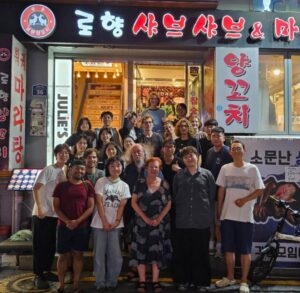
LEMONTREE Team at Seoul National University for the annual in person team meeting.
Day 1: Open Symposium
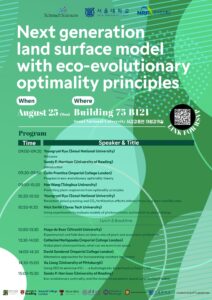 Our first day was something new for LEMONTREE: an open symposium at SNU. More than 100 researchers from across and beyond the university, including researchers from other cities, joined us to hear a series of talks from the team, focused on our research applying Eco-Evolutionary Optimality (EEO) principles to global ecosystem questions.
The symposium talks were led by the PIs on the LEMONTREE project as well as senior researchers. This was a great opportunity for all staff and students on the project to see our lead scientists in action. We heard about the work the LEMONTREE project has done so far, remote sensing products and their pros and cons, as well as the importance of field experiments and the variety of information they can provide. Further, we heard from experts about the development in soil moisture modelling from both the theory side and implementations in models such as VIC+.
The talks sparked great questions, thoughtful discussion, and follow-ups that carried on long after the session ended. Sharing our work beyond the team in this way gave us fresh perspectives—and it’s something we hope to continue at future meetings.
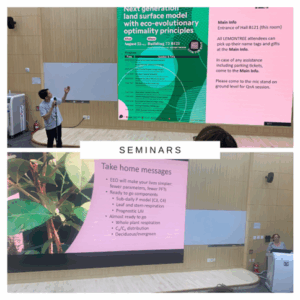
Days 2–3: Strategy and next steps
The next two days were devoted to the LEMONTREE team itself: progress reports from each working group, but more importantly, time to plan and strategize for the final 22 months of the project.
We heard from Evan Perkowski about new insights into how phosphorus addition affects plant photosynthesis, from Daniil Schiefes about upcoming fieldwork plans, and from Wenjia Cai about a roadmap for developing a comprehensive carbon allocation framework.
Big projects like ours are ambitious by design. They evolve as new discoveries emerge and as tasks shift in response to progress. The discussions in Seoul helped us re-focus on the priorities we need to hit to reach our ultimate goal: integrating EEO theory into land surface models.
We also identified some “wish-list” tasks that we’d love to tackle if time allows. By the end, the team felt re-energised, with a clear timeline taking shape to deliver everything we’ve committed to—and maybe more.
“Continual re-focusing is essential. The more enlightened funding bodies, like Schmidt Sciences, don’t expect scientists to map out all the steps in a project years in advance—serious science doesn’t work like that. We are doing new science, not building a power station…. In LEMONTREE we have repeatedly found that tasks that once seemed important are not, while new priorities have emerged.”
Colin Prentice, Imperial College London
Days 4–5: ECR Summer School
The final two days of the week were all about our Early Career Researchers (ECRs). Last year, our first Summer School in Utrecht focused on the P-model and running gas exchange experiments.
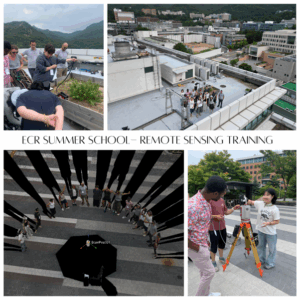
This year, the spotlight was on remote sensing. The programme combined lectures with hands-on training in LiDAR and hyperspectral techniques, giving the ECRs valuable experience and confidence with cutting-edge tools.
Of course, it wasn’t all serious. The group had fun experimenting—and even staged a group selfie using remote sensing equipment.
“The summer school is not only a valuable learning experience but also excellent teaching experience for the ECRs on the LEMONTREE project. It was wonderful to take part in lectures and hands-on demonstrations from the LEMONTREE students at SNU. The sessions delivered were engaging (the LiDAR selfie resulted in a lot of laughter), and we left the summer school with a number of resources to improve our use of google earth engine and remote sensing software. Over the two days of the summer school, we built not only stronger scientific knowledge, but teaching skills, and professional networks”
Sophia Cain – University of Reading
Outside the science
Annual meetings are as much about building relationships as they are about sharing research. Thanks to Youngryel, we had some unforgettable experiences outside the nicely air-conditioned lecture hall. Dinners out were a highlight, especially the sashimi (although the live sea cucumber wasn’t universally popular!). We balanced the heat with riverside walks and shaded forest trails. Did we mention that it was hot?!
“It was our great pleasure to host the LEMONTREE members at SNU. I thank my team members for preparing such a fun-filled event, and SNU for its generous support. I hope our LEMONTREE friends will remember Seoul and SNU as a wonderful place—and revisit us soon!”
Youngryel Rhu- Seoul National University
It was a week of science, strategy, learning—and a reminder of the importance of collaboration. We can’t wait to see what we accomplish this year.