
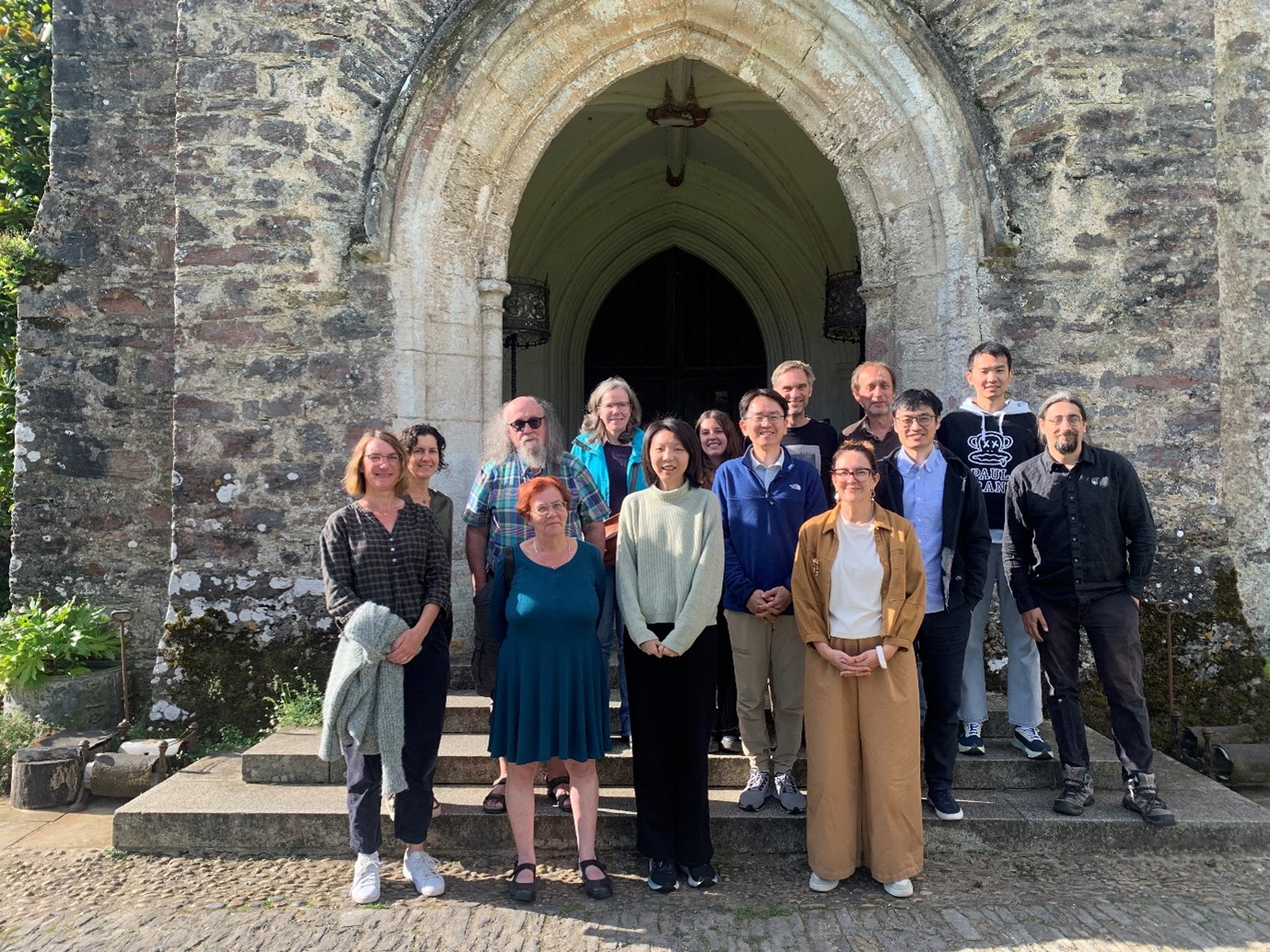

Last October, we hosted our first Energy Partitioning Workshop, bringing together a cross-disciplinary team to explore how better understanding of plant pigments could transform the way we monitor Earth from space. (You can revisit that first meeting here).
Back then, we promised to meet up again in a year—and at the end of September 2025, we did just that. This time, the team gathered for three productive days at Dartington Hall, Totnes, England, under a new banner:
“Ecosystem processing of absorbed solar energy and it’s coupling to carbon fixation: towards a new synthesis.”
The workshop brought together experts in remote sensing, ecosystem modelling, field ecology, and plant physiology to push forward our collective efforts to link satellite observations with the fundamental processes that drive plant growth and the carbon cycle.
The invitation captured the aim:
“A deeper understanding of primary production can be gained by closely examining leaf pigments, their role in photosynthesis, and their presence in data collected by existing and upcoming Earth Observation satellites.”
Building on our 2024 workshop, this second meeting focused on non-photochemical processes, evaluating and comparing hybrid models, and identifying the measurements needed to improve model–satellite cross-evaluation.
Day 1 – Recap and Aims
The workshop opened with Catherine Morfopoulos outlining the goals.
We then heard three perspectives on linking photosynthesis to ecosystem-scale processes:
- Lisa Wingate spoke on “Isotopic processes in plants and ecosystems and phenocams”, highlighting how belowground communities can be linked to remotely sensed inputs.
- Lina Mercado shared insights from her work in the Andes, in “Photosynthesis along tropical elevation gradient”, exploring how elevation and temperature shape photosynthetic dynamics.
- Youngryel Ryu (LEMONTREE PI) presented on “Integrating remote sensing into ecosystem modelling”, showing how observational and modelling approaches can be brought together.
The day ended with breakout groups, mixing disciplines to identify the “big challenges” around solar-induced fluorescence (SIF) and reporting back on shared priorities.
Day 2 – Models, data, and challenges
 Day 2 featured a series of talks focused on linking SIF with flux networks and modelling:
- Remi Luo: “Terrestrial ecosystem function through remote sensing and flux networks”
- Haoran Liu: “SIF-MIP”, comparing existing SIF models.
- Fabienne Maignan: “SIF in ORCHIDEE”, showing how fluorescence is integrated into the land surface model
The group then tackled three central questions: What do we know? What do we need? What experiments could help us move forward? The group came back together to share their thoughts before beginning to sketch a roadmap for next steps.
Day 3 – Synthesis and next steps
The final day was devoted to synthesis. A plenary session debated whether a review paper was needed to summarise the state of knowledge on energy partitioning and photosynthesis. The answer was unanimous: yes.
We then split into two groups:
- Leaf-level processes
- Ecosystem and canopy-scale processes
Each group asked those three questions again: What do we know? What do we need? What experiments could help us move forward?
This structured reflection brought clarity to what’s missing and how we can work together to fill those gaps.
Outcomes
From this workshop, we committed to:
- Drafting a review paper on energy partitioning and photosynthesis
- Advancing the hybrid model intercomparison project
- Finalising our list of missing observables and the experiments needed to better constrain satellite data and test models
A sunny conclusion
 The week before, our LEMONTREE colleagues Colin, Sandy, and Sophia had run another Dartington workshop—during a week of constant rain. Thankfully, the September sun returned for this meeting, allowing us to enjoy both the productive discussions indoors and the beautiful Devon surroundings outside. The collaboration continues and we look forward to sharing the outcomes of this workshop in the near future.