
The LEMONTREE annual meeting took place in Seoul, South Korea, from 25-29 August 2025. It was great to finally meet in person the people I had only seen online. During one group dinner, Hugo de Boer, Daniil Scheifes and Paul Drake told Youngryel Ryu about a planned field campaign in Western Australia and asked if I could join to handle the Analytical Spectral Devices (ASD) measurements. I had never been to Australia and had always wanted to visit for its unique ecosystems that I can’t experience in Korea, so I was thrilled to get the chance.
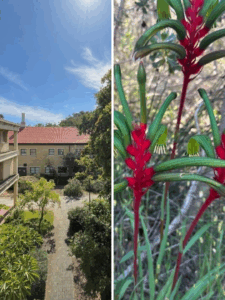
Thanks to this opportunity, I flew to Western Australia on 23 October with the ASD from Youngryel’s lab. I first visited the University of Western Australia (UWA) to share my ongoing research, then met Daniil and Paul to go over our field protocols. It was really nice to see them again. After the meeting, I stopped by Kings Park-the largest botanical park I’ve ever seen-full of incredible native plants I’d never encountered before. After that short break, our intense fieldwork began.
Summary of Fieldwork
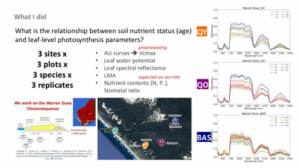
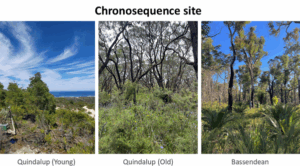
Our main goal was to measure photosynthesis across the Warren River chronosequence to examine how soil nutrient status relates to leaf‐level photosynthetic parameters. Also, if we can predict leaf traits from spectral reflectance, we can overcome the time- and labor-intensive limits of traditional leaf trait analyses and, ultimately, cover a much broader area than leaf-scale fieldwork allows. That’s why we collected ASD data alongside the physiological measurements.
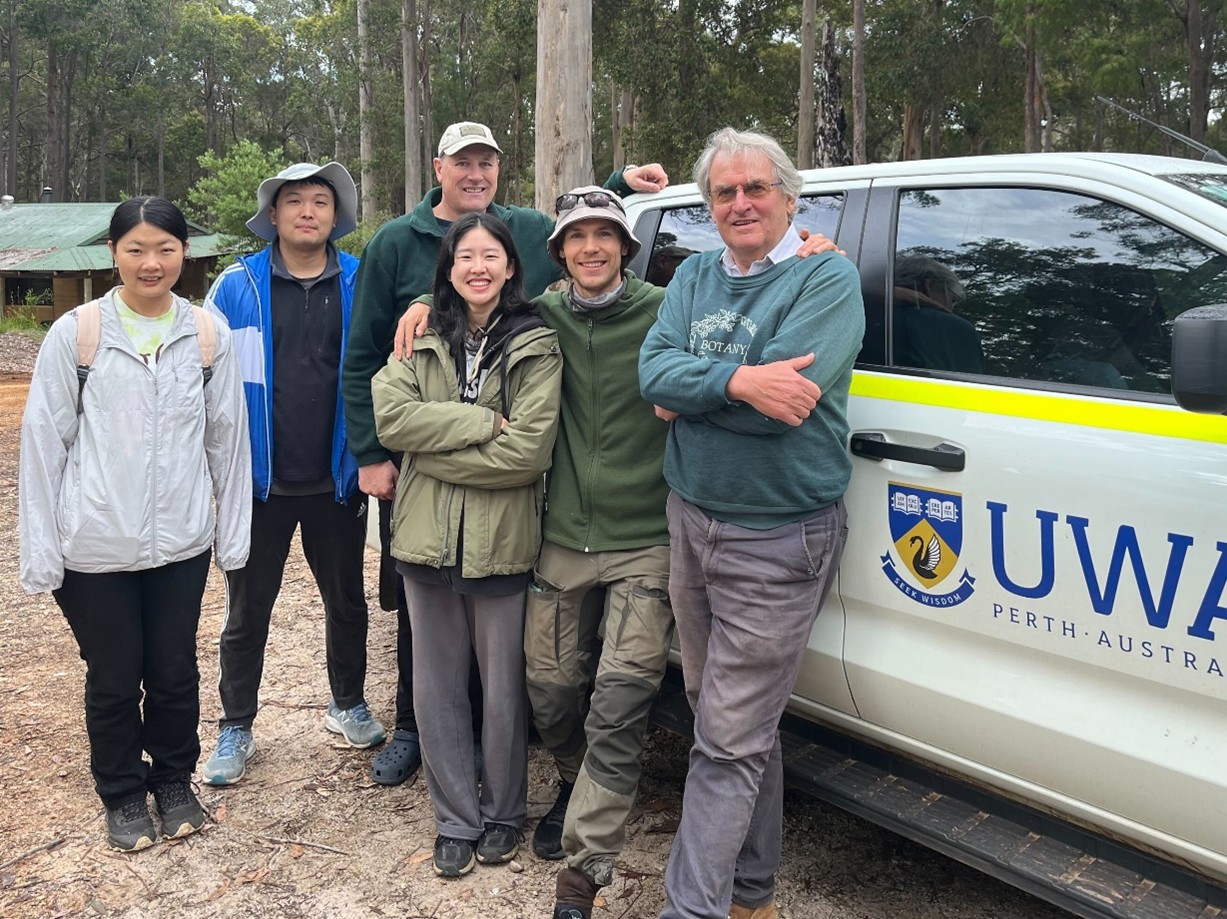
Our target was the Warren River chronosequence near Pemberton, Western Australia. Daniil (from Hugo’s group at Utrecht University) led the campaign. We stayed in a cottage near the site from 26 October to 5 November. Our team included Shutong, a postdoc in Hans Lambers’ ecophysiology lab at UWA; Hans, professor emeritus at UWA; and Marion, a research fellow at UWA. We sampled three sites along the soil age gradient, chose three plots per site, and selected three species, collecting three replicates per species.
Each day we visited a site, measured full A-Ci curves for the target species, then brought excised leaf samples back to the cottage for additional measurements: water potential, leaf reflectance, leaf area scanning, and nail-polish prints for stomatal traits.
What I Learned
The Warren River chronosequence felt surreal as almost every species was new to me and it was striking to see how diverse plant communities thrive on nutrient-depleted, ancient soils. From Hans and Marion, I learned about the unique symbiotic strategies of Western Australian flora. Because these forests are phosphorus-limited, plants with cluster roots (e.g., many Banksia species) release carboxylates to mobilize phosphorus. Mycorrhizal plants, which lack this ability, often grow near cluster-rooted plants to benefit from locally enhanced P availability. In turn, mycorrhizal plants are typically more resistant to native pathogens, while non-mycorrhizal species can be vulnerable, so co-occurrence can offset each other’s weaknesses. As someone who usually focuses on leaves, it was a valuable chance to look belowground to understand plant strategies.

The fieldwork was truly intense, but thanks to the dedication of Daniil, Shutong, and the whole team, we finished all measurements. Even when everyone caught a cold, Daniil and Shutong powered through like superheroes. Marion was an amazing botanist, she shared deep knowledge about our study species and even the local birds. Hans is a wonderful storyteller, and I was inspired by how he communicates long research journeys to the public in an engaging way. Our cottage was far from town, and it was unavailable to use the internet, so we cooked for ourselves. Shutong prepared breakfast every day, Marion prepared dinner most nights, Hans showed amazing barbecue, and Daniil usually did the dishes. One evening I cooked Korean noodles called Jjapguri (known as “Ram-don” from the movie Parasite), and I was so happy everyone enjoyed it. The whole fieldwork was tough, but I was happy to meet wonderful ecophysiology people and fully experience WA nature.


Future Work
Leaf trait analysis is ongoing, led by Daniil at Utrecht University, and we’re discussing curve-fitting approaches to handle a few low-quality samples. The leaf reflectance data also need calibration to remove artifacts. My first step is to train a PLSR model to predict V_cmax from leaf hyperspectral signals. After that, I plan to upscale using Sentinel-2 vegetation indices to extend these leaf-level insights to the landscape scale. This will help us predict leaf traits over much broader areas.