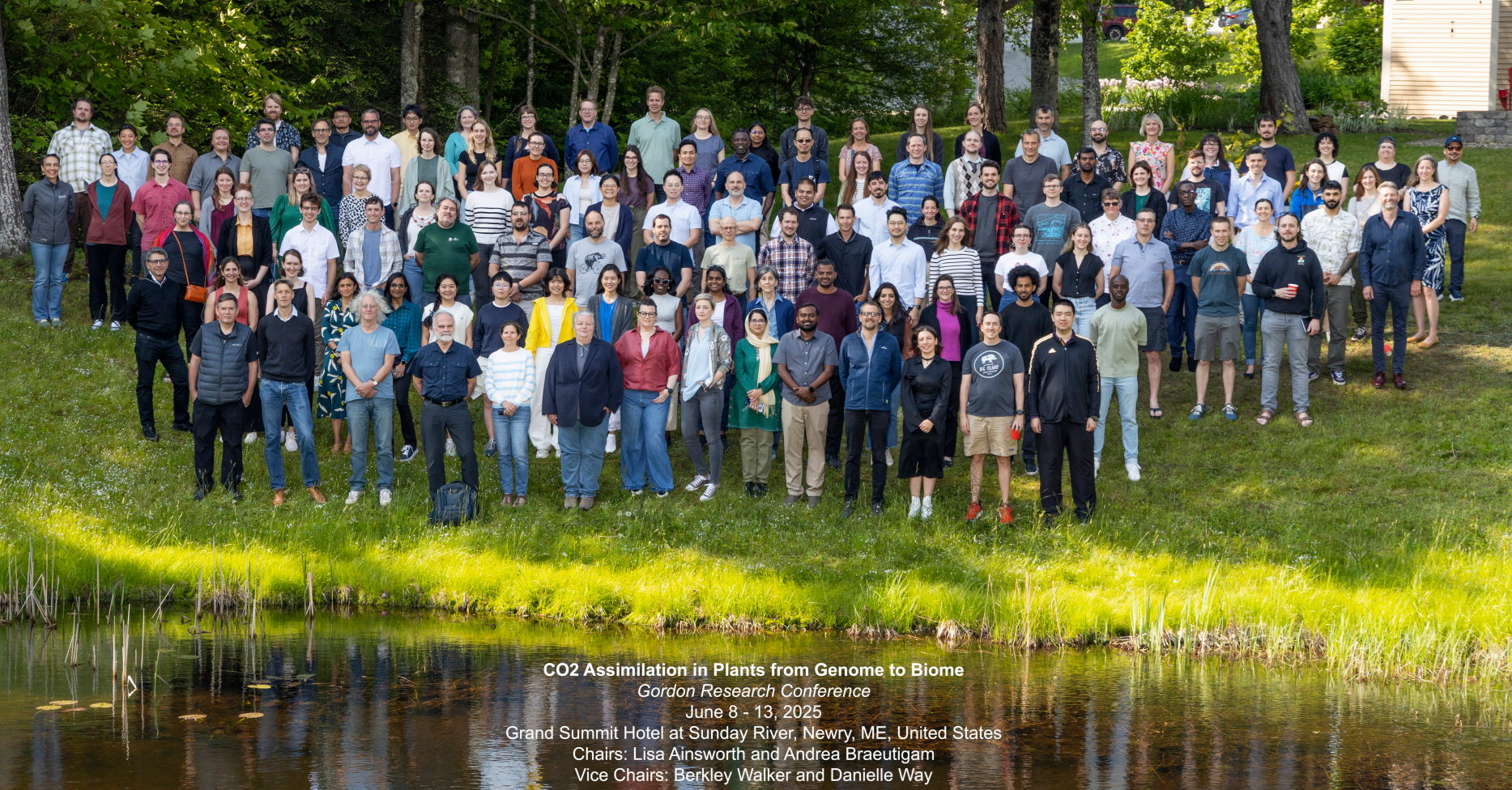

LEMONTREE Principal Investigator Professor Nick Smith was an invited speaker at this year’s Gordon Research Conference (GRC) on CO₂ Assimilation in Plants: From Genome to Biome, held 8–13 June 2025 at the Grand Summit Hotel, Maine. The conference, chaired by Lisa Ainsworth and Andrea Braeutigam, brought together global experts in photosynthesis research, spanning disciplines and biological scales—from molecules to ecosystems.
Nick presented his talk, “Using eco-evolutionary optimality principles to understand and predict photosynthetic acclimation,” on Tuesday morning in the session dedicated to ‘Modelling CO₂ Assimilation’. His presentation explored how eco-evolutionary optimality (EEO) theory is being used to simulate plant photosynthesis across changing environmental conditions—a key research theme for the LEMONTREE project.
Understanding Acclimation Through EEO
Nick highlighted recent advances in modelling photosynthetic capacity acclimation in response to environmental variability, drawing on findings from Smith et al., 2019 and Smith & Keenan, 2020. He emphasised how these acclimatory processes—especially under rising atmospheric CO₂—can reduce projected nutrient limitation in terrestrial ecosystems. This, in turn, leads to greater increases in simulated ecosystem carbon stocks compared to models that assume fixed photosynthetic and allocation traits (Smith et al., 2024).
His talk also showcased how EEO-based approaches are helping to make sense of both experimental data and long-term observations, improving our ability to link plant function with carbon cycle feedbacks under global change.
Collaboration and Conversation
The GRC format is intentionally designed to promote deep engagement and collaboration. With around only 100–200 participants and a single-track agenda, all attendees share talks, poster sessions, meals, and discussions. This structure encourages informal yet highly productive scientific conversations that often continue well beyond the lecture hall.
Reflecting on his experience, Nick commented:
“The GRC on CO₂ assimilation is one of the few places where you get leading scientists—from early-career researchers to established experts—all deeply engaged in every part of the meeting. The informal conversations over meals or during breaks can be just as thought-provoking as the scheduled talks. It’s a unique environment that fosters both collaboration and innovation.”
Photosynthesis Across Scales
The 2025 conference theme, “Probing Mechanisms Across Scales,” focused on integrating photosynthetic research across levels of biological organisation—from cellular biochemistry and synthetic biology to global modelling and remote sensing. Nick’s EEO-based approach to simulating plant carbon uptake offered a great example of how theoretical frameworks can bridge these scales, connecting mechanistic understanding with ecosystem-level predictions.
LEMONTREE’s Continued Contribution
Through contributions like Nick’s, LEMONTREE continues to provide key insights into the role of vegetation in the Earth system. By advancing theory-based modelling of plant function, the project aims to improve future projections of carbon cycling and climate feedbacks—making frameworks like EEO central to this mission.