
By Ben Westwood, Durham County Council
Friday the 13th of June was an auspicious occasion, in more ways than one. The Yorkshire Museum played host to a special event marking the opening of a new display co-curated with the Medieval Ritual Landscape or MeRit Project, an AHRC-funded research collaboration led by the University of Reading and the British Museum, with partner organisations across England, Denmark, and the Netherlands. Focused on the period AD 1000–1600, this fascinating project has been investigating the material traces of ‘medieval lived religion’ and ritual activity. MeRit’s collaboration with the Yorkshire Museum explored medieval religious experience through metal-detected finds, particularly those unearthed by local detectorists and recorded by the Portable Antiquities Scheme (PAS).
And so, after making sure the omens were good (essential when attending an event on religious experience and ritual activity on Friday the 13th), I took the short train ride from Durham down to York. The event was organised in partnership with York St John University and the Yorkshire Museum, and began with a lovely welcome from the Finds Liaison Officer, Rebecca Griffiths and Andy Woods, Head of Collections and Curatorial. Niceties out of the way, we were given an overview of the project by Head of PAS & Treasure, Professor Michael Lewis, who highlighted the collaborative nature of the project and how it was underpinned by data from the PAS. He emphasised how MeRit’s programme of public engagement was aiming to be inclusive and community focused, and so involving a diverse range of people (children, disabled and/or SEND museum users and visitors, and non-traditional audiences) that had perhaps traditionally faced difficulties in being involved and engaged in research projects such as this. Rebecca then returned to focus the discussion on what had been happening in York and particularly regarding the new display in the entrance to the museum. She explained how in consultation with a group of detectorist volunteers, the objects on display had been selected, and how those volunteers had been collaboratively involved in creating the accompanying text and the installation. The measurable impact, it was argued, was in the detectorists’ reflections on the discoveries, coupled with their modern meaning.
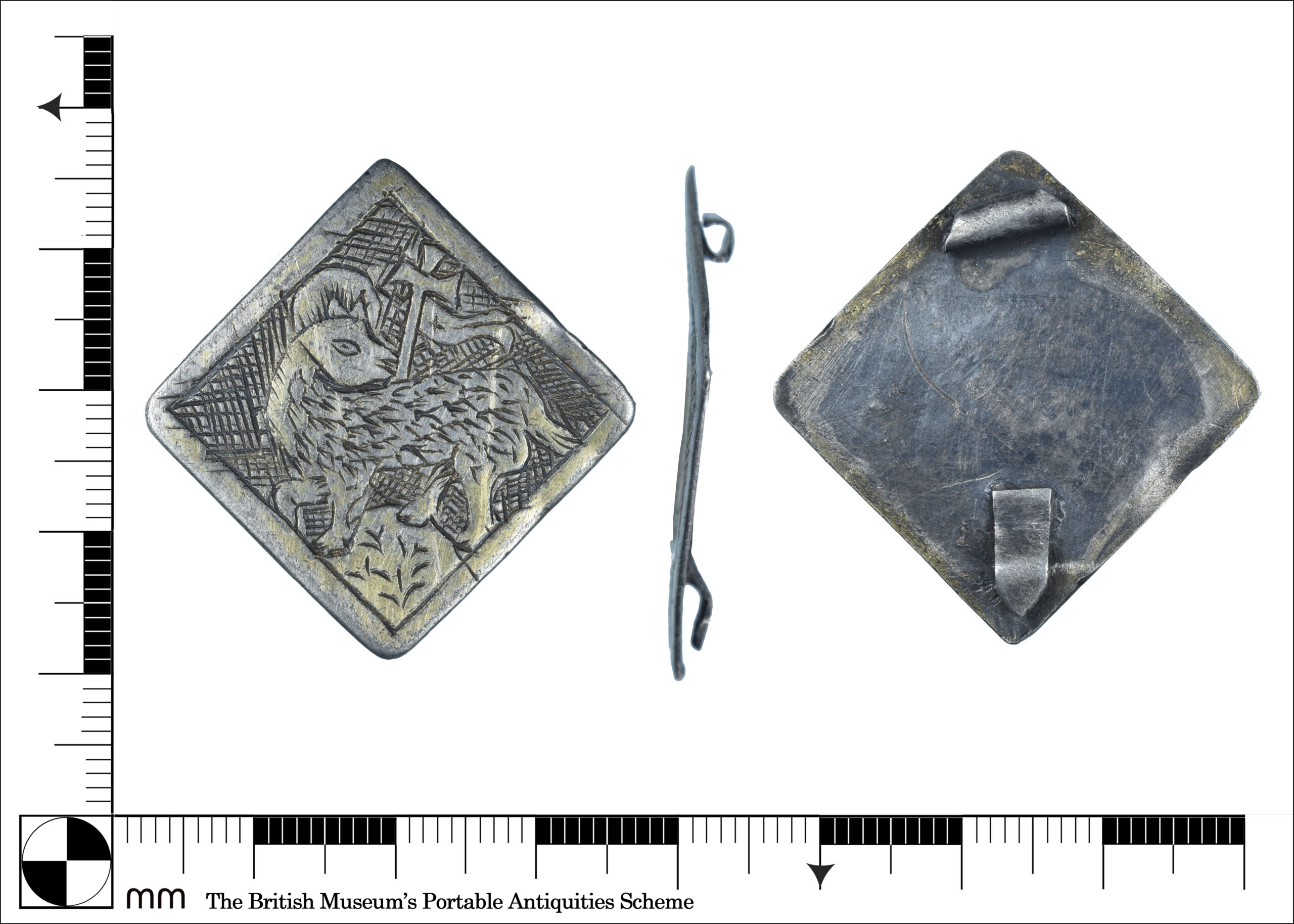
And in fact, this measurable impact had already made itself plain to me as I arrived at the museum earlier that morning. As you enter your eyes are naturally drawn to the bright display case to the left of the door in the entrance hall, and naturally to the object at the centre of the display, a small (but well lit) c.3.5cm silver lozenge shaped plate with the familiar ‘Agnus Dei’ (Lamb of God) motif engraved on the face. Familiar to me at least, as I remembered it arriving as an object of potential Treasure back in late 2020 (see DUR-2DBE88 on the PAS database).
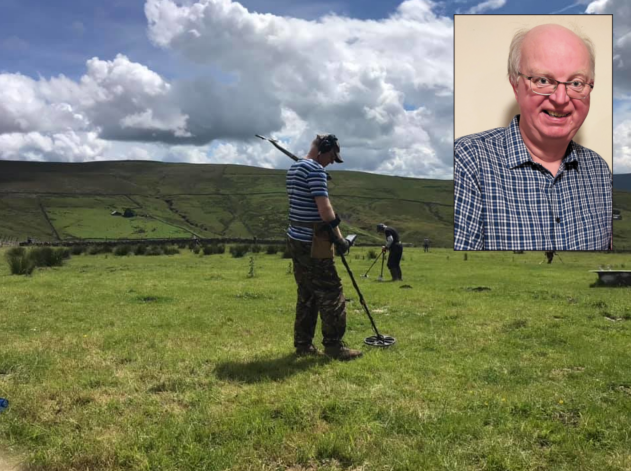
It had been difficult in 2020 to meet with detectorists and take in Treasure (and other finds) due to COVID restrictions, but Bill Smollett had been anxious to get this silver plate from a reliquary pendant (as it turned out to be) reported as soon as possible, in his usual conscientious way. Bill was one of my ‘regular’ finders, and it was a pleasure to see him after so many months of not being able to meet with anybody. The pendant itself was fascinating too, comprising just the lid of the reliquary, but with evidence on the reverse that it had been adapted into a badge of sorts in its later life. While the style of the engraving on the reliquary would firmly place it in the later 14th to 15th century, the adaptions suggest continued use possibly beyond the end of the medieval period, perhaps into the Reformation, and as such have a hint of rebellion in its use intention. However, it wasn’t just that sense of familial connection that all FLOs feel to those ‘special’ objects they have recorded: this object had a special resonance. Earlier this year, when attending a regular meeting of the Quaker’s Acres metal detecting club to which he had been a member for many years, I was informed that Bill had sadly passed away in late 2024. Thinking back on Bill and the significance of his find brought an added poignancy to the day’s events, which otherwise celebrated the broader aims of the project.
And to return to the day’s proceedings: my personal highlight was undoubtedly the talk given by the project lead, Professor Roberta Gilchrist. She explained how the MeRit project had begun with a review of material: the ‘religious’ objects selected for inclusion, how they were situated within the context of all other medieval objects, the biases in PAS data, and how a statistical analysis of the selected objects was to be undertaken to enable (as it was described) ‘archaeological perspectives on medieval lived religion’.
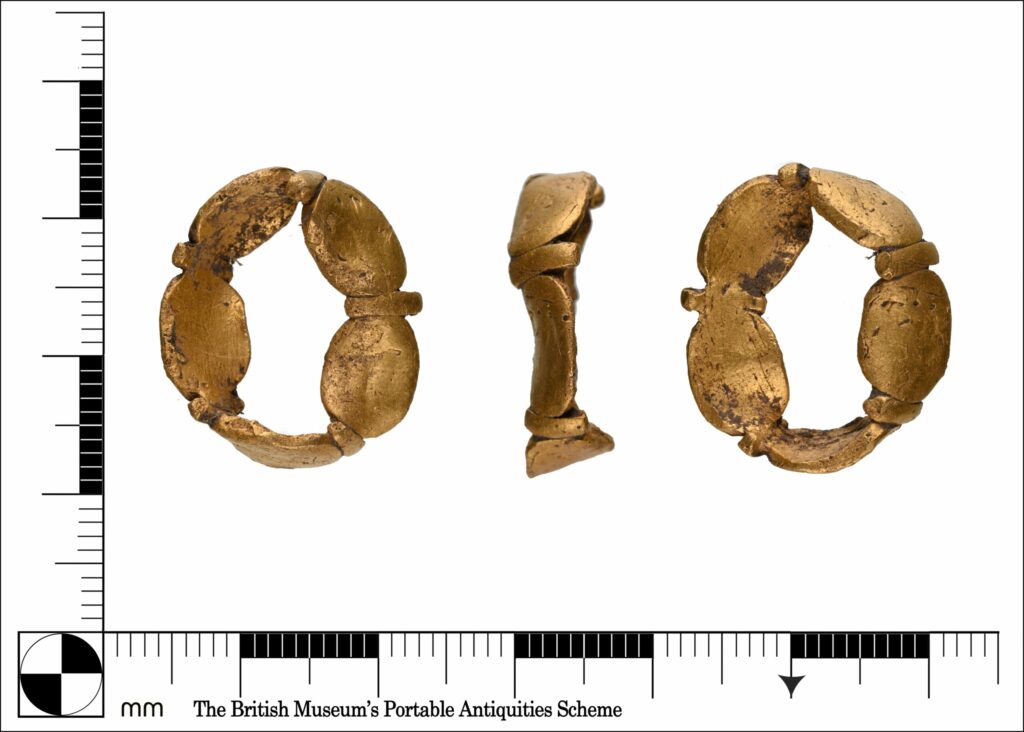
One of the themes being examined, partly inspired by the new display and the students’ animations (of which, more below), is the agency of objects. Using (amongst other objects) medieval religious finger-rings as examples, Roberta talked about how the act of wearing them was not only an outward display of devotion, but depending on the inscription or imagery (often particular saints etc.) would have had perceived prophylactic benefits in warding off disease through efficacious skin contact, and even perhaps more esoteric apotropaic virtues. Again, as two finger-rings recorded by the Durham PAS team flashed up on the screen the personal connection I felt with the day’s events became ever stronger as I recalled researching some of the inscriptions and depictions in Joan Evans book “Magical Jewels of the Middle Ages “, particularly when I saw the gold finger ring with five oval panels featuring the ‘Five Wounds of Christ’ (DUR-74FEFC). Evans (1922, 126) records a wonderful 15th-century charm which, when invoked and the five wounds listed, was quite literally used to treat wounds: “…And sey thys charme five tymes in the worschip of the fyve woundys of Christ.’
Turning to the theme of ‘Spiritual Journeys’, the difficulty in identifying objects that related to local pilgrimage was discussed, particularly in contrast to more common objects such as ampullae that seem to have travelled (presumably with the pilgrims) over much larger distances. Even so, the discussion that followed focusing on ‘Rogationtide’, the ritual processing of the parish boundaries, was incredibly insightful and especially so from a ‘FLO’s perspective’ when thinking about the medieval objects we commonly record and their relationship to the landscapes of our local areas. Tying these objects, perhaps pilgrim badges, coin hoards, or modified coins and objects, to notions of intentional deposition at landmarks on parish boundaries as acts of memory practice and the passing of generational knowledge, is incredibly evocative in the context of linking materiality to human habitation of, and emotional connection to the wider landscape. Roberta was more than able to demonstrate how this project is successfully using spatial and statistical artefactual analysis to ‘reconnect public finds to their social worlds’, give insight on the lives of ordinary Christians, and gain new understanding of lived religion during the medieval period.
Attention then turned to the world premiere of the York St John University student-produced animations with their creative responses to the themes of the display. The short animations came in a variety of forms, highlighting a variety of the objects. I was strongly reminded of Barkan’s (1999) work on the rediscovery of classical antiquities during the Renaissance and his arguments that this was not merely an historical or scholarly pursuit, but also an aesthetic and imaginative process, and a space in which the past was reimagined in the present. This is essentially what these students were doing through their animations: the materiality of the past reinvented through modern reflections, the objects themselves reoccupying a modern landscape: “When Renaissance artists look at works in the tradition of their own Christian civilization, whether religious or secular, they see a complex picture of the origins of their own society. Such art radiates meaning by reflecting the society’s past.“ (Barkan 1999, xxxii).
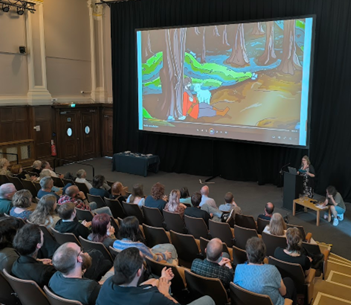
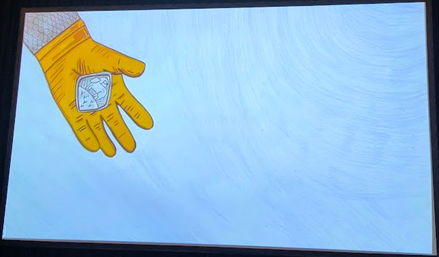
Some animations were more ‘traditional’ in retelling the stories of lost objects, a keepsake lost by a reposing knight, for example; other stories were more…abstract in their approach. And yet, it was Bill’s reliquary badge that seemed to crop up again and again and had clearly had a strong impact on the creative focus of many of the students. And again, through their work, I was drawn to my own personal connections to the object and my interactions with Bill.
We were asked towards the end of the workshop to vote for our favourite animations, but I’m afraid I cannot recall which came out the winner! And I don’t think it really matters; all were uniformly excellent in their approach, and they are all now available to view alongside the display case in the entrance to the Yorkshire Museum. Several will be available to view on the MeRit website soon. The workshop and animations not only marked the launch of this unique exhibition but also offered an opportunity to reflect on the ways in which archaeological research, creative practice, and community collaboration can bring the spiritual landscapes of the past to life. All that, I was prepared for when I set off from Durham on Friday the 13th. I don’t think I was quite prepared for my own ‘medieval lived religious’ experience, but it was quietly poignant and immensely rewarding.
References:
Barkan, L., 1999. Unearthing the past: archaeology and aesthetics in the making of Renaissance culture. Yale University Press, New Haven.
Evans, J., 1922. Magical Jewels of the Middle Ages and the Renaissance, particularly in England. Clarendon Press.