
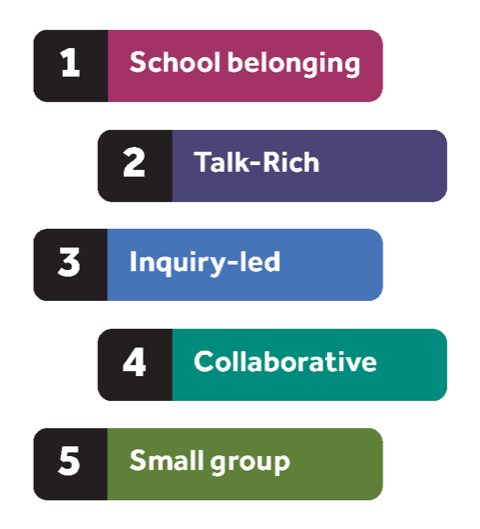

In this blog, we introduce our Talk-Rich Teaching Toolkit and share how schools in Hampshire have been piloting it with promising results. We highlight how small-step changes in classroom practice led to tangible gains for multilingual learners and their teachers. You can explore the structure of the Toolkit, and the core principles driving it, on our project page.
The Toolkit—currently hosted on the Moodle platform of Hampshire’s Ethnic Minority and Traveller Achievement Service (EMTAS)—is a joint venture between Naomi Flynn and the EMTAS team of expert teachers. Developed between 2024 and 2025 and funded by a British Academy Innovation Fellowship, it has already received enthusiastic feedback from pilot schools. One headteacher captured its impact thus:
“Children who were not talking are now talking.”
Designed to promote oracy for multilingual learners, the Toolkit combines Naomi’s research, EMTAS’s specialist knowledge and their existing resources, and the needs expressed by schools during interviews in summer 2024. It grew from both Naomi’s desire to scale up the work of The Talk-Rich Teaching Project and EMTAS’ aim to provide flexible online materials that schools can adapt. With oracy making a welcome return in the 2025 Curriculum and Assessment Review, the Toolkit is also timely. Crucially, the Toolkit requires that schools adopt approaches that are culturally sustaining and linguistically responsive.
Nine primary schools piloted the Toolkit and in all cases they worked with the principle of School Belonging alongside others such as Talk-Rich and Inquiry-Led. Some chose a whole-school focus on a single aspect of talk-rich teaching, following our a dvice to start with one small but purposeful change. For example, one junior school increased opportunities for pupil talk during maths problem-solving, while an infant school developed age-appropriate sentence stems to encourage dialogue among younger learners.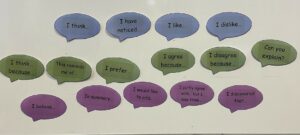
In other settings, smaller groups of teachers trialled more targeted approaches. A team of Year 5 teachers in one junior school used learning questions to stimulate richer talk in English lessons. In a primary school, teachers experimented with substitution tables to support vocabulary development for multilingual pupils.
When we interviewed headteachers and teachers at the end of the pilot, they reported that these small-step adjustments yielded significant benefits. Alongside multilingual learners’ increased confidence to speak, teachers noted shifts in their own practice: they found themselves listening more.
By saying less—and giving pupils more space to talk—teachers became more attuned to their learners’ needs and better able to support them.
Our next steps are to roll out the Toolkit across all Hampshire schools—beginning this week—and to expand the content to include materials for the secondary phase. Ultimately, we aim to launch the Toolkit as an independent website accessible to all. We look forward to sharing our progress as this work grows.
In the meantime, you can read our project report here