
Partnership seed-funded project: Testing the limits of ZooMS on NHMUK collections of British Pleistocene bones
Following on from a previous pilot study funded by the UoR -NHM Partnership a team of researchers from UoR (Geoff Smith, Karen Ruebens) and NHM (Neil Adams) explored the applicability and success of Zooarchaeology by Mass Spectrometry (ZooMS) to Pleistocene bone material more than 100,000 years old, pushing the limits of the method, as well as gaining new insights into species diversity.
Faunal remains from Palaeolithic sites are generally highly fragmented, meaning that for over 70% of the recovered bone fragments we do not know which animal or human species they belonged to. With the biomolecular method of ZooMS it is possible to identify these bone fragments by analysing variations in their Type 1 Collagen, but for the Palaeolithic applications have mainly focussed on sites 40,000 – 50,000 years old.
95 specimens stored at NHM, a random mix of bone and teeth including morphologically identifiable and previously unidentified bone remains, were chosen from 3 sites: Westbury Cave (Somerset), Tornewton Cave (Devon) and Bacon Hole (West Glamorgan).
The pilot study illustrated the applicability of ZooMS to provide novel and maximised data from bone remains older than 100,000 years old already stored within museum collections, and the to extract further data ecological and environmental data from these remains through additional analyses such as shotgun proteomics (for more refined species identifications) and stable isotope analyses (diet, ecological frameworks and mobility).
All the results and data will be further compiled and submitted for publication, as well as forming the basis for further study.
Seed-Funding is available to support the development of collaborative projects to be undertaken by researchers at the University of Reading and the Natural History Museum.
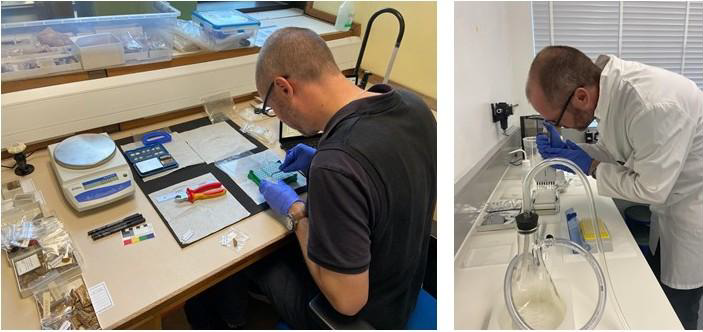
Featured image at top: Geoff Smith sampling at NHM (Left) and processing and extracting collagen for ZooMS at the Archaeological Proteomics Lab (Right); photos Neil Adams and Karen Ruebens