
Common pre-return concerns reported by mothers in our study related to expressing breastmilk and whether they would be able to express enough milk for their child. In this guide we discuss some practical considerations in relation to expressing breastmilk. We discuss practical considerations specifically related to the workplace in Mother Guide 7.
Hand Expressing vs Pumping
You might not need a breast pump; many mothers find hand expressing effective and hassle-free. A breast pump is a device for harvesting a portion of milk either to give to your child or, sometimes, just relieve pressure from your breasts. For most breastfeeding mothers using an electric breast pump is the quickest and most effective way to easily harvest a portion of milk to be fed by a childcare giver to the child with a bottle or cup (if over 6 months old). Some mothers prefer to use a manual pump. We discuss different types of breast pumps in Mother Guide 6.
How To hand express
See https://globalhealthmedia.org/video/how-to-express-breastmilk/
How to pump
Start by massaging your breasts for a few minutes to help the let-down (the release of milk from your breasts) reflex and to gently feel for congested (heavy) areas.. Note it may take a few minutes for your milk to start flowing. You then place the pump’s funnel / flange over your nipple and then start to pump. Note it is important for comfort and to aid the milk flow to get the correct flange size. We discuss more on flange size in Mother Guide 6.
Note. many manual pumps have a lever which pumps one way for massage/let-down mode then another way for expression mode. So you pump for 2 mins massage mode (or until you see the drips) them move to pump mode. Most electric pumps start with a massage or ‘let-down‘ mode which is fast with low suction, you should use this until you feel or see the milk flowing for 30 seconds or so, then move to pump mode. Many electric pumps move automatically after 2 minutes. In pump mode, turn the suction up as much as is truly comfortable.
Once you have finished pumping on one breast / the milk flow slows down you can switch to the other breast. You may find you can return to the other breast.
A few tips to get the most out of a pumping session
In order to let-down (release the milk from your breasts) you need to be relaxed and feel warm and safe. Some mothers look at a photo of their child, visualise the milk flowing for their child, or look at a film of their child drinking. There are even “mindfulness for breast pumping” tracks and affirmations on YouTube/Spotify etc. La Leche League GB provide some further tips1.
A note on milk supply
Breastmilk supply is based on a supply and demand system. The more milk you or your child removes from your breasts the more it will produce. When establishing breastfeeding, in the first 6-12 weeks, for instance, supply can be precarious. It’s important at that stage to frequently and effectively remove milk from your breasts in order to build or maintain supply. Later on in their feeding journeys, many mothers find that supply is more stable, and their bodies cope well with the ebbs and flows of altering sleep patterns, growth spurts, illnesses etc which change their child’s feeding patterns.
If you are keen to maintain supply or build supply then expressing until there is no milk flowing is probably appropriate. If the milk stops flowing and you haven’t expressed the portion you’d like to, some people find that going back into massage/letdown mode might trigger another flow of milk. If you are easily expressing the amount of milk you need, you might stop the expressing session as soon as you have the desired portion, in order to avoid oversupply.
How much to express and how often?
Many mothers are keen to understand in advance how often you’re likely to need to express at work. This helps with planning your schedules and understanding how best to balance returning to paid work with maintaining breastfeeding. This info is a rough guide based on professional experience; there is limited research in this area. One method of doing this is the “MAGIC NUMBER” concept, made famous by Nancy Morhbacher IBCLC2. Your “MAGIC NUMBER” is the minimum number of breastfeeds or expression sessions you need to meet your feeding goals (in this situation the goal is often making enough milk for your child). Your “MAGIC NUMBER” will be determined by several factors:
- How long you are separated from your child
- Your breastmilk storage capacity
- Your infant feeding goals (e.g. do you want to make more milk, maintain supply or are you happy to gradually reduce breastmilk supply)?
In brief, you look at how often you usually breastfeed your child or express (towards the end of your maternity leave) and also try to gauge your breastmilk storage capacity (see the graphic below). These things combined give you an approximate number of times in 24 hours that you need to breastfeed or express. This info can be used to find a rough schedule for expressing when your child is away from you. As your child grows your “MAGIC NUMBER” is likely to decrease.
Breastmilk storage capacity
Breastmilk storage is the maximum amount of milk the breasts can hold between feeds / expressions and is explained in the graphic on the next page. Breastmilk storage is unrelated to breast size or the amount of milk a mother can make but will impact the number of feeds / expressions needed in a day. A mother with a larger storage capacity will need to give fewer feeds / expressions. Storage capacity has a huge range of normal with studies finding figures from 74ml-606ml3.
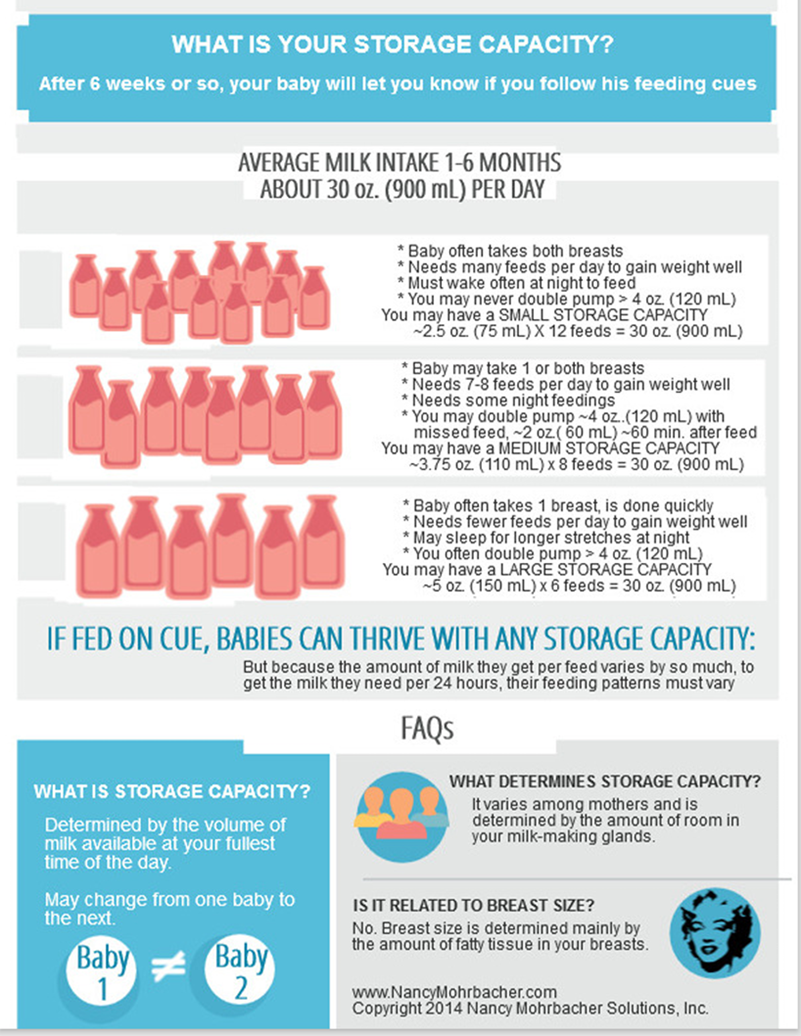
As a starting point, for many this means expressing every 3 hours at work; this number can change (usually reduce) during the first few weeks and months. A typical pumping session is 15/20 minutes, even 30 minutes, of pumping. Monitor how much you are expressing and check if your breasts are feeling uncomfortably full or tight. Over time you can usually leave longer gaps between pumping sessions without becoming uncomfortable or your supply reducing. If you have a large breastmilk storage capacity (see graphic above) you can probably have longer gaps between pumping and breastfeeding sessions. If you have a small breastmilk storage capacity you might need to pump or breastfeed more frequently.
| Case Studies
Sade, a consultant, returned full-time when her son was 6 months and expressed milk, to give to her son, once in the morning around 11am and once in the afternoon around 3pm. After a few months she expressed once during the day around lunchtime. By the time her son was 12 months she no longer needed to express during her working hours. Louisa, a library assistant, returned when her daughter was 10 months, she worked half-days. She had one expressing break for 25 minutes, which was more to maintain her milk supply as her child did not drink much of her milk at nursery. She expressed at work until her child was 13 months. |
Tips for maintaining milk supply
- Continue to breastfeed or express milk as frequently as during parental leave (assuming your baby was thriving and exclusively breastfeeding).
- Continue to breastfeed while together.
- Continue feeding overnight and avoid going longer than 8 hours without fully draining your breasts.
- Don’t become uncomfortably full. This sends the signal to slow production.
- Are you able to feed your child just before you start working and as soon as you are together again (or even during a work break if they are close by)?
Last updated: 3rd August 2026
References
- https://laleche.org.uk/expressing-your-milk/#expressing-tips
- https://nancymohrbacher.com/blogs/news/the-magic-number-and-long-term-milk-production-parts-i-and-ii
- Kent, J. C., Mitoulas, L. R., Cregan, M. D., Ramsay, D. T., Doherty, D. A., & Hartmann, P. E. (2006). Volume and frequency of breastfeedings and fat content of breast milk throughout the day. Pediatrics, 117(3), e387-e395.