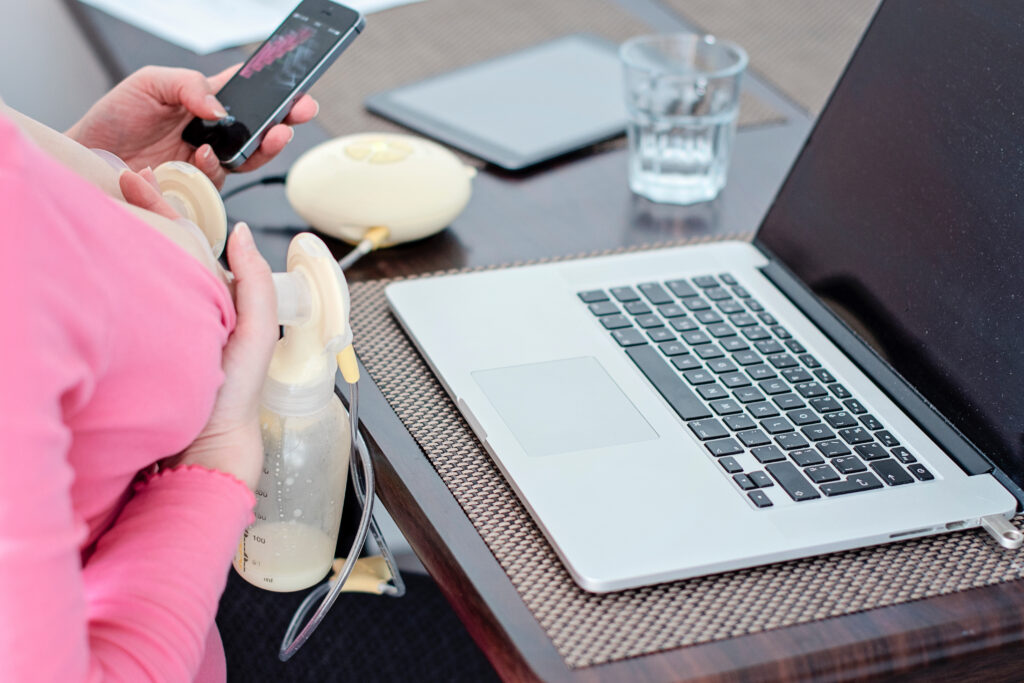
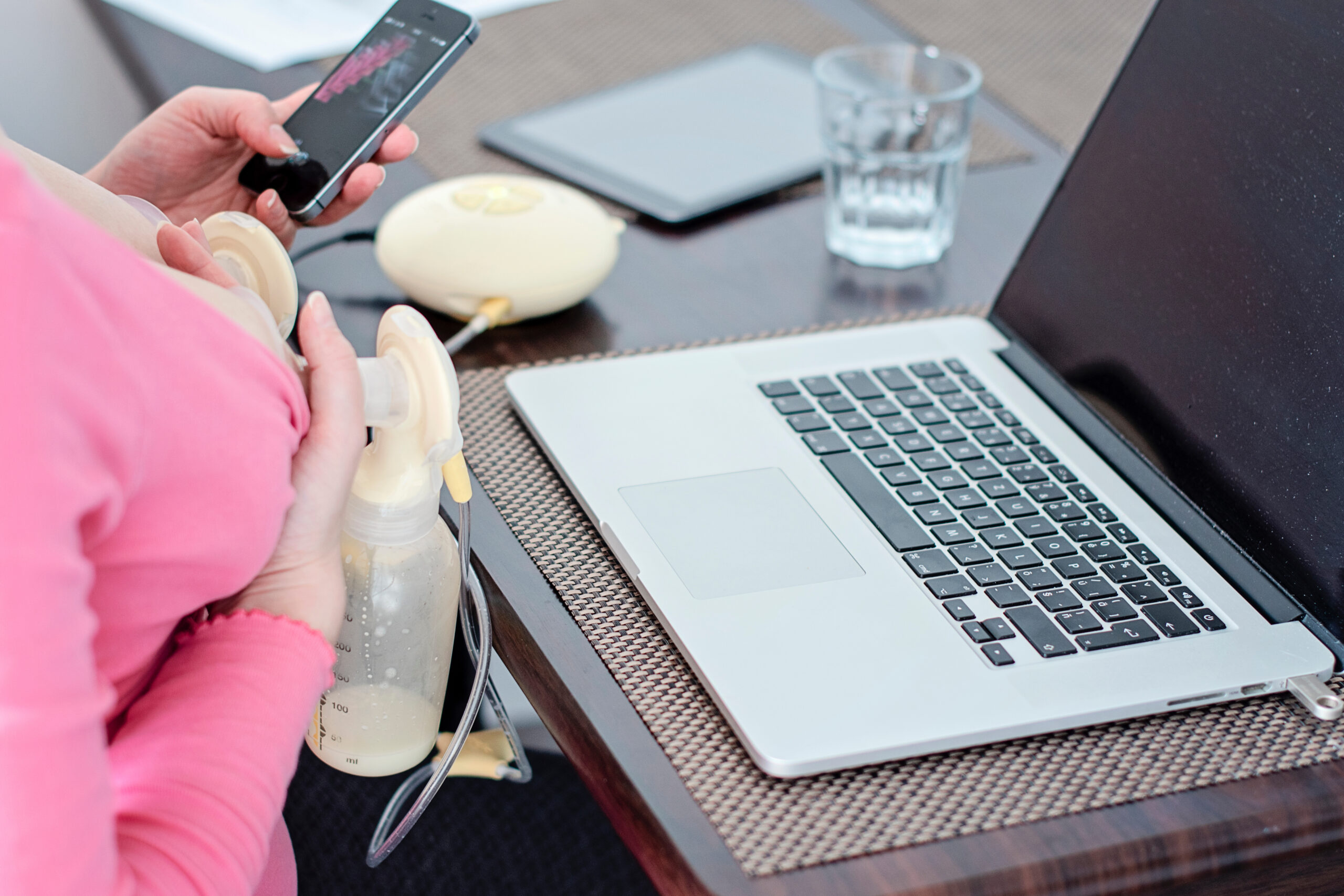
Common workplace concerns by mothers in our study included where they might express breastmilk / breastfeed, and whether this place would be hygienic, private and lockable, and whether there would be somewhere to wash pumping equipment. A big source of anxiety was around storing expressed breastmilk – where (and whether this would be a communal fridge), would it be hygienic and safe (in terms of temperature) – and transporting expressed milk home. This guide discusses some practical considerations for those wishing to express and/or breastfeed at work.
It is worth remembering that employers and line managers may lack knowledge of their legal obligations or what combining breastfeeding and paid work actually involves. Therefore you may need to explain your specific needs to your employer/ line manager. Such conversations maybe difficult to initiate and/or awkward and we discuss ways to open communication with your employer / line manager in Mother Guide 10. It is useful to consider and discuss the following with your employer if needed – ideally as part of your risk assessment (discussed in Mother Guide 4):
- Where will you breastfeed / express breastmilk?
- Where will you store breastmilk?
- Where will you store your breast pump and parts?
- Where will you wash up any breast pump parts?
- Frequency and length of breaks, will breaks be paid?
- What accommodations can be made if you need to travel outside of your normal workplace?
If you plan to express your milk during the working day you might want to discuss the following:
Facilities
Employers only have to provide breastfeeding employees somewhere to rest. However it is good practice for them to provide a room that is private, lockable and clean, with somewhere to store expressed breastmilk. Ideally it should be near a sink with running water for washing hands and rinsing out breast pump parts and have an electrical outlet. If your employer does not offer facilities you may need to request they find somewhere private and hygienic (toilets are not a suitable place) or allow alternative arrangements such as working from home or adjusting your work patterns. We discuss potential changes to working patterns in Mother Guide 8. Your employer may not understand your needs, so in the event of no existing suitable facilities you may need to make suggestions that you are comfortable with.
Storing and transporting expressed breastmilk
You might need a fridge. Would you prefer a designated fridge? Some mothers use an insulated (cool) bag with ice blocks (sometimes combined with a fridge). At the time of writing the current NHS guidelines for where and how long breastmilk can be stored1 are:
According to NHS guidance, expressed breastmilk can be stored in a sterilised container or special breastmilk storage bags for the following maximum lengths of time:
Sources: https://www.nhs.uk/baby/breastfeeding-and-bottle-feeding/breastfeeding/expressing-breast-milk/, https://www.yorkhospitals.nhs.uk/our-services/organdonation/a-z-of-services/maternity-services/breastfeeding/storing-breastmilk/ |
Note: You may notice that different sources provide slightly different advice on storing expressed breastmilk.2 Some sources may also distinguish between maximum safe storage times and optimal storage times. The storage times in this guide are based on NHS guidance. You may prefer to follow another trusted source if it better reflects your circumstances or preferences.
Tips for storing express breastmilk
- Many mothers use an insulated bag or specially designed flask with ice blocks to transport their milk.
- Beware breastmilk storage bags are more likely to split or spill than breastmilk containers (bottles).
- Store away from meat products, eggs or any uncooked foods.
- Store at the back of the fridge and not in the door.
- If you don’t know the temperature of your fridge, assume it is running at the higher temperature.
Should I have a “stash” of frozen milk?
Refrigeration preserves the unique properties of breastmilk more effectively than freezing2. Some mothers deliberately overproduce breastmilk during their maternity leave in order to build up a “freezer stash” to use once they return to paid work. This can take the pressure off if expressing at work is difficult and enables some children to receive breastmilk for longer. However, deliberately over producing is not ideal for your breast health and puts you at risk of mastitis. Frozen milk doesn’t have all of the nutrients and anti-infective properties of fresh breastmilk3.
Storing and washing your pump4
Depending on the type of pump you have, you might want to store it (or parts of your pump) at work, to save you from having to transport it to and from work each day. You may also need to store it during the day between uses. Therefore you may need to ask your employer if there is somewhere you can store your pump or suggest somewhere you are comfortable with.
Pumping can be a time-consuming task, but did you know, you may not need to sterilise your pump parts every use?
Because live cells in human milk kill some bacteria5 breastfeeding and pumping equipment doesn’t always need to be sterilised like formula feeding equipment. Research6 suggests it is sufficient to wash equipment with hot soapy water. You may still feel you want to sterilise equipment after every use for extra protection, especially if your child is under six months old.
We know breastmilk can be stored at room temperature for several hours, and in the fridge for several days, so some mums who are pumping frequently put pump flanges into a Ziplock bag or plastic sandwich box and put them in the fridge between uses, washing once in 24hrs in a dishwasher or with hot soapy water.
If your child is healthy then washing with soapy water should be enough. As an alternative some mothers invest in several “Pump sets” (maybe owning one motor & hose but several sets of flanges (depending on pump design), so they don’t need to worry about washing them while at work.
Breaks for Expressing breastmilk / breastfeeding
Breaks for breastfeeding / expressing breastmilk are not a legal entitlement. However, ensuring you have enough time to breastfeed / express breastmilk during working hours may be part of your employer’s duty to protect you and your child. As discussed in Mother Guide 4, employers have a duty of care to avoid you or your child coming to harm. Therefore it is important that you are given breaks, if not giving you breaks puts your health at risk (e.g. becoming engorged/getting mastitis, or if having to use existing breaks means you have may leave you less time for other needs such as adequate nutrition/hydration, rest.). Such risks should be identified through a risk assessment. You may need to explain to your employer the importance of breaks for you, as they may not understand / it may not occur to them.
How many breaks will you need and how long? We discuss more on how often you may need to express in Mother Guide 5. You should probably allow 30 minutes for an expression session depending on how long it takes you to get set up (e.g. go to private room, wash hands, assemble pump, express, store milk, wash equipment). However the time you need may depend on your individual circumstances and changes as your child gets older, and you may need shorter breaks if you need to express only for comfort.
Example good practice: Julie was given an hour a day (on top of her standard breaks) to use for expressing breastmilk/breastfeed in any way that suited her specific needs. For example she could use the time for rest, breastfeeding, expressing breastmilk, and split the time up into whatever blocks she needed. She could take this in 15 minutes or 30 minute blocks or take the full hour to go home, say, to breastfeed / express breastmilk. This also meant she could use the time differently as her and her child’s needs changed.
Clarify with your employer if breaks are paid or whether you are expected to make the time up. Do you need a colleague to cover for you during this time? Or do you need other changes such as changes to working patterns? We discuss changes to working patterns in Mother Guide 8.
Travel
Some jobs may mean you travel throughout the day as part of the regular duties of your job, say, if you need to visit clients or work in emergency services. And, therefore, you may not have a specific/regular work base. As part of the risk assessment (see Mother Guide 4), it is important for your employer to identify any potential risks to you and/or your child. If risks cannot be controlled or removed, your employer should offer suitable alternative work. We saw a few examples of this in our study where mothers who had to travel regularly as part of their duties were given a temporary desk-based job. For some in our study, travel meant more flexibility, particularly around breaks but one of the biggest problems for those expressing breastmilk was safe storage and transportation. Some mothers had a portable fridge that could be plugged into their car.
Some jobs may require occasional or regular travel to a different workplace location or site outside of your usual place of work, which may provide challenges if you need to express breastmilk / feed your child. For example, legal professionals may need to attend court or employees may need to travel for a meeting, workshop or training. Here you may want to plan ahead and discuss with your employer. Maybe your employer can book you a room at the other work setting if you need to express or could you attend a meeting/event virtually? If you need to express, you will need to consider where you may need to store it and how you can transport it, will you need a cool bag, is there somewhere to store the milk at the other location? Or you employer may permit you not to travel, where possible, whilst you are breastfeeding.
There may be occasions where you need to travel overnight as part of your work. Some mothers in our study, particularly when their child was older than 12 months, reported that travelling overnight and being separated from their child did not impact their breastfeeding journey. Some, however, did find they become engorged given they were not used to be separated from their child for that length of time, and did need to express for comfort. Others reported travelling with their child and another adult, such as their partner, who could care for their child whilst they worked.
If you are not comfortable with being away from your child overnight, you could first check if travel is essential, maybe your employer can permit you not to travel overnight whilst you are breastfeeding? If you wish to travel with your child it will be important to discuss with your employer, as there may need to be a travel risk assessment. Even if you are not travelling with your child you may still need an update to your risk assessment as it is important that your employer identifies whether travel imposes any additional risks. You may need to consider, if needed, where you might express or if you are travelling with your child, where you might feed. If you need to store and transport your expressed breastmilk it may be useful to know that you are permitted to travel with expressed breastmilk on planes. At the time of writing you are permitted to travel with up to 2000ml of breastmilk in your hand luggage (no limited listed for hold) and cooling gel/ice packs.7 Note you cannot carry frozen breastmilk in your hand luggage. You should check with your airline should you need to travel with expressed breastmilk.
Last reviewed: 3rd August 2026
References
- https://www.nhs.uk/baby/breastfeeding-and-bottle-feeding/breastfeeding/expressing-breast-milk/
- https://www.breastfeedingnetwork.org.uk/variations-in-recommendations-for-storing-expressed-breast-milk/
- Peters, M. D., McArthur, A., & Munn, Z. (2016). Safe management of expressed breast milk: A systematic review. Women and Birth, 29(6), 473-481.
- https://www.baby-thrive.com/blog/washing-pumping-equipment
- https://www.mkuh.nhs.uk/news/baby-milk-constituents
- https://abm.me.uk/breastfeeding-information/expressing-breast-milk/
- https://www.gov.uk/hand-luggage-restrictions/baby-food-and-baby-milk#:~:text=You%20can%20carry%20breast%20milk,screened%20at%20the%20security%20point.