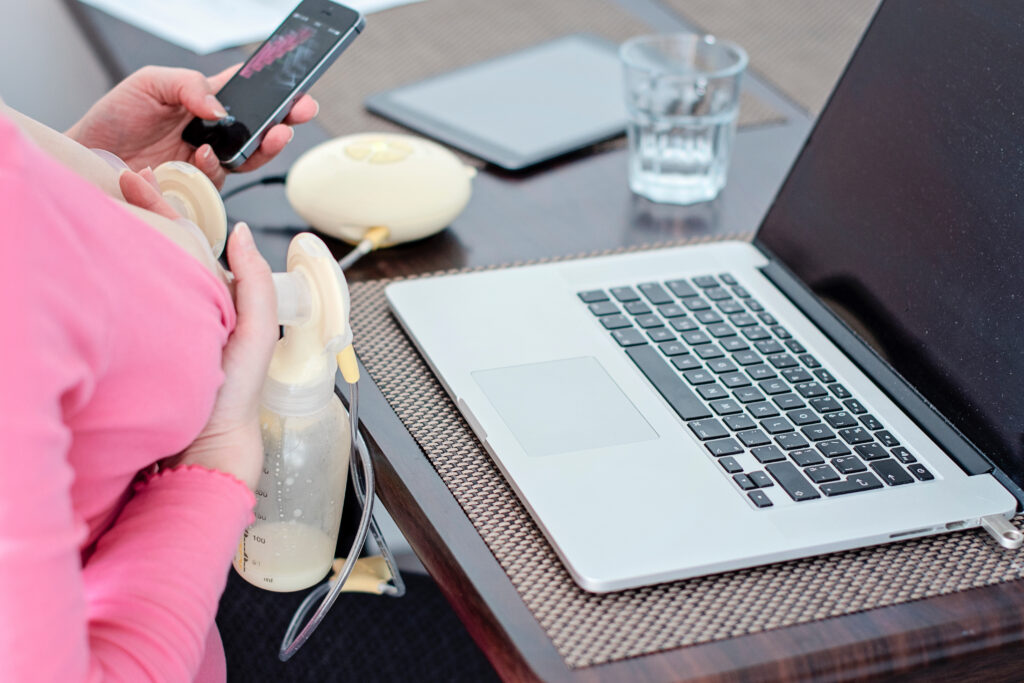

In our study mothers reported a number of common pre-return anxieties and concerns in relation to their own and child’s physical and emotional wellbeing / adjustments, the practicalities and workplace support. Balancing breastfeeding and work responsibilities can add a level of stress during an already challenging period of transition to work. Whilst you cannot alleviate all concerns, there are some steps employers can take, many which are small and simple which can make a big difference. We discuss some examples of best workplace practice in this guide.
Communication and Policy
Mothers in our study expressed the need for open and supportive communication and often felt uncomfortable, themselves, raising the topic of breastfeeding. They felt the onus was unfairly on them to ask and seek information/workplace support. Further our research suggests line managers often lack necessary knowledge and guidance to support breastfeeding employees. Thus a good place to start is to introduce a formal workplace policy to provide transparency and clarity for both line managers and employees. This policy should outline available workplace support in the organisation, and the responsibilities of employers/employees. We provide an example breastfeeding policy in Employer Guide 6.
Our research found that many mothers would welcome a conversation initiated by their line manager/employer to discuss: their needs, concerns, available workplace support, and any adjustments that they may require (such as flexible working, more frequent breaks). This conversation can go a long way to making the employee feel valued and supported; signalling that their wellbeing is important to the organisation and that breastfeeding at work is both understood and accommodated. The earlier the conversation the better (ideally before return to work) as there is often anxiety about returning to work and/or a lack of awareness of what is possible in relation to breastfeeding. While such discussions can feel awkward, having a clear policy in place can open up space for such a conversation and help normalise the topic. Following an employee’s return to work regular check-ins can be helpful to understand how they are managing and whether any further workplace adjustments/support are needed. To help employers engage in relevant and open conversations, we provide an example communication pathway in Employer Guide 8.
Facilities
Expressing breastmilk can be difficult and time consuming. The process can be significantly aided by being in a comfortable, calm, and relaxed setting, and by being given sufficient time to do so. It is good practice to provide a space that is private and hygienic, and ensure this space is maintained and kept clean. It is important to consider the setup of the room, for example, are there any windows, glass doors or other ways to see in, is it lockable, can others gain access whilst it is in use?
Example good practice: Where possible, facilities for expressing breastmilk/breastfeeding should be equipped with comfortable seating, electrical outlets, and safe (cool enough) refrigeration (with a thermometer) for storing breastmilk. There should be somewhere clean to wash up and store breast pump equipment. Facilities should be in a convenient location and private (lockable, no risk of interruptions, no way of seeing in) and hygienic.
Providing suitable facilities ensures that mothers do not have to resort to inappropriate locations such as toilets or their cars. Where space is limited, alternative arrangements (e.g. working from home, extended breaks, changes to shift patterns/work location) could be made to ensure mothers, who wish to, are able to breastfeed/express breastmilk in a safe, private and hygienic place and ensure their health and wellbeing are not compromised. Space can be a challenge for some organisations and we discuss this in Employer Guide 5.
Our research found that storage of expressed breastmilk is a common source of anxiety for returning mothers. Concerns often relate to the reliability of shared fridges such as fluctuating temperatures due to frequent opening, or discomfort with storing milk alongside colleagues’ food as well as no access to a clean sink (for washing hands and cleaning breast pump parts). . Simple steps such as placing a thermometer inside the fridge or investing in a small portable fridge for breastmilk storage which can also be used by future employees returning from parental leave, can go a long way in reducing stress and helping employees feel respected and supported. Some employees may prefer to use a cool bag which they may or may not wish to put in a fridge.
According to NHS guidance, expressed breastmilk can be stored in a sterilised container or special breastmilk storage bags for the following maximum lengths of time:
Sources: https://www.nhs.uk/baby/breastfeeding-and-bottle-feeding/breastfeeding/expressing-breast-milk/, https://www.yorkhospitals.nhs.uk/our-services/organdonation/a-z-of-services/maternity-services/breastfeeding/storing-breastmilk/ |
It is also important to consider the convenience of facilities, for example, that their location I not too far away from the employee’s usual workspace, and employees’ preferences. Some may prefer to express breastmilk / directly feed in a private room away from their workspace whilst others who have a private office/workspace, may prefer to use this space. Where feasible, working from home can also support employees who wish to express breastmilk/ breastfeed during working hours, alongside providing suitable onsite facilities.
Paid Breaks for Breastfeeding/Expressing Breastmilk
For many mothers time for breastfeeding/expressing breastmilk during working hours was really important. As a rough estimate, a mother who needs to express breastmilk/breastfeed their child during work hours might need to have a break every 3 hours to start with. Typically, mothers in our research who did so, reported they needed around 30 minutes to express and clean pumping equipment. Most mothers started off needing to express/feed once or twice during their work hours, with this decreasing as the child gets older. Often by the time the child was over 12 months mothers found they no longer needed to express/feed during working hours. A common issue was a lack of clarity around breastfeeding/ expressing breaks, specifically whether they were expected to use their standard breaks, or if additional time was available and whether this time needed to be made up. A lack of additional breaks is a potential health and safety risk for breastfeeding employees (as discussed in Employer Guide 7). Thus, it is important to discuss frequency, timing, and expectations around breaks and have regular check-ins.
Example good practice: Julie was given an hour a day (on top of her standard breaks) to support breastfeeding in any way that suited her specific needs. For example, she could use the time for rest, breastfeeding, expressing breastmilk, and split the time however she needed. She could take this in 15 minutes or 30 minute blocks, say, or take the full hour to go home, say, to breastfeed / express breastmilk. This also meant she could use the time differently as her and her child’s needs changed. Julia needed this adjustment for 3 months only as her child stopped breastfeeding around the age of 15 months.
Flexibility
Not all mothers may need to express breastmilk or feed during the working day. However, many may still need to adjust working patterns to help facilitate a change in the timing and frequency of breastfeeding. Employers are encouraged to explore flexible working arrangements that can support this transition. This can involve adjusted start or finish times, modified shift patterns to avoid late or night shifts or the option to work from home either full time or for part of the day.
Offering a phased return
When returning to work many mothers may need to make changes to their feeding patterns and/or the way their child is fed (e.g. introducing expressed breastmilk, infant formula) which may require a period of adjustment for the mother, their body and the child. During this period mothers may be at greater risk of engorgement/mastitis and changes to their milk supply. Our research has shown that a phased return when mothers return for a few days a week to start with and then build up over several weeks to their full days, can help with this adjustment. Keeping in Touch (KIT) Days may also help with this adjustment. Often mothers in our study used annual leave to enable them to do a phased return which meant they had less time off prior to return than they may otherwise had. You may want to consider offering a phased return as a way to support employee’s transition back into the workplace without them having to use their annual leave. This will allow employees to return when their child is slightly older which may also help make adjustments/transitions easier.
Phased return case study: Lisa’s employer offered her a phased return and she returned to work 2 days a week for 2 weeks when her son was 12 months old. In the first week, she found that she became engorged so she hand expressed but this was manageable as she was only working 2 days. By the second week, she no longer got engorged and was able to feed her son before she left for work, once in the evening and during the night. She then gradually worked up to 5 days over the next few weeks. She found that by the time she was working her full days her son was only feeding once in the night which was easier to manage and did not require any additional adjustments at work.
Peer Support
Many mothers in our research shared that they would benefit from informal conversations with colleagues who have had similar experiences, particularly around returning to work while breastfeeding and wishing to continue breastfeeding. Being able to share tips and discussing challenges can provide reassurance and a sense of solidarity during what can be a difficult transition. Employers can support this by facilitating a peer support network for employees returning from maternity leave or setting up a buddy or mentoring system, pairing new returners with colleagues who have recently gone through the transition and offering informal drop-ins where experiences and advice can be exchanged. Such initiatives do not require significant resources but can have a positive impact on employee wellbeing, confidence, and connection to the workplace.
Other considerations
Keeping in Touch Days (KIT) Days: Breastfeeding employees may request to bring their child with them on KIT days, if this is possible. They may request to breastfeed their child or if attending without the child, they may need time and space to express breastmilk. In our study, most of the examples of children being brought to the workplace occurred during KIT days. This reflects that often childcare arrangements are not yet in place and/or children are younger and need more frequent feeds. In several cases, KIT days were kept short enough so the mother did not need to bring her child in.
| KIT day examples
Zara started KIT days when her son was 5 months old. She only worked a couple of hours on her KIT days so she could go home to feed her son. Laura started KIT days when her daughter was 3 months old. She brought her child to the office and fed her during meetings. Seema started KIT days when her daughter was 6 months. She needed to express twice during the day and she was offered a private and hygienic space to do so. Brenda started KIT days when her son was 6 months. She took her mum and son with her. She fed her son in her office before she started work and her Mum looked after her son and brought him back around lunch time for a feed, then her Mum took him home. Brenda then was able to feed her son again when she got home. |
Note: a risk assessment should take place before any KIT days to ensure any necessary adjustments are in place.
Out-of-hours duties: It may be difficult for breastfeeding mothers to work outside normal work hours particularly evenings and night shifts, when children may make up breastfeeds or feed to sleep. Flexibility around shift allocations/schedules can be helpful during this time.
| Case studies
Faith, an event manager, led events and had two events on the same day. Her work colleague was able to cover for the evening event so she could go home and feed her child. She was able to do evening events again a few months later when her child stopped breastfeeding. Georgia, a teacher, was initially unable to conduct parent evenings due to her child feeding to sleep. A colleague was able to cover for her and by the next parent evening her child no longer needed the bedtime feed so she was able to do this. Shirley, a healthcare worker, regularly did night shifts prior to her pregnancy. Whilst pregnant and breastfeeding she was given day shifts. She resumed night shifts when her child slept through the night at 2 years old. |
Travel for work: Travel/change of work location may be difficult (particularly if there is less familiarity around available facilities) and some mothers may even need to travel with their child for overnight travel to facilitate breastfeeding. Offering flexibility in travel requirements can ease some of these concerns. We discuss travel more in Employer Guide 5.
Caring for sick children: When children are unwell, direct breastfeeding may provide both health benefits and comfort for a child. Consequently, breastfeeding mothers may wish to be the primary carer when their child is sick and may need time off work to care for their child. Supporting parental leave for sick children can help families manage these needs effectively.