
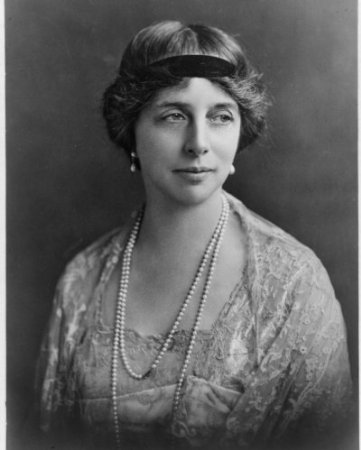
For International Women’s Day 2026, we are privileged to be able to post this ‘long read’ by Amy Gray whose recent biography, Red Duchess: Kitty Atholl, A Rebel in Westminster, challenges the anti-feminist headlines often associated with Scotland’s first woman MP and takes a longer view of her politics.
Scotland’s anti-suffrage woman MP:
How the Duchess of Atholl changed her mind.
During the period covered in this piece, Kitty’s name and title changed three times, from Katharine Ramsay to the Marchioness of Tullibardine and then the Duchess of Atholl. She is referred to throughout as Kitty for simplicity.
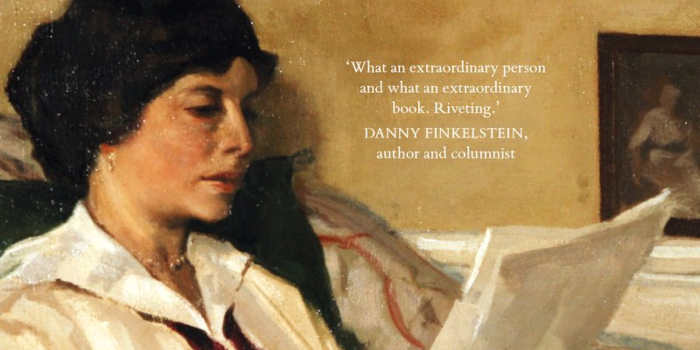
In 1923, the voters of Kinross and Western Perthshire elected their local duchess as Scotland’s first woman MP. Eyebrows were raised, not just because of her title and sex, but because the Duchess of Atholl was the only one of the early women MPs who had actively campaigned against her own right to vote. As late as 1917, she was adamant that it was not yet time to widen the franchise, so what changed?
Although she was far more interested in mastering the piano, politics had always been in the background for the young Kitty Ramsay. Her father had been a Liberal Parliamentary candidate before he defected to the Unionists over Home Rule for Ireland, the family of future Prime Minister Arthur Balfour were good friends, and as a schoolgirl in London she was a regular visitor to the Ladies Gallery at the House of Commons. After her marriage to the Marquess of Tullibardine (known as ‘Bardie’), the heir to the Duke of Atholl, she assumed that she would have a quiet life bringing up the future duke and his siblings. After multiple miscarriages and unsuccessful operations, it became evident that she would never have children. She would always think that the first duty of women was motherhood, but from then on threw her considerable energies into local philanthropic work and soldiers’ welfare committees.
Her in-laws were prominent Unionists, semi-feudal owners of vast estates and naturally opposed to contemporary arguments about land redistribution. In 1906 Bardie stood unsuccessfully for the neighbouring constituency, East Perthshire. During the campaign his wife made her first political speech, despite her natural shyness, and began to get a taste for explaining things. In 1908, A Military History of Perthshire was published, edited and largely written by Kitty after several years of research. It was well-received, her sex remarked on by all the reviewers who were surprised by her innovative approach and intellectual rigour. On the same day, she presided over the formation of the Women’s Unionist Association for Perthshire, and ruled out suffrage as a topic for the new organisation. “It behoves women to look to the interests of their country, rather than to the interests of their sex,” she pronounced in her first public comment on the issue.
By 1910 Bardie had been selected for their local constituency of West Perth. He won narrowly in the January election, and held onto his seat in December. Kitty made a good impression during the many election meetings in which she spoke as her husband’s proxy; one of Edinburgh’s Liberal-leaning newspapers noted that “It must be confessed that were her ladyship seeking the suffrages of the electors on her own account, [the Liberal candidate] would run a considerable chance of suffering an ignominious defeat!” While Bardie made a mixed impression as an MP, speaking mainly on military affairs, Kitty was appointed as the one female member of the Highlands and Islands Medical Committee, which travelled to some of the most remote parts of Scotland to gather evidence about access to healthcare. Her title, philanthropy and political work had made her one of the most prominent women in Scotland, whose endorsement was much sought. The Scottish anti-suffrage movement’s leadership was largely drawn from the same stratum of society and the Duchess of Montrose, who had been a good friend of Kitty’s late mother, was the president of the Scottish Women’s National Anti-Suffrage League. It was perhaps inevitable that Kitty would be drawn to the movement.
When the novelist Mrs Humphrey Ward wrote to the Times in August 1912 to announce the formation of the Local Government Advancement Committee, Kitty was one of its leading members, alongside the explorer Gertrude Bell, several MPs and the heads of three Oxford colleges. Ward set out “the true alternative to the suffrage agitation”. “It is not enough to say ‘No’ to the suffrage demand,” Ward wrote, “We must be able to show the young or the enthusiastic reformer that there exists already a more excellent way.” Some women could vote and stand in local elections, but few did so; Ward claimed that “on all the county and borough councils of England, Scotland, and Ireland there are only 21 women,” and this needed changing before women turned their eyes to national government. Many more “capable and conscientious women” were needed to work on health and welfare issues relating to women and children before they bothered about the national vote. These were arguments which Kitty would rehearse several times over the next few years.
Her most prominent appearance for the cause was at Scotland’s largest anti-suffrage meeting, in front of an audience of six thousand people in November 1912. “Lord Curzon pressed me, as an old friend, to help him at his Glasgow meeting. I felt I ought not to refuse,” the Duchess remembered forty years later. Recently back from serving as Viceroy of India, Curzon was another friend of her late mother, a famously strong personality, and had attended Kitty’s wedding, so a complex sense of obligation and loyalty would have made it hard to turn him down.
Curzon argued (at some length) that women’s very physiology, as well as their education and domestic duties, made it impossible for them to acquire the training and experience necessary to cast an informed vote. Kitty’s much shorter speech covered very different ground. She gave what the historian Julia Bush describes as “a passionate defence of the values of the forward movement” – those who believed that women were not yet ready for the vote rather than, like Curzon, being incapable of it. Kitty saw a clear division between moral and social questions, which needed women’s involvement, and issues of state, which women were not yet ready for. She was cheered often, including when she said that “woman’s place in the state is radically and fundamentally different from the place occupied by man.” She thought that woman’s “unique power of lavishing herself on the individual has led women for centuries past in to philanthropic work,” and she thought this work an undersung and essential priority. Public life needed women to steer welfare and philanthropy, and she thought “that no body, public or voluntary, is ideally constituted for this work unless there be a woman representative upon it.” She then argued that women should take an interest in politics, both to widen their own horizons and also because “if we enter political life in an advisory capacity, we can help to form public opinion and keep political discussion on a high level”. Curzon’s response to her declaration that “there are many women in this country who could intelligently exercise a vote” went unrecorded, but the suffragists noticed – and ironically cheered the articulate marchioness who showed how capable women could be.
She developed her arguments further at a meeting on home turf in Perth in October the following year, alongside the recently ennobled Liberal Lord Forteviot, who had chaired the Medical Committee. In this speech, Kitty was at pains “to repudiate emphatically the idea, which she thought was current among some people, that those who were opposed to the granting of the suffrage to women were satisfied with the scope and opportunities afforded to the women of the early or mid Victorian era, or that they were indifferent to all that higher education had done for women.” Kitty and her five sisters were lucky to have a father who believed in educating his daughters. Her oldest sister had come top of her year in Classics at Cambridge in 1887, and Kitty herself had turned down an offer from Somerville College at Oxford to study at the Royal College of Music. But the battle for education was, she argued, “a claim for each individual woman to have liberty to develop herself, to attain to further realisation of her personality… but to argue that women should vote as men vote was tantamount to saying that the service which women were to render to the community and the State were to be the same as those rendered by men.” For now, at least, she thought the sexes should keep to separate spheres.
Anti-suffrage campaigners often cited men’s imperial responsibilities, questioning how women could help govern an empire when they could not help defend it. Kitty thought British women had a special responsibility to their sisters overseas. The professional and educational opportunities now open to British girls were, she thought, a good example for societies with “an infinitely lower conception of the status of women than happily obtained in our country.” The imperial Parliament “must and could raise the status of the women of those nations, but it was an immense task which would be accomplished not in a day.” She would consistently apply the argument for gradual reform to other issues. In the early 1930s, for example, she argued that, whilst India should eventually have more autonomy, the proposals in the Government of India Bill were too much, too fast. She was in that sense a true conservative, sceptical of major change unless she felt the evidence for it was overwhelming, believing that consensus for reform could be built if given enough time.
Kitty opposed the suffragettes not just in substance but in style, exhorting the anti-suffrage movement to “oppose ourselves to the emotionalism and fanaticism which distinguish our opponents”. She praised The Anti Suffrage Review (which now reads unbearably turgidly) for the “moments of great delight and intellectual relief in perusing the solid facts, the reasonable arguments, and the moderate statements which I find in its pages”. Facts, reason and moderation would all become hallmarks of the way she would work in government a decade later, as well as justified grounds for criticising her rather dry speaking style. She even suggested that the anti-suffrage committee should write to Millicent Garret Fawcett, leader of the peaceful suffragists, to suggest that they jointly oppose the violence of the suffragettes; the letter was not sent.
The willingness of both militant and peaceful suffrage campaigners to devote themselves to the war effort is often cited as a deciding factor in the government’s decision to pass the Representation of the People Act. It was a transformative time for Kitty too. She worked locally for the Red Cross and then nursed her husband’s soldiers in Egypt after their evacuation from Gallipoli. After her father-in-law died in 1917 and she and Bardie became the Duke and Duchess of Atholl, she turned the ducal castle into a convalescent hospital. Although this was nearly all-consuming, she found occasional time to dip back into the suffrage debate.
She was still opposed to any change in the franchise in December 1917, when she argued in a long article for The Anti Suffrage Review that the proposals for legislation needed proper scrutiny. “To pass the Women’s Franchise Clauses without direct reference to the electors seems to me to be a gross betrayal of the party truce, and an outrage on the Constitution,” she said. And the burden of war work was so great, that “it seems to me nothing less than a calamity that the burden of political responsibilities should be added to those which are already taxing the strength of many of us to the uttermost.”
But it was that war work which seems to have changed her mind. In preparation for a trip the government asked her to make to the US, Kitty visited the suffragette hospital at Royaumont near the Western Front. This was one of the pioneering Scottish Women’s Hospitals, barred by the War Office from treating British troops, but gratefully accepted by the French and renowned for innovative care during the Battle of the Somme. Having nursed casualties in both the Boer and First World Wars, Kitty admired their work greatly. On the way home through Paris, she attended an international women’s conference, meeting suffragists like Ray Strachey. These were women she simply hadn’t come into contact with before, and seeing a shared commitment to the defence of the Empire may have been formative.
As this article shows, Kitty’s views against women’s suffrage are on the record in some detail. Unhelpfully for her biographer, she left no equivalent surviving record of why she changed her mind. There are few papers relating to the anti-suffrage committees in her vast surviving archive, and the whole issue receives just two short paragraphs in her memoir. We must suppose that meeting women doctors and activists during the war convinced her that women could play a part in issues of imperial defence. By 1919 she was serving as president of the committee fundraising for a memorial to Dr Elsie Inglis, Scottish Women’s Hospitals founder and suffragist, who she recognised as a great Scotswoman. Perhaps too, having seen the House of Commons up close, she realised that she could do at least as good a job as her husband and his friends.
Kitty always tried to practise what she preached. After the war, Kitty took her own advice and stood for election to the Local Education Authority in Perthshire. She worked closely with Elizabeth Haldane, the only other woman and sister of the Liberal politician Richard Haldane, to ensure that one of them was on each subcommittee. Here she realised the power of women in spaces where issues relating to children in particular were debated. She was still involved with charities like the Red Cross, and was on the Executive Council and four sub-committees of the local Unionist Association. (Bardie had had to give up his seat in the Commons when he became the duke.)
In 1921 Lloyd George visited Blair Castle and asked her to stand for election. There were still only two women MPs and he wanted to see more. The diligent duchess’s credentials were irresistible. When the local association asked if she would be their candidate for the snap election in 1923, she had just one day to make up her mind, but the decision was never really in any doubt. Less than six years after she had opposed the Representation of the People Act, her election as Scotland’s first woman MP was celebrated by all sides. Suffragists and Unionists alike thought she was the right kind of woman for the House of Commons: serious, aristocratic and clever. Over the next fifteen years, her independence of mind would cause many of them to regret those celebrations.
Red Duchess, Amy Gray’s biography of the Duchess of Atholl, was published by The History Press in August 2025. You can find it here Red Duchess – The History Press
In a future piece for this site, she will explore the duchess’s changing attitude to the expansion of the franchise in 1928.