
-
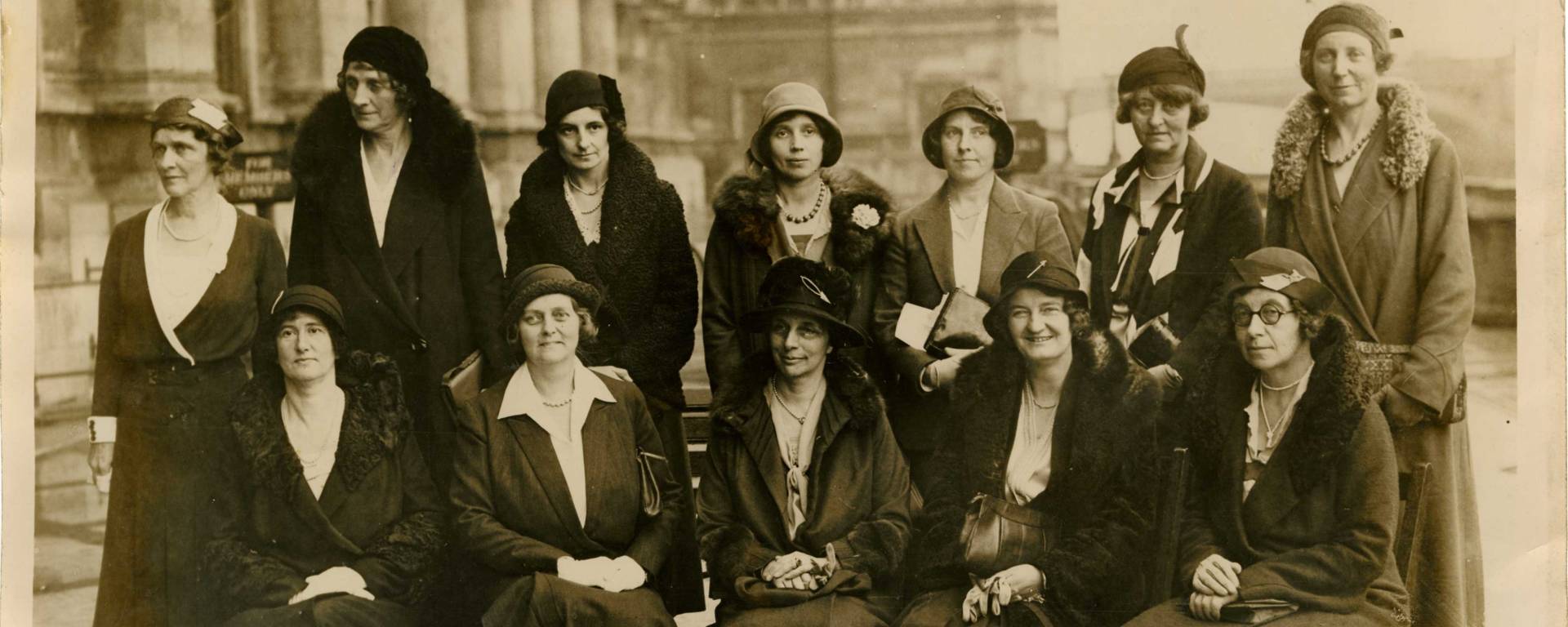
Nancy Astor and Gendered Interwar Politics
Challenging the male narrative in parliament
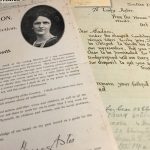
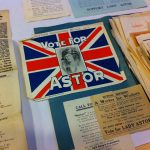

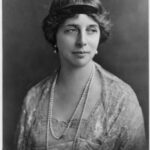

Nancy Astor was ‘An Unconventional MP’. The first woman to take her seat in the House of Commons, she represented Plymouth Sutton constituency from 1919-1945 negotiating the highly gendered political culture of interwar Britain. As Astor’s personal collection is housed within Special Collections at the University of Reading, this site serves as the hub for research on gendered interwar politics conducted both on-site and beyond.
This website also shares research and resources relating to Astor and the gendered political culture of the early twentieth century, providing a new voice and a new legacy for how we think about women’s role in politics and our heritage. Multiple, often conflicting voices, engage with ways in which history has influenced the present. We consider how the identities of Astor and other women of the time were constructed and generated discourses on government, citizenship and transformation.
Astor 100 was a major project marking the centenary of Nancy Astor’s election. Astor was the first woman to take her seat in the House of Commons. Delivered in 2019 and 2020, the project brought together researchers, heritage partners, and the wider public to explore Astor’s legacy and the broader history of women’s entry into Parliament. Astor 100 sparked new conversations about gender, power, and representation in British politics. As the project concluded in 2019, this site now serves to highlight aspects of the research, as well as new projects led by Dr Jacqui Turner. It also features new contributions from the British Class and Gender Research Group, made up of Dr Turner’s PhD students.
Drawing on the momentum of Astor 100, the University of Reading continues to support collaborative research and public engagement around the political lives of women in the 1920s and 1930s. This next phase broadens the focus beyond Astor to explore the wider landscape of interwar political change and the women who shaped it. By collaborating with organisations and networks outside the university, this project is preparing for the centenary celebration of the Representation of the People (Equal Franchise) Act 1928.
The centennial programmes also considered public representations of political women. As part of the Vote100 and Astor100 centennial programmes, we also considered the questions and controversies of who to immortalise as a sculpture and how they are represented in public spaces which feeds into the celebration of the centenaries and competing narratives of women’s emancipation.
‘Nancy Astor, Public Women and Gendered Political Culture in Interwar Britain’ is an Open Library of Humanities collection that addresses a range of approaches to Astor and her time. The collection is edited by Dr Daniel Grey and Dr Jacqui Turner. Daniel Grey is Head of History at Hertfordshire and has published extensively on women, crime and the state. Jacqui Turner is Associate Professor of Modern British Political History and curator of the national Astor100 centenary programme.
This research group engages beyond Astor as an individual, facilitating a wider celebration of what she represented for women.
We welcome contributions. Please contact Dr Jacqui Turner at e.j.turner@reading.ac.uk.