
What happens when a project comes to an end? What happens to its digital output? Do the websites, social media and video content become abandoned? The answers to these questions often depend on those left to manage and renew those outputs. Read on to find out how PhD student Abbie has been involved.
The success of Astor100 in 2019 spurred new discussions, narratives and research around early women MPs, specifically Nancy Astor and more broadly the gendered nature of interwar politics. However, at the time of writing, nearly six years have passed since Nancy Astor’s statue was unveiled outside her former home in Plymouth. The website hosting this blog may have retained its original domain name, but many changes have occurred since it was renewed and refreshed for the next project. The next project is still being defined, but we are beginning to consider how we approach the upcoming centenary of the Representation of the People (Equal Franchise) Act 1928 and the questions of democracy and citizenship it raised, questions that remain relevant today.
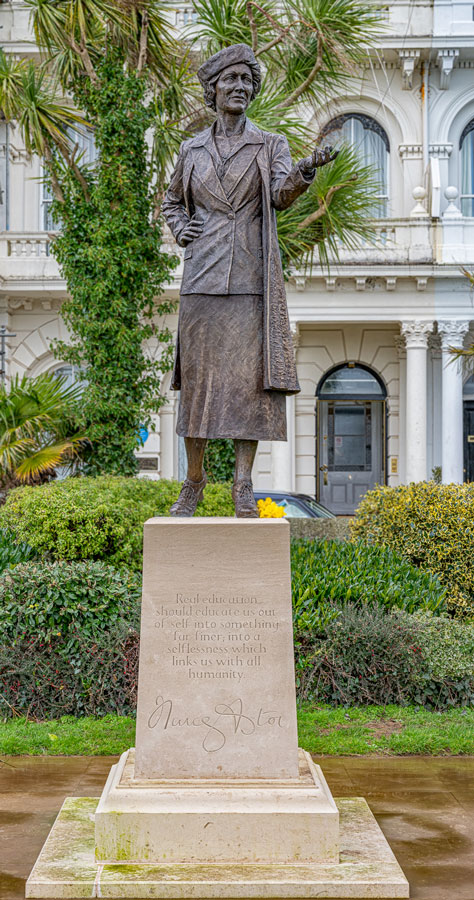
Digital Humanities continues to grow as a sector, and it is essential that our digital outputs accurately reflect the work that is often still conducted in reading rooms or home offices. Our process may not be glamorous, yet it is the visual element that catches the eye and boosts site visits. I took on the challenge of transforming this site and adding new elements to better reflect what is yet to come.
The process
Reading everything came first. Every word, both archived and public. Dr Jacqui Turner and I then worked together to decide what was missing. There is still a lot unfolding, so I wanted to create new spaces on the site where Jacqui can build in new information alongside all the other tasks she has to manage. Website maintenance shouldn’t be labourious; it should be logical and structured. By building a solid template, I was able to future-proof any necessary expansion. Many digital projects are abandoned because they become too bloated, and due to the transient nature of academia, the responsibility often shifts to others. I realised that the new version of the site needed to be simplified to effectively emphasise the new elements.
I looked for repetition and aimed for simplicity. Jacqui had put considerable work into this site when it was first built, so I used her to build a brief. She wanted to retain core information that would be relevant to upcoming projects, whilst I wanted to pioneer some new digital elements to showcase some really interesting history. I identified where Jacqui needed to pitch in and where I needed some outside help.
New digital inputs
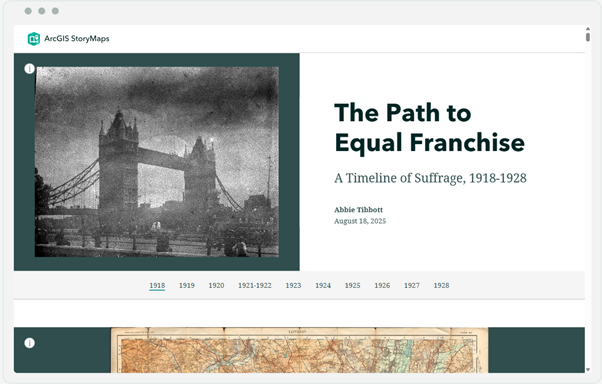
The image above is from a new ArcGIS StoryMap that I have recently built for the website. As new projects look towards the 2028 centenary of the Representation of the People (Equal Franchise) Act, it was necessary to develop entirely new content to act as a fresh element of the website. This helped shift the focus of the content and built on the template I mentioned earlier. The StoryMap was something I introduced because I had seen several other excellent examples, and I felt that the decade between the two franchise acts would suit being displayed in this way. I researched, wrote, and built the StoryMap from scratch.
There was some trial and error. I wanted the timeline to focus on the contributions of female MPs and organisations, as that reflected the wider aim of the website. It also needed to maintain an academic tone, as it is part of a research website, while also being accessible enough for an audience that cannot be assumed to be solely experts on the subject. My MA and elements of my PhD have focused on this period, so I was well-placed to deliver this particular element. Now that I feel confident in using this technology, I have also seen its potential applications elsewhere. It’s always really gratifying when this happens, as sharing your success (and proving it isn’t that scary) can often be enough to convince someone to take the plunge.
Bridging the gap
I have spent the majority of my PhD years straddling a fine line. Sometimes it is between staff and student, sometimes it is between expert and novice. I have been both the learner and the teacher, and diving deeper into the world of website design, content creation, and digital humanities has developed my skills alongside those all-important academic ones. It is not simply enough to write a thesis! It was always more about the impact I could have. Finding a niche like this is vital on days when your thesis is anything but great, and projects like these have taught me a lot. For reference, I am completely self-taught! There are so many free guides and tutorials available, so anything is possible. I will not pretend I was a computer whiz six years ago, but I was happy to be a learner, so then I became more of an expert.
So, what happens now?
Transitioning from one project to the next ensures that information remains relevant and that our understanding of impact is clear. This can help in a variety of ways, including securing the next round of funding or proving the legitimacy of a future project. Having been involved in Astor 100, it has been an ideal role to develop and grow alongside a project that is only going to get more exciting. Watch this space!
If you’d like to read my ArcGIS StoryMap and teach yourself a little more about women, politics and citizenship, you can access it here. Our new 2028 centenary tab will be the hub for new outputs in the next phase, but don’t forget to check out what my fellow PhD students are up to as well.