Projects that the BESS Lab has supported:
Virtual Reality and Biometric Measures: Assessing Affective Responses
As part of her PhD research at the University of Reading as a part time doctoral researcher, Nina Patel is conducting an experiment to explore the emotional responses of children and young people when immersed in virtual reality (VR) environments. The primary aim of Nina’s research is to understand how children aged 12-16 emotionally react to various stimuli presented through VR. To achieve this, she utilised the Consensys GSR Development Kit by Shimmer Sensing, which is available for loan from BESS.
The Consensys GSR kit has been instrumental in our study due to its comprehensive capabilities:
- Galvanic Skin Response (GSR) measurement allows us to detect changes in skin conductance.
- Integrated Photoplethysmography (PPG) sensor enables heart rate monitoring and heart rate variability analysis.
- Bluetooth connectivity provides unrestricted participant movement during experiments.
- Its compact and lightweight design minimizes participant discomfort during extended wear, crucial for our 12-16 year old participants (plus adds to ease of transport for our mobile lab).
- Long battery life supports data collection for the duration of experimental sessions.
Using the ConsensysBASIC software, it’s possible to stream data for live visualisation, while raw data is logged to an SD card for later analysis. This dual approach allows us to monitor participants’ responses during the experiment and conduct more detailed analyses post-session.
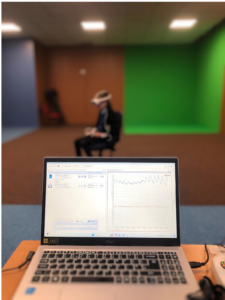
Participants in the study wore a virtual reality (VR) headset and corresponding hand controllers, and their eye movements are tracked alongside the biometric data collected by the GSR kit. This multi-modal approach enabled us to analyse the raw data to develop our understanding of affect for participants in virtual environments.
“The toolkit has proven particularly reliable and the ability to access this kit via BESS has been fundamental for my research.” –Nina
FoodSEqual
Co-production of healthy, sustainable food systems for disadvantaged communities
This work will provide citizens of culturally-diverse disadvantaged communities with choice and agency over the food they consume, by co-developing new products, new supply chains and new policy frameworks that deliver an affordable, attractive, healthy and sustainable diet. The BESS Lab facilities are being used to enable communities to take part in generating and collecting data collection using Surface Devices and eye-tracking equipment in a series of real-world and lab based studies.
Lead Research Organisation: University of Reading
Department Name: Food and Nutritional Sciences
Research Lead: Prof. Carol Wagstaff