
by Lawrence Jones, Visiting Research Fellow (2026), Centre for Book Cultures and Publishing (CBCP), University of Reading
For my visiting fellowship with the CBCP at the University of Reading earlier this year, I wanted to find out more about E. M. Forster’s (1879-1970) publishing activities in the US. Such is Forster’s legacy of cross-cultural engagement between Britain and America that soon after his death in 1970, the American Academy of Arts and Letters established the E. M. Forster Award which provides a $20,000 prize given annually to an Irish or British writer to fund a period of travel in the US. It remains a prestigious award which is presented to writers to this day. Recipients include Julian Barnes, Alan Hollinghurst, Carol Ann Duffy, and Sally Rooney.[1] Yet despite his enduring stature in the literary world, Forster’s transatlantic activities have received limited critical attention. Although Stuart Christie examined Forster’s revival in the US market in the 1940s, there has been little commentary on Forster’s ambition to break into the transatlantic market before this period.[2]
My research sought to address this gap.
Making it in America in the early twentieth century would not only mean higher financial returns for Forster, it would also mean a wider readership and cultural legitimacy. His friends and fellow Bloomsbury group members, Maynard Keynes and Lytton Strachey, had published works in the US in the 1920s which had not only sold well, but had garnered critical acclaim. Keynes’s The Economic Consequences of Peace became a bestseller after Harcourt, Brace published it in 1920, and when the same publishing house published Lytton Strachey’s Queen Victoria in 1921 it sold over 50,000 copies in just six months.[3] News of this success would no doubt have intrigued Forster. His biographer observes that Forster’s finances suffered in the wake of the 1914-18 conflict – his investments were ravaged by the war and the royalties from his pre-war novels had dwindled.[4] Although he was able to supplement his income through journalism by writing reviews for publications such as the Daily Herald and the Athenaeum, success in America at this time would have been welcome financially.
Forster did not have his first significant breakthrough in America until the publication of A Passage to India by Harcourt, Brace in 1924 – the same house which had published both Keynes and Strachey with such success. My research focused on the two years that bookended the publication of Forster’s Indian novel – 1923 and 1925 – and two of his lesser-known works which were published during this period: Pharos and Pharillon in 1923, and his edition of Eliza Fay’s Original Letters from India in 1925. Pharos and Pharillon is a collection of essays on ancient and modern Alexandria in Egypt, and Original Letters from India is a collection of Eliza Fay’s correspondence written during her travels in India in the late-eighteenth and early-nineteenth centuries.[5] Forster wrote both an introduction and extensive textual notes for his edition of these letters.
Both Pharos and Pharillon and Original Letters from India were published in Britain by the Hogarth Press, which was owned and operated by Forster’s friends, Leonard and Virginia Woolf. The University of Reading’s Special Collections holds correspondence between Forster and the Hogarth Press for both publications in its Hogarth Press Archive. One such exchange of letters from June 1922, reveals not only how keen Forster was to sell in the US – it also shows how eager Leonard Woolf was to sell the Press’s books there. After Forster sent Woolf the manuscript for Pharos and Pharillon in June 1922, Woolf asked Forster, ‘What about America?’, and added, ‘Will you deal with that or shall the Press as your agents, taking as agents commission of 10%?’.[6] Just two days later Forster replied in the affirmative by asking Leonard to ‘try and deal with America for me’.[7] It might seem surprising that the Hogarth Press acted as de facto literary agents for their authors when it came to the US rights market, but this was a time when the literary agent was still emerging as a profession.
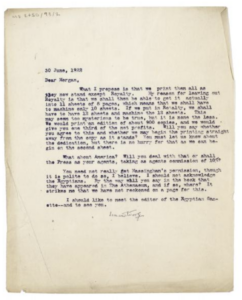
Fig 1: Letter from Leonard Woolf to E. M. Forster from 30th June 1923, in which Woolf
asks Forster (aka ‘Morgan’) about selling the rights to Pharos and Pharillon in America.
From the Hogarth Press Archive, courtesy of Penguin Random House Archive & Library
UK and the Modernist Archives Publishing Project.
Reading through the Hogarth Press correspondence relating to Pharos and Pharillon, I got to see the rocky road to publication it had in the US. It was rejected by one publisher, and the one who finally agreed to publish it (Alfred A. Knopf), initially refused to pay Forster an advance – a decision which jeopardised any agreement being reached. But with a mixture of Leonard Woolf’s business nous and Knopf’s fear of losing Forster to another publisher, an advance was finally agreed to and Forster’s book was published in America by Knopf in July 1923. However, unlike its success in Britain where Pharos and Pharillon ran into a second edition soon after the first was published, the book only had a small print run in America. Forster was yet to make his mark across the Atlantic.
The correspondence in the Hogarth Press Archive relating to Pharos and Pharillon reveals how Leonard Woolf was possibly the catalyst for Forster’s eventual success in America. In June 1923, he wrote to Forster to tell him that he had had tea with ‘Mr Brace of Harcourt, Brace & Co’ when the latter was paying a visit to London, and that Brace had told Leonard he ‘is after the American rights’ of Forster’s novel, A Passage to India.[8] In the same letter, Leonard went on to tell Forster that Harcourt, Brace ‘are very nice people to deal with’ and that if they offer Forster good terms he ‘should far rather go to them in America than any one else I know’.[9] Forster would indeed ‘go to’ Harcourt, Brace with A Passage to India, and would not regret this decision. The novel was a huge commercial and critical success on both sides of the Atlantic, and it finally launched Forster’s career in America.
Soon after completing A Passage to India, Forster began editing Eliza Fay’s Original Letters from India, a work which was originally published in Calcutta in 1817. It is difficult to know with any certainty when Forster was first introduced to Fay’s letters, but we know from the introduction he wrote for his edition that he first came across them in Walter Firminger’s 1908 edition.[10] Maryam Khan speculates that this initial encounter took place during Forster’s first visit to India in 1912-13.[11] Although Forster was grateful for Firminger’s volume, he had deep reservations about the way the latter had ‘tinkered and repunctuated’ Fay’s letters, and no doubt felt he could do a better job editing them himself.[12] However, several years would pass before Forster would commence this task. In early 1924, he approached Leonard Woolf to ask him if the Hogarth Press would be interested in publishing a new edition of Fay’s letters. Woolf agreed to Forster’s offer and in a letter dated 16th February 1924 asked him to write ‘an introduction and notes’ for the new edition.[13] In his response the following day, Forster asked about the ‘American possibilities’ for the proposed book.[14] Harcourt, Brace, the publisher of A Passage to India, would eventually publish Forster’s edition of Original Letters from India in the US in June 1925, and they would go on to be his long-term publisher there.
My CBCP visiting fellowship was a very fruitful and enjoyable experience, and I hope to turn my research into a journal article in the near future. E. M. Forster’s publishing activities need more sustained critical attention as they shed a light on an aspect of his professional career that is little known at present.
I would like to thank the co-directors of the CBCP, Prof. Nicola Wilson, Prof. Sue Walker, Dr. Sophie Heywood, and Dr. Marrisa Joseph for supporting this research, and I look forward to returning to the University of Reading soon to carry out more work in Special Collections.
Works cited
[1] For more information on the Forster Award, see the Christopher Isherwood Foundation website: https://www.isherwoodfoundation.org/e-m-forster-award
[2] Stuart Christie, ‘E. M. Forster, Lionel Trilling, and the American Turn, 1942-1953’, Wenshan Review of Literature & Culture, 11 (2018).
[3] John Tebbel, A History of Book Publishing in the United States: The Golden Age between Two Wars 1920-1940, Vol. 3 (New York & London: Bowker, 1978), 133-34. More recently, Mark Hussey has highlighted how ‘money was the motivation for Bloomsbury’s engagement with “barbaric” Americans’ in Mark Hussey, ‘Bloomsbury and the USA’, in A History of the Bloomsbury Group, ed. by Derek Ryan (Cambridge: Cambridge University Press, 2025), 155-70 (160).
[4] P. N. Furbank, E. M. Forster: A Life, Vol. 2 (London: Faber and Faber, 1978), 53.
[5] Forster’s interest in Alexandria as both an ancient and modern city began during the 1914-18 war when he was stationed there with the British Red Cross as a ‘searcher’ for three years. His duties included interviewing wounded soldiers in hospital for information about military personnel who had been reported missing.
[6] Letter from Leonard Woolf to E. M. Forster, 30th June 1922, MS 2750/93. Available at: https://modernistarchives.com/node/15261. Date accessed: 20th March 2026.
[7] Letter from E. M. Forster to Leonard Woolf, 2nd July 1922, MS 2750/93. Available at: https://modernistarchives.com/node/15263. Date accessed: 20th March 2026.
[8] Letter from Leonard Woolf to E. M. Forster, 24th June 1923, MS 2750/93. Available at: https://modernistarchives.com/node/15331. Date accessed: 20th March 2026.
[9] Ibid.
[10] E. M. Forster, ed., Original Letters from India (1779-1815) by Mrs Eliza Fay (1817; London: The Hogarth Press, 1986), 8.
[11] Maryam Wasif Khan, ‘Enlightenment Orientalism to Modernist Orientalism: The Archive of Forster’s A Passage to India’, Modern Fiction Studies, 62 (2016), 217-35 (220). Khan’s sources for speculating when Forster first came into contact with Eliza Fay’s letters are the introduction Forster wrote for his 1925 edition and “correspondence”. Forster’s introduction does not specify a date or year when he first read Fay’s letters, and Khan does not provide a citation for the correspondence she sourced the 1912/13 date from. Nevertheless, Forster’s interest in Fay probably started when he began his research into India before his first visit to the country from 1912-13, or before he commenced writing A Passage to India in 1913. Although Fay’s letters are not listed, Oliver Stallybrass itemises some of the books Forster read in 1911-12 in preparation for his visit to India, and suggests that he commenced writing A Passage to India in the summer of 1913 after his return home to England. Oliver Stallybrass, ‘Editor’s Introduction’, in A Passage to India, ed. by Oliver Stallybrass (London: Penguin, 2000), 9-11.
[12] Original Letters from India, 8.
[13] Letter from Leonard Woolf to E. M. Forster, 16th February 1924, MS 2750/92. Available at: https://modernistarchives.com/node/21126. Date accessed: 20th March 2026.
[14] Letter from E. M. Forster to Leonard Woolf, 17th February 1924, MS 2750/92. Available at: https://modernistarchives.com/node/21128. Date accessed: 20th March 2026.