


A decade ago, the idea that a border officer might conduct a biometric identity check using a standard smartphone would have seemed far-fetched. Border technology meant specialist hardware — dedicated fingerprint readers, RFID chip readers, document scanners with multispectral illumination. Expensive, specialised, and stationary. That picture is changing rapidly.
What mobile checks can do
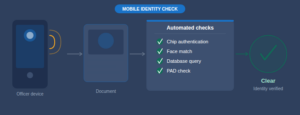
Modern smartphones carry cameras of remarkable optical quality, near-field communication (NFC) readers capable of reading biometric passport chips, and processors powerful enough to run face recognition algorithms locally. A mobile document and identity check might involve: capturing an image of the document’s visual inspection zone to verify its printed security features; reading the chip via NFC and verifying its authenticity through Passive Authentication; capturing a live facial image and matching it against the chip’s stored biometric; and checking the document number against relevant databases.
The fraud detection challenge on mobile
Running fraud detection on a smartphone introduces constraints that do not apply to fixed infrastructure. The camera lacks the multispectral illumination that allows specialist document scanners to detect UV-reactive security features. Processing power is finite. Network connectivity may be unreliable. These constraints require algorithms specifically designed for mobile deployment: lightweight enough to run in real time, robust to variable capture conditions, and capable of graceful degradation when certain checks are unavailable.
Privacy and legal considerations
Mobile checks raise specific privacy questions about who can initiate a check, under what legal authority, and with what logging and accountability. The GDPR requirements for purpose limitation and data minimisation apply regardless of the hardware platform. Data captured on a mobile device must be handled with the same security standards as data captured on fixed infrastructure.
The EINSTEIN project’s Mobile Document Checks application is developing and evaluating mobile identity verification tools that meet operational security requirements while remaining deployable on standard commercial hardware.
© 2026 EINSTEIN Consortium. EINSTEIN is funded by the European Union’s Horizon Europe programme (GA No. 101121280) and by UKRI (IFS 10093453). Views expressed are those of the authors only. www.einstein-horizon.eu