


On 22 June 2026, the EINSTEIN project hosted its first dedicated exploitation webinar, bringing together participants from across the Stopless Borders Cluster for a 90-minute session on innovation procurement — and why it matters for the future of EU-funded security research.
The event, Introduction to Innovation Procurement, was open to partner organisations and end users from across the Cluster, reflecting a recognition that the challenge of getting research results into operational use is one shared by every project in the portfolio, not just EINSTEIN alone.
Why Innovation Procurement?
The webinar opened with a question that sits at the heart of EINSTEIN’s exploitation work: what actually happens to project results when the funding ends?
Too often, the answer is: not enough. Technologies that have been developed, tested, and validated within Horizon Europe projects remain on the shelf — not because they lack value, but because the pathway from research output to public procurement is poorly understood by most research consortia, and underused by the public buyers who could deploy them.
Innovation procurement instruments — in particular Pre-Commercial Procurement (PCP) and Public Procurement of Innovative Solutions (PPI) — exist to close that gap. The webinar set out to give participants a grounded, practical understanding of what these instruments are, when to use them, and how to begin applying them to EINSTEIN’s specific outputs.
What the Session Covered
The programme was structured across four main sessions:
Introduction to Innovation Procurement provided a comprehensive overview of the EU landscape, covering:
- The distinction between PCP (procuring R&D services where no market solution yet exists) and PPI (acting as a launch customer for a newly developed solution)
- The legal basis for PCP under Article 14 of Directive 2014/24/EU, and why it sits outside standard procurement rules
- Supporting instruments including preliminary market consultation (PMC), functional specifications, value engineering, competitive dialogue, and competitive procedure with negotiation
- A worked example drawing on the SHIELD PCP project, which is using pre-commercial procurement to develop crowd safety and coordination tools for law enforcement
A particular emphasis was placed on functional specifications — defining procurement requirements in terms of outcomes rather than prescribed technologies — as a proven approach to attracting innovative solutions from the market.
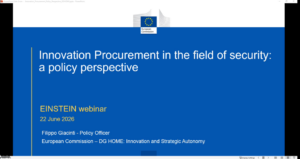
Innovation Procurement from the DG HOME Perspective brought the European Commission’s view on policy priorities for innovation procurement in the security sector, covering DG HOME’s instruments and direct experience supporting the uptake of Horizon Europe results.
Survey Results: Consortium Needs Analysis presented early findings from a survey of EINSTEIN consortium members conducted ahead of the webinar. The results were instructive:
- 4 out of 5 respondents reported only basic knowledge of innovation procurement
- 4 out of 5 were unfamiliar with Open Market Consultation
- 3 out of 5 had no practical experience with PCP or PPI
These findings underline why this work is needed — and confirm that building procurement capability within the consortium is a genuine gap to address, not a box-ticking exercise.
Procurement Methodology for R&D Project Results closed the substantive content with a practical focus on the pathway from Horizon Europe research to procurement. Drawing on the iProcureNet methodology — developed over five years with 23 European procurers across 11 countries — the session covered how to select the right procurement instrument, how to structure a needs analysis, and what EINSTEIN partners can begin doing now to prepare for future procurement activity.
Speakers
The session featured three speakers with complementary expertise:
James Ferryman, Professor of Computational Vision at the University of Reading, opened the webinar and set the exploitation context. Within EINSTEIN, James leads Work Package 7, which covers innovation management, exploitation strategy, and market uptake.
Jozef Kubinec, Managing Director of Keennovate and former Director of the Methodology, Analytics and Innovation Procurement Department at the Ministry of Interior of the Slovak Republic, led the main technical content. With over 15 years in government administration and direct involvement in Horizon Europe innovation procurement projects, Jozef also served as a member of the European Commission’s CERIS expert group and SSRI sub-group. He presented both the conceptual framework and the iProcureNet methodology results.
Filippo Giacinti, Policy Officer at the European Commission’s DG HOME, coordinates the Strengthening Security Research and Innovation (SSRI) destination of Horizon Europe Cluster 3 — the very programme under which EINSTEIN is funded. Filippo brought the EU institutional perspective on how Horizon Europe projects are expected to achieve real-world uptake of their results, and on the policy priorities shaping innovation procurement in the security domain.