


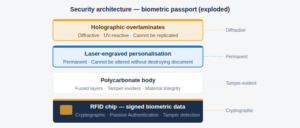
A modern biometric passport is one of the most technically sophisticated objects in everyday circulation. It contains a chip with cryptographically signed biometric data, multiple layers of security printing, holographic overlaminates, laser-perforated personalisation, UV-reactive inks, and materials engineered to make alteration both difficult and visible. Yet document fraud persists.
The layered security architecture
Identity document security operates at multiple levels. At the materials level, polycarbonate document bodies fuse personal data and security features into a single physical layer — making it impossible to alter the data without destroying the document. At the chip level, the logical data structure of a biometric passport chip contains the bearer’s facial image and biographical data, all signed with a country-specific certificate that can be verified against the ICAO public key directory.
How fraudsters attack documents
Despite this architecture, attacks exist at every level. Lookalike fraud — presenting a genuine document belonging to someone with a similar appearance — remains the most common attack. Morphing attacks have demonstrated that the upstream process — the document application — can be targeted before the document is even issued. Digital attacks in online application systems do not require any physical manipulation of a document at all.
Automated document authentication
Automated document authentication systems analyse a captured document image against a reference model for that document type, checking hundreds of security feature properties — the position and size of printed elements, the spectral response of inks under different illumination, the texture of security printing, the geometric relationship between personal data and security features. Machine learning models trained on datasets of genuine and fraudulent documents can detect subtle inconsistencies invisible to the human eye.
The EINSTEIN project’s document authentication application is developing and field-testing these capabilities in operational border environments, contributing to a new generation of fraud detection tools that work reliably across the full diversity of documents in circulation worldwide.
© 2026 EINSTEIN Consortium. EINSTEIN is funded by the European Union’s Horizon Europe programme (GA No. 101121280) and by UKRI (IFS 10093453). Views expressed are those of the authors only. www.einstein-horizon.eu