



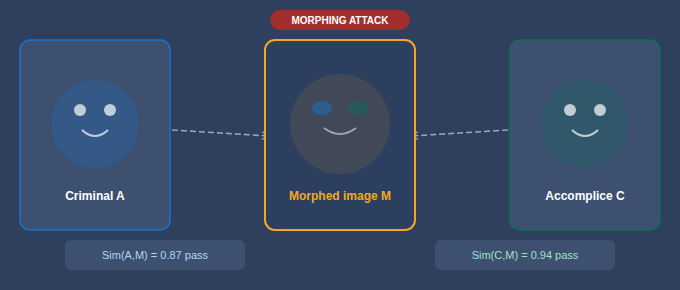
Ask most people whether a trained border guard should be able to spot a forged passport, and they would probably say yes. Passport examiners receive specialist training. They know what to look for. They have years of experience. The research says otherwise.
The largest study of its kind
A study involving 572 participants across multiple professional groups — border guards, case handlers, document examiners at three levels of seniority, face comparison experts, ID experts, and students — presented each with a series of facial image pairs and asked them to judge whether the document image was genuine or morphed.
The results were sobering. For differential MAD tasks (where participants saw both a suspected document image and a trusted live capture), average accuracy was 64.7% for border guards and 72.6% for face comparison experts. For single-image MAD tasks, performance dropped further. A random classifier would achieve 50%.
Does experience help?
Document examiners at the most senior level outperformed their first-level colleagues by around 8 percentage points — an improvement, but still far from reliable. Research tested whether exposure to a greater number of morphed images improved accuracy during the experiment. Performance improved, but the effect was small.
Combining humans and algorithms
Research on conditional fusion — combining the outputs of automated detection algorithms with human examiner judgements — shows that the combination can outperform either alone. When an algorithm is highly confident, its verdict can be trusted and the human adds little. When the algorithm is uncertain, the human examiner’s assessment provides meaningful additional signal. This has practical implications for system design: route uncertain cases to human review selectively, with algorithmic assistance to guide attention to relevant features.
The EU AI Act classifies biometric identification systems used in border management as high-risk AI applications, subject to requirements for human oversight. This is appropriate — but it requires human reviewers to be given the tools, training, and algorithmic support to exercise that oversight meaningfully.
© 2026 EINSTEIN Consortium. EINSTEIN is funded by the European Union’s Horizon Europe programme (GA No. 101121280) and by UKRI (IFS 10093453). Views expressed are those of the authors only. www.einstein-horizon.eu