



Behind every passport chip, every eGate, and every border biometric system lies an invisible architecture of international standards. Without them, a German eGate could not read a Japanese passport, a British border system could not verify a Kenyan biometric, and the entire fabric of interoperable global travel would unravel.
The key standards organisations
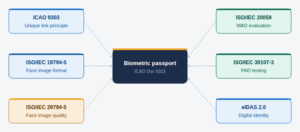
Two bodies dominate the biometric standards landscape. The International Civil Aviation Organisation (ICAO) sets the standards for travel documents under its Doc 9303 series — the framework that governs Machine Readable Travel Documents and the principle of the unique link between a document and its holder. ISO/IEC JTC 1/SC 37 develops the broader biometric standards portfolio.
The standards that matter most
ISO/IEC 19794-5 defines the data format for face images stored in biometric passport chips. ISO/IEC 39794-5 is the newer, more flexible successor. ISO/IEC 29794-5 defines face image quality — the 28 measures that determine whether a face image is biometrically useful. ISO/IEC 20059 defines the testing methodology for morphing attack detection systems. ISO/IEC 30107-3 defines the testing framework for presentation attack detection systems.
Why standards contributions matter
Standards are not handed down from on high — they are developed through technical contribution, deliberation, and consensus. Research projects like those funded under Horizon Europe have a direct pathway to influence standards development, because their outputs — algorithms, datasets, evaluation methodologies — can be contributed to the standards process. EINSTEIN consortium partners have contributed to five ongoing ISO/IEC standards during the project, covering biometric quality, morphing attack resilience, demographic variability, and biometric corridor specifications.
The EU AI Act, the GDPR, the EES Regulation, and eIDAS 2.0 all reference or build upon these technical standards. The interplay between technical standardisation and legal regulation is where the field is most rapidly evolving.
© 2026 EINSTEIN Consortium. EINSTEIN is funded by the European Union’s Horizon Europe programme (GA No. 101121280) and by UKRI (IFS 10093453). Views expressed are those of the authors only. www.einstein-horizon.eu