



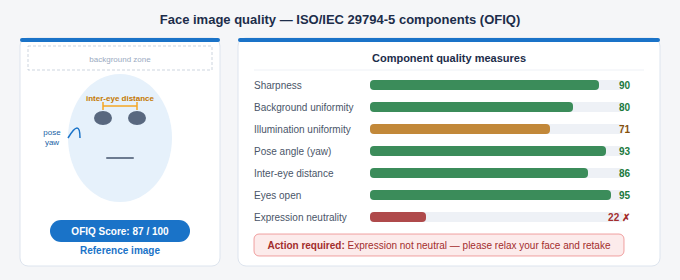
When you submit a photo for a passport application or an online identity check, you probably assume that as long as it looks like you and meets the basic format requirements, it will do the job. You would be partially right. But the gap between a recognisable photo and a biometrically useful photo is wider than most people imagine — and it matters enormously for the reliability of face recognition systems.
What is face image quality?
Face image quality is not the same as image resolution or aesthetic quality. In biometrics, quality refers to the utility of an image for automated recognition — specifically, how reliably a face recognition algorithm can extract a useful biometric template from it. A photograph can be perfectly sharp and well-lit and still have poor biometric quality if the subject’s head is turned, the mouth is open, or the background is patterned.
The international standard ISO/IEC 29794-5 defines a set of face image quality measures, grouped into capture-related and subject-related quality components. These include sharpness, background uniformity, illumination uniformity, head pose (yaw, pitch, and roll), inter-eye distance, expression neutrality, eyes open, mouth closed, and the absence of compression artefacts.
OFIQ: the open-source quality tool
OFIQ (Open Face Image Quality) is an open-source implementation of ISO/IEC 29794-5 developed with significant contributions from EINSTEIN consortium partners Hochschule Darmstadt and NTNU. It produces both a Unified Quality Score (UQS) — a single overall quality indicator — and Component Quality Measures that tell a developer or user exactly which aspect of the image is causing a quality problem.
OFIQ has been independently evaluated by NIST in their SIDD programme and demonstrated best-in-class performance on Error versus Discard Characteristic curves — a measure of how much face recognition error rates improve when low-quality images are rejected. The tool is freely available and is being adopted in operational identity systems across Europe.
Quality in the regulatory context
Commission Implementing Decision (EU) 2019/329 specifies that facial images captured for the Entry/Exit System (EES) must comply with the image requirements of the ISO/IEC 19794-5:2011 Frontal image type. Poor image quality is therefore not merely a performance issue for face recognition systems; it can also constitute non-compliance with EU requirements. A quality assessment system that merely informs an applicant that their image failed is of limited operational value. Operational systems instead need to identify which specific requirement was not met and provide guidance on how the image can be corrected.
© 2026 EINSTEIN Consortium. EINSTEIN is funded by the European Union’s Horizon Europe programme (GA No. 101121280) and by UKRI (IFS 10093453). Views expressed are those of the authors only. www.einstein-horizon.eu