



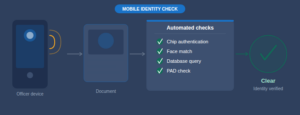
For as long as international travel has required documentation, that documentation has been physical. The biometric passport embedded a digital chip in that physical object but did not replace the object itself. The next evolution is more radical: a fully digital credential that lives on a smartphone and can be verified at a border without any physical document being presented at all. This is the Digital Travel Credential (DTC).
What is a DTC?
A DTC is a cryptographically secured digital representation of a traveller’s identity and travel entitlement, derived from a physical identity document but held on a personal device. It conforms to ICAO specifications and contains the same data as the chip in a biometric passport: biographical information and a facial image, both digitally signed by the issuing authority. The DTC-Virtual Component (DTC-VC) allows the credential to be transmitted to border authorities ahead of travel — enabling pre-arrival screening without requiring the traveller to present a physical device at the border.
The legal and technical framework
The DTC operates within a layered framework. At the technical level, ICAO Doc 9303 and its associated technical reports define the data structure, cryptographic requirements, and trust model. At the EU regulatory level, the revised eIDAS Regulation (eIDAS 2.0, Regulation 2024/1183) establishes the EU Digital Identity Wallet (EUDI Wallet) ecosystem — a standardised digital identity infrastructure that DTCs can be issued into and verified from.
A pilot of the ICAO DTC in Finland reduced average border processing time from approximately 25 seconds to under 8 seconds per traveller — a threefold improvement achieved through pre-registration alone.
Privacy by design
A well-designed DTC can offer stronger privacy protections than a physical passport. Selective disclosure — presenting only the data elements required for a specific transaction — means a traveller can prove their nationality and entry entitlement without revealing their full date of birth or address. The EINSTEIN project is exploring how DTC technology integrates with biometric verification and fraud detection systems in real operational environments.
© 2026 EINSTEIN Consortium. EINSTEIN is funded by the European Union’s Horizon Europe programme (GA No. 101121280) and by UKRI (IFS 10093453). Views expressed are those of the authors only. www.einstein-horizon.eu