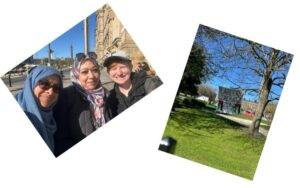

The Food Lives Team, Elaine, Julia, Sajna, Shazna and Zoe, from FoodSEqual Tower Hamlets, travelled up to Liverpool to attend The UK Food System in Crisis Symposium on 7 April 2025. They were invited by Professor Damian O’Doherty to talk about the research they are carrying out in Tower Hamlets as part of the bigger FoodSEqual Project funded by the UKRI. The Symposium call argued that that the current food system is inefficient, if not dangerous. The organisers’ aim was to examine the causes of the crisis in the food systems with presentations from leading academics and practitioners expert in food systems and food studies. In particular the symposium wanted to address ideas of transformation in the food system.
Along with representatives from the Tower Hamlets FoodSEqual team, speakers included:
- Lucy Antal, Senior Project Manager and Lead for Food Justice at Feedback (a UK and Netherlands-based environmental campaign group)
- Sarah Arens, Environmental Historian, University of Liverpool
- Claes Belfrage, Reader in Global Political Economy, University of Liverpool
- Johnathan Rushton, Professor of Animal Health and Food Systems Economics, University of Liverpool
- Mike Zundel, Professor of Organisation Studies, University of Liverpool
- Bob Doherty, the founding Dean of the School for Business and Society at the University of York and PI of the Fix Our Food UKRI project
- Steven Jacobs, Business Development Manager at Organic Farmers and Growers CIC
- David McDiarmid, Corporate Relations Director at Princes Ltd Food
Professor Bob Doherty outlined the precariousness of the food system, talked about the fragmented way in which government departments operate, calling for more inter-departmental policy support, and asked ‘What is a regenerative food system?’

Lucy Antal spoke about the inter-connectedness of ‘everything’ (food, learning, earning) and how the food crisis is ‘disenfranchising’ a ‘whole generation’. She described food banks as a ‘secondary food economy’ and how businesses dump their waste on food charities. She asserts that community-focused consultation is essential and that we need food economies staying with us – going back into the local economy.

Dr Sarah Arens examined our contemporary food economy in the context of colonialism, using the example of transcolonial exploitation in the case of the Lever brothers (founder members of Unilever) and how, due to concessions granted by the state, the palm oil plantations can be seen to be a ‘direct lineage’ of the old rubber plantations. She argued that colonial trade meant a movement from self-sufficiency to reliance on food imports and a rise in demand for wheat-based products rather than older grains like barley and rye. She called for intersectional approaches to studying agriculture and food systems in context.
Professor Johnathan Rushton spoke about a food system based on ‘food at any cost’ and the need to move towards a ‘one health food system.’ Food system companies are stock listed and therefore primarily driven by profit. He described various changes in the food system to create the problems we have today. Among these is the fact that animals are no longer integrated into the food system (they are no longer used for power or their manure, nor can crop residues be used to feed them), which has led to significant changes in land use; and there has been a move from a grass-based to a wheat-based food system. He explained that there needs to be more than behavioural change, but systemic change in the food system.
David McDiarmid outlined the obstacles to change faced by one industry leader, Princes Food. He spoke about the consolidation of power and the illusion of choice (12 companies dominate), how only major companies can afford to place their products on the gondolas at supermarkets and the ‘relentless drive for growth.’ He explained the difficulties of mapping food chains at an individual farm level when there are around 600 suppliers. He also pointed out that the longer contracts with first suppliers that the move to Net Zero will require will also limit the ability to swap to alternate suppliers. In the example of tinned tomatoes and the human rights issues associated with supplies from some regions of Italy, where Princes have stopped using those suppliers they’ve found that their customer base ‘isn’t interested’ and are more focused on price.
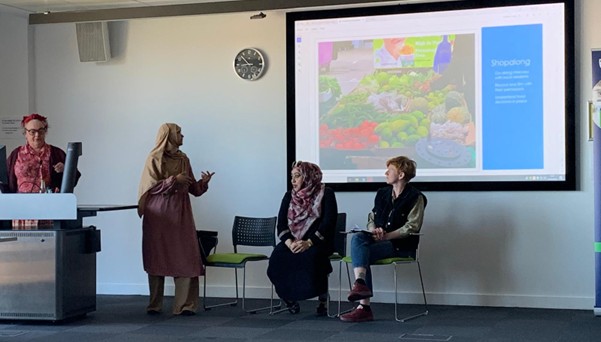
Elaine, Sajna and Shazna (the community researchers), and Zoe, from the Women’s Environmental Network, presented their talk ‘No One is Speaking about Gender, Race or Class.’ Elaine introduced the Food Lives team and the project. Elaine underscored the importance of feminist methodology and intersectional feminist food studies in offering new knowledge and insights for academics and policy makers. Shazna talked about our Shopalong method, some of the challenges we’ve faced and how we overcame them. Sajna presented our Cookalong method. Both CRs shared why it is important to carry out our research methods on themselves first, in order to experience things from the participants’ point of view, as well as enabling them to discover the pros and cons of the methods. Zoe talked about the work they have been doing in line with Tower Hamlets Food Partnership and our work with Tozer Seeds.
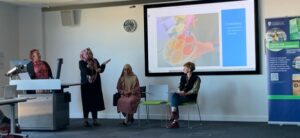
There were some TED-style ‘provocations and interventions’ by Mike Zundel, Steven Jacobs and Dr Claes Belfrage and the event ended with a round table discussion.
Zoe Miles, Local Food Partnership Manager and Food Co-op Strategy and Development Lead at Wen, says, ‘’Within Wen, we welcome conversations about food justice that address systemic issues, that highlight community solutions, and that uplift the experiences and voices of women and gender non-conforming people, particularly from racial and economically marginalised backgrounds.
This symposium, focused on The UK Food System in Crisis: Origins, Solutions and Well-Being, was a great chance to join in the conversation happening across Great Britain and Northern Ireland at the moment, and we always want to take the opportunity to bring in an intersectional feminist perspective into these spaces. Food production, consumption and preparation is highly gendered, so taking an intersectional feminist approach is crucial for working towards a just food and climate transition.
We were in good company presenting alongside Lucy Antal of the Queen of Greens – a fantastic community solution to address food access locally, and Dr Sarah Arens who focused on colonial roots of our food system. Wen advocates, that all those involved in food systems conversations, policy making, and research, to take intersectional feminism seriously and approach food and climate justice with this lens – in order to ensure a truly Just Transition is possible.’
Contributions from Shazna Hussain, Sajna Miah, Zoe Miles, Julia Kidd and Elaine Swan.
Whilst at the university we had an opportunity to explore the campus including the student camp in support of Gaza.