
Jessica Horne, Research Fellow:
Learning from the ‘Food for All’ Conference
The Food for All conference aimed to ‘critically explore the diverse roles of media and communication in shaping and advancing food democracy in all its dimensions’ (FoodforAll, 2025). We wanted to participate in the conference as it was focused on food and communication, topics central to our research. We were keen to learn new concepts and ideas and to share our own preliminary findings. This was my first food studies conference, and I noticed there were a combination of communication scholars and food science scholars. At a time of funding cuts and redundancies across the university sector, I was grateful to have the opportunity present some of the early findings from our FoodSEqual meal kit research at an international conference. What stood out to me from the conference were critical reflections on the role of communication in shaping different ways of thinking about food.
Day 1: Keynote Speech
Processed Food and the Anti-Politics of Communication
Charlotte Biltekoff. University of California, Davis
The conference began with a keynote presentation from Charlotte Biltekoff, who is a Professor of American Studies and Food Science and Technology at the University of California, Davis. Biltekoff based her keynote speech on her new book: Real Food, Real Facts: Processed Food and the Politics of Knowledge. In essence, she examines how food communication shapes public understanding of health, responsibility, and the food system.
Central to Biltekoff’s argument is the concept of the “real facts frame”, a dominant way of talking about food that treats debates as technical problems solvable through “better” scientific information. This frame assumes that if the public had the “correct” facts, consensus on healthy or ethical food choices would follow.
However, Biltekoff critically points out that this approach functions as a form of anti-politics, foreclosing democratic debate by reducing complex social, environmental, and ethical questions to matters of scientific literacy. Closely tied to this is food scientism and the deficit model of public understanding, which positions science as the only legitimate way of knowing food and assumes the public is ignorant rather than differently concerned. As a result, values-based questions about sustainability, power, labour, and corporate control, are sidelined.
Biltekoff situates these dynamics within a broader framing contest between the “real food” frame and industry-led narratives defending processed foods. While the “real food” frame emerged as a form of counter-pressure against industrial food systems, Biltekoff shows how it can also mislead by reinforcing simplistic binaries (real vs processed, natural vs artificial) and promoting overreliance on scientific authority. She explains that both industry actors (such as the International Food Information Council) and food advocates often mobilise transparency and “facts” in ways that mask underlying power relations and corporate interests.
Biltekoff illustrates these arguments through examples such as the All Natural Banana image and Food Inc’s educational Discussion Guide. She suggests that the guide speaks to an imagined public that is “engaged” and “ready” to participate in food system transformation. This is illustrated in the photo below of the guide’s Lunchbox lessons, delivered by a fictional character, Professor GU Eatwell, and driven by food scientism and ideas about the public. Biltekoff explains the attitudinal scientism at play – creators use images associated with science to reinforce the supremacy of science.
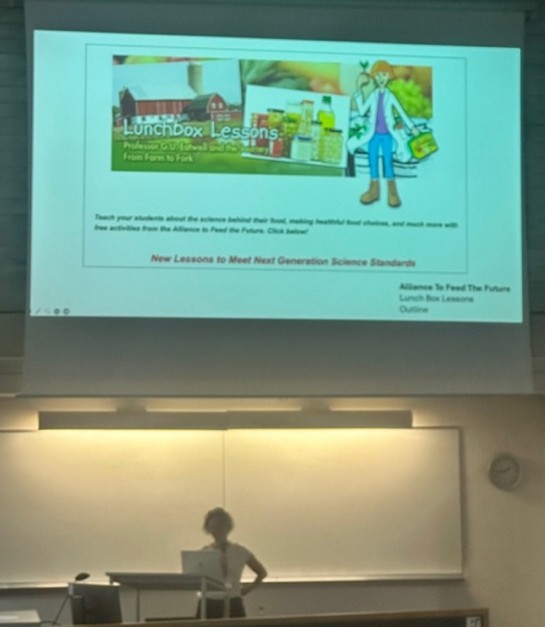
In these examples, the communications project assumptions about the public either as passive consumers needing correction or as rational actors persuaded by facts. Biltekoff argues that both assumptions advance commercial or technocratic agendas. She stresses that visual strategies that “naturalise” technologies like genetic modification further demonstrate how transparency can function as a corporate communication strategy rather than a democratic one.
To resist anti-politics and reinvest in food democracy, Biltekoff proposes four strategies for building counter-power:
- Flip the public understanding of science by turning scrutiny toward experts and institutions.
- Examine the purpose of food communication, not just its content. This reveals assumptions about what food companies believe about the public.
- Remain alert to food scientism and the deficit model of the public understanding of science.
- Look beyond conflicts over the facts to the underlying value conflicts shaping food systems.
Key learning: Overall, the keynote underscores that food is inherently political and social. In addition, it reveals that how food is communicated profoundly shapes public preferences, trust, and possibilities for systemic transformation.
Day 1
Libraries and Food Democracy: New Practices on Food Knowledge Mediation
Laurence Favier, Simona De Iulio. University of Lille.
Aside from the keynotes, there were lots of interesting panels at the conference, each with their own focus on food communication. In the morning of Day 1, Shazna and I attended a panel on Memory, Heritage, and Food Democracy which included a highly affective talk from Professor Meredith Abarca on her El Paso Food Voices project (see Shazna’s reflections).
Later that day, Shazna and I remained in the same room and listened to a talk by Professors Laurence Favier and Simona De Iulio. Both professors are communications scholars, and both based at the University of Lille. De Iulio was one of the conference organisers and I enjoyed listening to another of her presentations on the last day of the conference, as she was presenting in the same panel as me on food packaging.
A central question addressed by Favier and De Iulio relates to the role of libraries in food-related activities. The scholars ask: What does the role of libraries in food-related activities tell us about their emerging role?
Favier opened the presentation by positioning libraries as key actors in knowledge democracy. She insisted that they are both cultural institutions and social infrastructures. Favier argued that changes to the French policy food landscape from 2010 to 2019 have created new opportunities for libraries to become involved in food policies and actions. She referred to two policies in particular: PNNS (Programme National Nutrition Santé) which aims to improve eating habits and health through education and industry partnerships, and PNA (Programme National pour l’Alimentation) which works with stakeholders in the food system to supply ‘healthier’ food options.
- Informational approach, libraries include specialised collections on food topics and “seed libraries”.
- Event-based approach – workshops and exhibitions, transforming libraries into learning spaces showing how food becomes a lens for exploring cultural heritage, community meals and sharing.
- Territorial integration – most ambitious approach which sees libraries as an integral approach in food systems, for example libraries as partners in food systems, integration with local food strategies, collaboration with urban agriculture projects.
The typology was informed by their case Study on Nuits de la lecture – a national event, which takes place in Northern France in all libraries. They organise activities based on a theme; the 2024 theme was community heritage.
Favier and De Iulio observed different food initiatives at this national event, including a watercolour workshop on food themes, storytelling and film screening related to food, cooking workshops with external facilitator, a spice identification game created by the library and meals prepared by a French conversation class (whose native language is not French).
They gathered perspectives from interviews with librarians, who illustrated that food can be a vehicle for social connection and sharing. They present some of the bigger considerations that food democracy requires diverse knowledge sharing, expert knowledge, popular knowledge, and local knowledge. Favier and De Iulio insist that a knowledge democracy is necessary for the implementation of food democracy.
Key learning: The talk enhanced my understanding of the evolving role of libraries in food initiatives and democracy. I was interested to learn that libraries in France are running cooking workshops. Favier and De lulio argue that this emerging function of libraries goes beyond their traditional missions. However, I thought more about this claim in light of research that explores the role of libraries as social infrastructures. For example, sociologists have positioned public libraries as “low intensity” institutional meeting-places” (Andunson, 2005 cited in Bain, 2022) that afford care to historically marginalised groups, including the Queer community (Bain, 2022). Favier and De lulio’s observations on the emerging role of libraries in food initiatives reminded me of some of our participants’ hopes for the future of food in Brighton.
Day 2:
The Styles of “Healthy Food” in Stock Images
Iben B. Jessen. Aalborg University.
On the second day of the conference, Julia and I attended an insightful talk by Associate Professor in Media and Communication, Dr Iben Jessen. I found this talk particularly interesting because I have used visual analysis in my PhD research and was familiar with some of the visual grammar that Dr Jessen was using in her analysis.
Dr Jessen opened her talk by positioning stock images as generic visuals and outlining their uses. She suggested that they are often overlooked, deemed uninteresting and unremarkable. They are accessible for free or can be obtained through stock databases for a fee. Stock images are often used for marketing, teaching and other communications purposes. However, these images have a particular style or manner, which makes them recognised as stock images. Stock images are stereotyped and can also be stereotyping. They are decontextualised images – detached from their time and location. In this sense, they have multiple meanings.
Dr Jessen adds that stock images are characterised by ambivalence for what they refer to. They are therefore also “polysemic” (Barthian term), which means they allow multiple interpretations in relation to other things. They have been investigated in health, education, science and governmental communication and in the urban environment. Scholars have also explored how social groups or phenomena are portrayed in stock images.
Why study stock images? Dr Jessen argues that although stock images are often seen as isolated and not disseminating any specific knowledge of healthy food they are, in fact, used to produce specific ways of seeing food. In this way stock images are not neutral – they are ideological constructs that offer ways of seeing the world. Stock images provide a generalised understanding of what healthy food is, and how it is communicated.
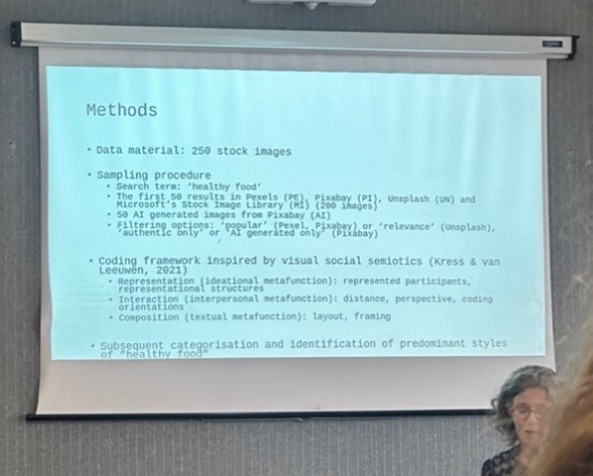
What are the prominent representational and stylistic features of stock images of “healthy food” and how do they frame understandings of healthy food?
Dr Jessen outlined her conceptual framework for her analysis, arguing that style plays an important role in the aesthetics of stock images. She draws on the work of German scholar Wolfgang Welsch, whose 1996 work unpacks the processes of aestheticization of society – a domain not only in art, but outside the domain of art. Dr Jessen explains that the underlying assumptions of Welsch’s work is that we increasingly make things using aesthetic means:
- Welsch distinguishes between surface aestheticization and a deep-seated aestheticization. It involves the styling of identity and lifestyle.
- Deep seated aestheticization influences the way we see the world. This relates to the styling of art into actions which is based on aesthetic content, conveying belonging to a particular lifestyle.
- Style distinguished between form and content – Susan Sontag’s essay On Style focuses on style not just as something on the outside, but that “style is on the inside, the organic aspect of the works’ expressivity and it cannot be reduced to purely decoration. It is shaped by history and belongs to specific time and place”.
- Emphasises the role of the context. Burn and Kress (2019) style is a politics of choice.
- Taste and relation to the domain of aesthetics – “aesthetics is the politics of style”.
Dr Jessen’s Methodology – What is style in relation to stock images?
Dr Jessen analysed material from 250 stock images. She focuses on the specific style choices make by visual resources. The data in her study is comprised of a sample of search results from stock image databases Pexels, Pixabay (latter two are among the top three stock image providers), Unsplash, and Microsoft’s stock images library. 50 images were AI generated. Her coding is inspired by visual social semiotics, Kress and Van Leeuwen, 2021, and the images are analysed in relation to representational, interactional, compositional modes.
The findings indicate that vegetables and fruit were the dominant types of healthy food depicted, with clear patterns in how ingredients and methods of preparation were represented. In particular, Microsoft’s imagery more frequently emphasised ingredients in ways that revealed or suggested preparation methods. The visuals alternated between naturalistic representations and more sensory, aestheticised depictions.
Several stylistic patterns emerged:
- Images resembling micro-photography transformed food ingredients (such as close-up shots of apples) into objects of contemplation.
- Isolated compositions of items like nuts and eggs positioned the viewer as being in control of the food; and flat-lay images conveyed preparation alongside a sense of order, clarity, and structure, often drawing on social media aesthetics.
- Another pattern involved representations of asparagus that referenced painting and still-life traditions, including AI-generated imagery. However, unlike traditional still life imagery, these images were not heavily symbolic, instead foregrounding their own contemporary stylisations.
Key learnings:
- Stock images are ideological, not neutral: Despite appearing generic, stock images shape and standardise ways of seeing “healthy food,” promoting normative and stereotyped visual understandings.
- Style is central to meaning-making: Visual style operates beyond surface aesthetics, reflecting deeper processes of aestheticisation that link food to lifestyle, identity, and cultural values.
- Visual depictions of healthy food are narrow: Fruits and vegetables dominate representations, reinforcing limited and conventional definitions of health through repeated visual patterns.
- Distinct stylistic conventions frame viewer relations to food.
- Visual choices are political and contextual.
Day 2
Improving Access to Nutritious Food for Migrants from Disadvantaged Backgrounds: A Rapid Evidence Assessment
Alexandra Constantinescu, Naz Ali. Buckinghamshire New University
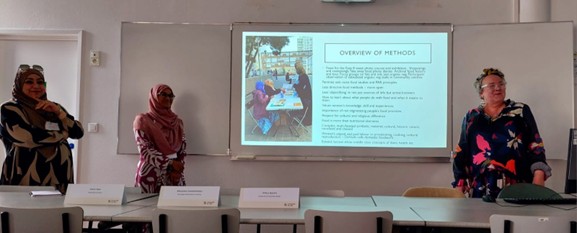
On day 2, I attended two presentations at the Food Systems and Social Equity stream. One was an excellent talk by the Food Lives team (Elaine, Shazna and Sajna). Before this, we listened to a talk by Dr Alexandra Constantinescu from Buckinghamshire New University (UK) titled: Improving Access to Nutritious Food for Migrants from Disadvantaged Backgrounds: A Rapid Evidence Assessment.
I didn’t take extensive notes of this presentation, but I have chosen to share my limited notes because of Constantinescu’s attention to the politics of food aid, particularly in relation to asylum seekers in the UK, which wasn’t much discussed elsewhere. She presented alone and explained the project aim to explore the health impact of low income on migrant workers and asylum seekers. Constantinescu shared stark statistics about the living conditions for migrants and asylum seekers, stressing that, at the time of her study, there were 10 million migrants in the UK, 1 in 6 of whom were living in poverty after housing costs.
Constantinescu stresses that although asylum seekers are offered some support (including access to the healthy start scheme for pregnant women and some NHS provision), in reality, the financial support offered to asylum seekers is very low. The amount offered gets even lower when you live in accommodation (asylum seekers are given just £8 per week). Exemption items for purchases show the whiteness of policymakers – they include flowers and fur coats. Constantinescu stresses that the social, economic and health implications are such that asylum seekers spend half of their income on fruit and veg. Food banks provide some relief but offer limited fresh fruit and veg and often provide ultra-processed foods.
Key findings: Constantinescu realised that over time, the evidence gets muddled by looking at the two groups (migrant workers and asylum seekers) together. Asylum seekers are mothers from India, Sub-Sahara Africa, Asia. She observed that people in these groups are more likely to be living in areas where they have limited access to fruit and veg. Some vouchers are given of the value of £5, but these are not effective for people who live far away from stores that stock fresh food.
Constantinescu characterises the systemic violence against asylum seekers as “food apartide”. She insists that border hotels are characterised by low quality food provision, inhospitality, biopolitics, bordering and racialisation, and this extends to lack of access to healthcare. Although there is some access to food, the facilities are inappropriate for asylum seekers to prepare meals.
Constantinescu set out the following recommendations for meaningful food systems transformation to support asylum seekers and migrant workers, many of which chime with our findings from FoodSEqual. She stresses the need for:
- Comprehensive, multi-component programmes.
- Recipe cards in different languages. (Constantinescu caveats this by cautioning that the recipe card intervention does not seek to address migrant workers and asylum seekers’ lack of knowledge about how to cook).
- Local place-based interventions with a co-design approach advocated to help work towards culturally sensitive interventions
- Measuring the impact of interventions.
Key learning: The talk provided a timely reminder of the food insecurity and slow violence that asylum seekers face in an increasingly hostile environment. What stood out to me was Constantinescu’s point about how the longevity of food systems interventions is restricted by the length of funding. This means that when the funding ends, the intervention disappears, and people are left in the same circumstances as they were before. This reminded me of the ethical considerations we faced with our own project in Brighton and Hove, as our meal kit intervention pilot ran only for a few weeks and we had to carefully manage participants’ ongoing expectations of the outcome of our co-production work.
References
- Bain, A. L. (2022). Queer affordances of care in suburban public libraries. Emotion, Space and Society, 45, 100923.
- Food for All. (2025). Food for All: Media, Communication and Food Democracy. Available at: https://foodforall.sciencesconf.org
Useful links and resources I discovered through the conference:
- Write up of some of the talks at the conference, including my presentation, by Dr Ramírez: https://www.linkedin.com/pulse/reflections-food-communication-a-susana-ram%C3%ADrez-wx2bf
- Professor Simone De lulio’s book – De Iulio, S., & Kovacs, S. (Eds.). (2023). Food Information, Communication and Education: Eating Knowledge. Bloomsbury Publishing.
- El Paso Food Voices Project – https://volt.utep.edu/epfoodvoices/
Link to a free copy of Charlotte Biltekoff’s book, Real Food, Real Facts: Processed Food and the Politics of Knowledge. See here: https://www.charlottebiltekoff.com/real-food-real-facts.html