
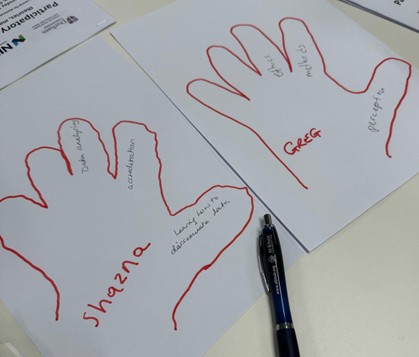
On the 12th & 13th June last year, the Tower Hamlets community researchers, Shazna Hussain and Sajna Miah, and Shelley Taylor from the Brighton and Hove Food Partnership attended a Participatory Action Research (PAR) course led by Durham University’s Centre for Social Justice and Community Action, Nine DTP (Doctoral Training in the Social Sciences) and the UK Participatory Research Network.
The two-day course was designed ‘to develop understanding and skills in the theory and practice of PAR.’ The course covered ‘key values, ethical/political issues, theorizing and critiquing PAR, working with partner organisations to influence change, and participatory approaches to research design, process, analysis, dissemination and implementation.’ Ten places were reserved for members of community organisations and Sajna and Sajna were among those selected to attend.
The course was facilitated by a team of academic and community-based practitioners of PAR, with a variety of areas of expertise and experience, including:
- Professor Sarah Banks, Centre for Social Justice and Community Action, Durham University
- Professor Mary Brydon Miller, University of Louisville, USA
- Professor Tina Cook, Liverpool Hope University
- Yvonne Hall, community researcher and
- Professor Kristin Kalsem, University of Cincinnati, USA
Here Shazna and Sajna reflect on what they learned from the sessions.
Day 1
Introduction
Sarah Banks was leading the PAR course and welcomed everyone with an introduction and some ice breakers.
What is the Key to PAR?
When it comes to PAR the key thing to ask yourself is ‘what is your aim?’
- The action bit is the ‘doing’ to make a change.
- People should have an option about the way the research should go.
- Collaboration with participants that need the change/want the change so that you can learn from them about their needs.
What does PAR mean?
There are levels of participation in research (partnership & power):
- Community-controlled and managed – no professional researcher involved.
- Community-controlled with professional researcher – managed by and working for community groups.
- Co-production – equal partnership between professional researchers and community members.
- Controlled by professional researchers – but with greater or lesser degrees of community partnership.
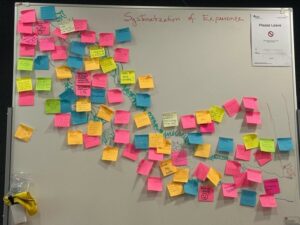
Overview of participatory methods
The role of Action Researchers is to work as a change agent.
Examples of research methods:
- Adapting the traditional interviews
- Focus groups
- Statistics
- Participatory arts-based methods
- Photovoice
- Digital story telling
- Participatory diagramming
- Participatory theatre
- Short exercise using methods.
Funding follows the problem: Mary talked about the negativity of saying ‘fix this problem.’ Instead, start with the good then expand – ‘what do you want to improve?’ Where there is a problem, that’s where the funding goes and sometimes too many organisations are involved in trying to solve the same problem which can become overwhelming for the participants but also within organisations. It can be positive if organisations work collaboratively.
There are many different methods of PAR, one of those covered was the World Cafe method: this is like a focus group with smaller discussion groups around multiple tables, you would facilitate and listen in.
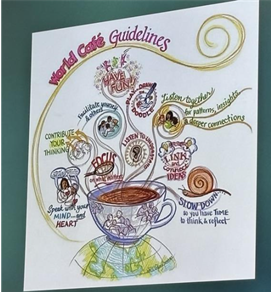
Principles for running the World Café method:
- Set the context
- Create a hospitable space
- Explore Questions that matter
- Encourage everyone’s contribution
- Connect diverse perspectives
- Listen together for pattern and insights
- Share collective discoveries
Day 2
Ethics in PAR
Sarah and Mary discussed ethics in PAR and the practical issues for doctoral researchers and community organisations: partnership agreements, power and responsibility in research, building ethical practices into research and challenges in the research ethic approval process. Ethics are important and need to be reviewed and approved by the universities. It is a lengthy process and sometimes because you can’t get the ethics through, research is abandoned.
You must think about:
- Who owns the data?
- Allowing people to retract.
- Community groups can set up their own Ethics.
- Social change – who will it harm? Who will it benefit?
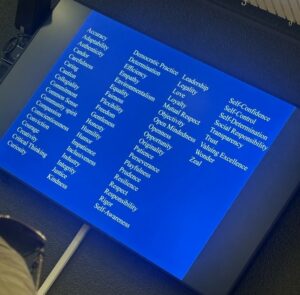
They spoke about what qualities of character a community researcher should have.
You should develop a working agreement which should include the following and more:
- Agreed set of ethical principles
- Communication platform
- Safety should be considered
- Agreed aims and objectives of the research
- Methods to be used
- Identify training needs
- Job description
- Know what funding is available
- Budget for dissemination and time
Impact of PAR
Sarah talked about the impact of PAR and pathways to impact. Things to be mindful of are:
- Intended and unintended impact
- Developing networks
- Stimulating ongoing actions – ripple effect
- Policy changes
- Formal partnerships
- Public engagement
- Dissemination
Ways of capturing and demonstrating impact could involve creating indicators as part of the research.
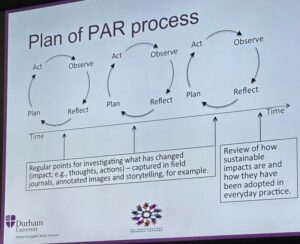
Co-designing a PAR project: issues and challenges – Mary Brydon-Miller & Sarah Banks
Key learning:
- Centring Community Engagement – spending time, listening to them before deciding anything. What’s important to them? What solutions do they want? Recognising community knowledge.
- Valuing Local Knowledge and Experience – learning from the locals, the history, the knowledge and be open to learning.
- Mobilise Additional Resources – traditional knowledge, understand that change that is happening, educating the children at school so that they can then go home and educate their parents.
- Fostering Meaningful Opportunities for Knowledge Exchange – share knowledge across the globe.
- Making Research Matter – it addresses a genuine problem, it provides opportunities for communities’ voices that are often unheard to engage about issues that matter to them. It recognises the communities’ strengths and build on them. It connects theory to practice in innovative ways. Research matters when we take responsibility for making a difference to the world.
Participatory data analysis and interpretation
Sarah asked, ‘What counts as data?’ How is data generated? Are some types of data easy to analyse?
Key Learning:
Start with data then identify themes. Think about what that theme would look like.
- The goal of the data analysis in participatory research is to find meaning in the data for all the people that were involved in the research.
- There is no one ‘right way’ of making sense of the data collected, there will be a different meaning according to individual projects.
- The process of analysing data can be extremely lengthy and therefore the advice was to work in pairs or groups.
‘This is what we have started to do with our work, shredding our transcripts and trying to pull out themes and making sense of them.’ (Shazna.)
Examples of data analysis:
- Writing and reflection group
- Interview data and reflections from all community partners
- Drawing out key themes in pairs or small groups
- Using Post-it notes and grouping themes together
- Being critical – cross checking, questioning
- Deciding on a strategy – how, who, when?
Disseminating Findings and processes of PAR – Sarah Banks and Kristin Kalsem
Key learning:
When you are disseminating a PAR you need to consider who your audience is. This could be decision makers/policy makers, the council, organisations. It could also be members of the public, academics, journalists, other people experiencing the same problem and funders.
Different ways to disseminate research: reports, blogs, websites, articles, films, artwork, exhibition, conferences.
Conclusion
The course was rewarding for the CRs, Sajna explains that ‘it was an educational experience for me to hear how PhD students worked on their research methods….To hear their own experience, challenges and how they overcame those obstacles with support.’ The learning was a shared exchange, the CRs had the opportunity to share their experiences with local, national and international researchers – Sajna describes how ‘We talked about the importance of cultural sensitivity with any research methods…some students were interested in FoodSEqual work and our Food Lives project and said that they have learned from our findings.’