
Food for All: Media, Communication and Food Democracy’
University of Lille, Infocom Roubaix 10-12 September 2025
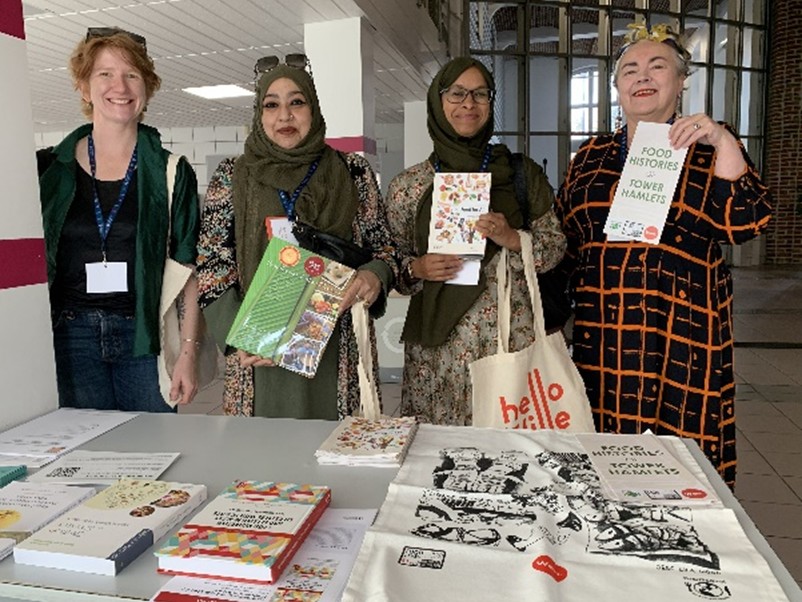
In September 2025, the Tower Hamlets CRs – Sajna Miah and Shazna Hussain – along with Zoe Miles (Women’s Environmental Network) and Jessica Horne, Julia Kidd and Elaine Swan from the University of Sussex attended the Food for All: Media, Communication and Food Democracy conference in Lille.
We wanted to participate in the conference as it was focused on food and communication, topics central to our research. The conference set out to:
…critically examine how media and communication shape and support food democracy—ensuring fair access to sustainable, nutritious, and culturally meaningful food, while promoting transparency, public engagement, and individual rights.
Here we share key learning from the conference and abstracts from the talks that helped develop our understanding of food and communication. We start with the official abstract for the talks we’re sharing here, followed by our learning summaries.
KEYNOTE: Processed Food and the Anti-Politics of Communication
University of California, Davis
Abstract
Drawing on Real Food, Real Facts: Processed Food and the Politics of Knowledge this talk looks at the role communication about technology can play in foreclosing, rather than opening, possibilities for food democracy – including by using tools taken up by advocates of food democracy such as education and transparency – and suggests analytical strategies that can help resist this antipolitics.
The research explores how the U.S. food industry communicates with the public about processed food and identifies a framing contest between two different ways of understanding the processed food problem and what should be done about it. Since the early 21st century, proponents of the Real Food frame have viewed processed food as a troubled product of a troubled food system and encouraged people to both avoid it and reform the food system. Championed by actors within the food industry and its allied sciences, the Real Facts frame emerged as a response to this.
From the perspective of the Real Facts frame the problem is not processed food, but the public’s misinformed and irrational concerns about it; what is needed is not food system reform but communication (education, information) to correct the public’s misperceptions and improve attitudes toward processed food.
While the Real Food frame is a practice of politics that expresses legitimate concerns about the food system and projects an inherently political imaginary of the public, the Real Facts frame enacts antipolitics by reframing these concerns as misinformed and irrational and projecting a purely commercial imaginary of the public. The Real Facts frame and its antipolitical side effects are rooted in food scientism; the intertwined assumptions that science is or should be the primary way of knowing about food and that public concerns about science and technology can only be the result of lack of scientific knowledge / understanding or anti-science sentiment.
Analytical strategies for resisting this antipolitics include turning the gaze from public misperceptions of science to expert misperceptions of the public, looking not only at the content of communication but also the assumptions it makes about the public’s role in the food system, naming food scientism in all its forms, and looking past conflicts over the facts to get to the questions that really matter; what kind of food system to do we want – and how can we produce a culture and politics of communication that allows us to ask and answer this question democratically.
Zoe shares how this talk relates to the FoodSEqual project: Charlotte Biltekoff’s talk highlighted the importance of questioning the aims behind communications tools, which relates to our work on health communication within Food Lives. Within our research, we have explored how health communication methods have been experienced by women in Tower Hamlets, particularly from British Bangladeshi backgrounds, specifically when they relate to oils and fats health communication.
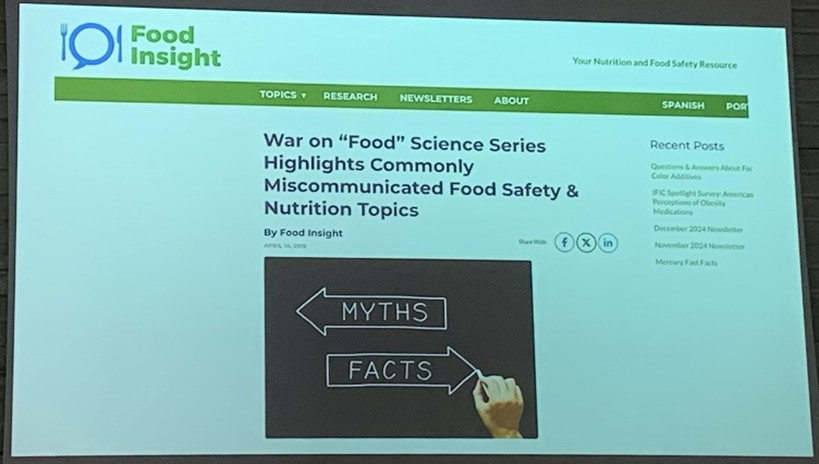
Charlotte Biltekoff’s analysis that some communication tools are used by both corporate food bodies and by those trying to engage in food democracy, is an interesting framing for us to consider. Though the tools may be the same, the aims of what they want to achieve is different. In one case the public is viewed as citizens who can take back power over the food system from corporations in part through informed decision making based on transparent communication.
In the other case the public is viewed as consumers who need to overcome their ‘anti-science’ perspective of distaste for ‘chemicals’ in food (as food is all made up of chemicals) in order to continue to happily consume food produced. In the context of our research, it’s interesting and useful to think about this dichotomy, when we are learning about participant’s experiences of health/food communication.
Official Heritage vs. Edible Memories: Contesting Authenticity in Singapore’s Hawker Culture
University of Colorado, Denver
Abstract
When UNESCO inscribed Singapore’s hawker culture as intangible cultural heritage in 2020, it elevated street food vendors into celebrated national icons—but whose vision of authenticity was enshrined in this official recognition? Drawing on historical analysis, theories of heritage-making, and contemporary ethnographic scholarship, this talk investigates how institutional narratives selectively validate particular culinary practices and traditions to reshape the already contested boundaries of authenticity and heritage. Singapore’s hawkers—once portrayed as informal, itinerant nuisances—are now curated as symbols of national identity. State institutions determine which dishes and practices are deemed representative and thus valorized. Yet this institutionalization of certain culinary identities risks marginalizing alternative food histories, limiting culinary creativity, and restricting participation in Singapore’s evolving foodscape. Official recognition—despite positive intentions—privileges static and sanitized versions over dynamic, lived food experiences and inadvertently constrains the democratic and diverse practices that originally made hawker culture meaningful.
By analyzing the tensions between government-sanctioned heritage preservation and sensory-rich food memories cherished by local communities, this work contributes to broader discussions on heritage politics, the social construction of authenticity, and cultural memory in urban foodways. Foregrounding competing narratives and ongoing contestations over Singapore’s hawker culture, this exploration prompts essential questions: Whose culinary stories gain legitimacy in the global spotlight? Whose food memories and practices are marginalized or erased? And critically, what spaces remain for diverse, democratic foodways to thrive beyond official narratives?
This talk about Singapore’s hawker culture, edible memories, and the politics of ‘heritage’, felt highly relevant to Food Lives’ research as it focuses on the intersections of migration politics, the effects of colonialism, class and labour, and institutional recognition and support. Within Food Lives, the team has researched food histories of Tower Hamlets, particularly Shadwell, highlighting the stories of food histories of working class migrants, women, and activism within this, which is often left out of mainstream stories of the history of this borough.
This talk about the politics of institutional focus on certain marginalised food traditions (in this case, hawkers), felt very relevant to the work within Food Lives to examine mainstream and institutional messages and focuses about British Bangladeshi people in Tower Hamlets in relation to food. For example, within Food Lives we have questioned the tendency towards ghee shaming, and overly associating British Bangladeshi people with over consuming ghee, which is wrapped up in power dynamics of racism and white supremacy, and ignores how people actually use ghee.
Also within this talk the focus on ‘edible memories’ and how these change over time, and are kept in living memory through cooking and eating and experiencing them, is relevant to Food Lives’ research. This may be a helpful framing for our research into the importance of cultural reproduction which is integral to food work especially for women, in the British Bangladeshi community in Tower Hamlets. Understanding this work of reproducing the religious significance, traditions, sensory experiences and feelings of certain foods, whilst understanding these as ‘edible memories’ which can be passed down, is important because it shows that without regularly cooking these things, these memories can get lost.
Feasting & Fasting: How Ramadan’s Food Rituals Influence Social and Psychological Health
Charlotte De Backer, Andrea Codina-Fernandez, Sarah Ahannach, Sarah Van den Bosch, Isabel Erreygers, Inas Rahou, Samira El Messaoudi, Yukta Pai, Marit Van der Poel, Sarah Lebeer
Abstract
Food is more than sustenance—it serves as a social glue that binds people together. Commensality (eating together) fosters conviviality (pleasant sociability), which in turn may result in health benefits. Anthropologists and sociologists such as Mary Douglas, Roland Barthes, and Claude Lévi-Strauss have argued that food choices, preparation, and dining contexts form a system of communication that reflects a group’s social structure. Some food practices become ritualized, occurring at specific times within cultural or religious frameworks. However, little is known about how such food rituals function as a complete process and their role in shaping group belonging and well-being.
This study addresses this gap by exploring Ramadan as a case study, focusing on how commensality influences social and psychological experiences. In 2024, 48 women completed weekly surveys over 10 weeks surrounding Ramadan. Findings show that eating together with family increased significantly during Ramadan (p < .01), accompanied by a rise in perceived closeness (p < .001), which slightly declined post-Ramadan. Workplace commensality decreased (p < .001), and closeness with colleagues temporarily increased but later declined (p = .012). Self perceived stress levels dropped significantly during Ramadan (p = .003), suggesting potential psychosocial benefits of fasting. We are currently replicating the survey study during Ramadan 2025 and will add qualitative insights from 20 in-depth interviews with Ramadan participants to further explore the meaning and impact of these changes. By integrating survey and interview data, this research aims to deepen our understanding of how food rituals like Ramadan shape social connections, stress regulation, and well-being.
Sajna reflects on this talk and our own research: Often there is a misconception about Muslim people who fast during the holy month of Ramadan that they eat unhealthy food, for example food cooked in lots of fats and oils, lots of sweet dishes and they overeat. Understanding the cultural and religious backgrounds of the families and the food they consume is important Accessibility to fresh food is also important to make good choices for meals.
The research on ‘Fasting and Feasting’ made me think about our own research methods and the work towards health information currently available to the Bangladeshi community through BNF or other health organisation in Tower Hamlets. Health messaging to any ethnic group should be well thought through and researched before carrying out any research with cultural sensitivity.
Things that should be taken in consideration are their cultural food, religion, health issues, financial situation, mental health and immigration status (which can give an indication of food being supplied through an agency that they have no power or choice over) and language spoken – so communication is not misunderstood and lost. Health messaging can be carefully planned with people on how they could adapt their cultural food to healthy eating rather than telling someone to completely give up food that they have been eating all their lives and eat things they maybe haven’t eaten before.
The following talks were particularly important in developing Shazna’s understanding of food and communication:
Digital Technologies to Gather, Preserve, and Share Food Stories: Culinary Memories and Practices as Narratives of Food Democracy from the Grown-Up
University of Texas at El Paso
Abstract
Our first aim is to share our collaboration on the vision, creation, and on-going growth and maintenance of El Paso Food Voices (EPFV), an open-source, digital archive. EPFV explores the El Paso, Texas culinary knowledge by engaging with its diverse multicultural, multiethnic, and multinational community members to document the rich and complex culinary culture and history of this region as this has been lived through people’s live experiences. Three intentions motivate this public-facing project.
First, to gather and engage with our community to record, through audio and video, their food stories. Second, to preserve our community’s culinary knowledge for the benefit of current and future generations interested in learning how ordinary people’s food practices shape food systems that impact the history, culture, politics, economics, natural environment, and health of a region. Third, to share this knowledge with the general public to food scholars. The stories featured in EPFV, gathered from home cooks, professional chefs, restaurant owners, and educators, are filled with history, culture, and politics that challenge us to re-think our relationships with food. Secondly, we reflect upon our intellectual labor that urges us to listen and witness as narrators define and perform what food means to them.
While editing video and audio to create cohesive video narratives complete with music and narrator’s personal photographs, we are pressed even more to listen as we strive to represent narrators’ food memories as this carry familial and cultural heritage as defined by their p(a)late. Balancing our roles as listeners, relationship builders, and stewards of people’s stories with our roles as academics illustrates the importance of centering peoples’ food memories, practices, and stories which in turn invite us to consider what living histories are carried on our p(a)late, and how our culinary actions influence the kinds of living stories future generations will experience.
Meredith’s talk was so interesting, I felt really connected because it was giving the community a sense of ownership and really making them feel valued with all their food stories. It brought forward another culture’s kitchen and will remain on the internet for many more to see worldwide. With diversity and the younger generation’s food choices changing, it will be good to go back and see their heritage and cultural dishes. What I learned here is how the internet will be used to showcase the authentic recipes (captured via cameras and voice-recordings) of the Hispanic community for many years to come.
Libraries and Food Democracy: New Practices on Food Knowledge Mediation
Laurence Favier, Simona De Iulio
Université de Lille
Abstract
While public libraries’ engagement with sustainable development has been clearly established for two decades, their growing involvement in food democracy raises intriguing questions about the evolution of their social role. This presentation examines how French public libraries are developing food-related initiatives and explores their potential contribution to food democracy through knowledge mediation. This emerging phenomenon challenges conventional understandings of library missions.
When libraries host cooking workshops, establish seed exchanges, or participate in community food festivals, they venture beyond traditional information provision toward active community engagement. Yet this expansion raises key questions: How do libraries balance their cultural and educational mandates with these new social functions? What forms of knowledge do they actually mediate in food-related activities? Drawing on exploratory research of French library practices and a detailed case study of Villeneuve d’Ascq’s Till l’Espiègle library, this presentation traces how policy evolution has enabled this transformation. Libraries evolved from complete absence in 2010 food policy guidance to explicit recognition as community partners by 2019, coinciding with the expansion of Territorial Food Projects across France.
The analysis reveals three distinct approaches: informational (specialized collections and seed libraries), event-based (workshops and community meals), and territorial integration (participation in local food strategies). However, the case study reveals a significant tension: while policy frameworks often position libraries as nutrition educators, practitioners explicitly prioritize social connection and cultural sharing over didactic approaches, emphasizing “sharing and joy” rather than formal education. This tension illuminates broader questions about “knowledge democracy”—the democratization of diverse knowledge forms necessary for effective food democracy. The presentation argues that libraries occupy a unique position to facilitate connections between expert knowledge, popular wisdom, and local experience, but questions remain about how effectively they can bridge these different forms of knowledge and whether their interventions genuinely enhance democratic participation in food systems.
I like the idea of the libraries being able to host these activities as this can be influential for all ages. Libraries are a relaxing and calm environment to be in and contain a lot of knowledge and information. It would be a great community asset if the Idea Stores in Tower Hamlets were to employ some of these initiatives as they are well situated public spaces and many residents visit them.
Attending this conference expanded my knowledge. I often find shared values and practices between Tower Hamlets, my Bengali heritage, and other communities – for example the El Paso community cooks and shares with their neighbours, which is what we do in our Bengali community.
Contributions from Zoe Miles, Sajna Miah and Shazna Hussain.